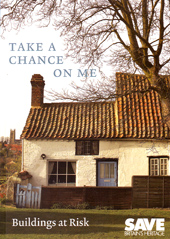
‘Take a Chance on Me’ – Buildings at Risk Register 2011

'Take a Chance on Me' - 2011 SAVE Buildings at Risk Register

Despite the obvious deep and passionate interest society has with historic buildings every year the SAVE Britain’s Heritage Buildings at Risk Register highlights just how many properties are still under threat from neglect and those in power who believe the only good building is a new one with their name on the opening ceremony plaque.  The 2011 BaR register – ‘Take a Chance on Me‘ – has just been published and sadly, as always, it contains some country houses which really deserve a better fate.

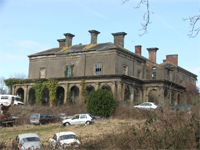
Perhaps the one of the most attractive, both architecturally and in terms of being a  case for restoration is Blackborough Hall, near Cullompton in Devon. This elegant, if thoroughly dilapidated grade-II house, is a remnant of the grand building plans of the Earl of Egremont whose many-columned main house, Silverton Park, was demolished in 1902.  The house is actually two, as when built in 1838, it formed one house at the front and a second at the rear for the local rector.  In recent years it became a car scrap yard which covers most of the immediate grounds and would obviously need clearing first – though I suspect the costs could be made back through selling some of the classic cars. The house is currently for sale for a nice round £1m and has been listed with Winkworths who, after an initially poor showing, have now managed to put a few more photos and a floor-plan online.

Elvaston Castle, Derbyshire (Image: Steve Tomkinson / Friends of Elvaston Castle)

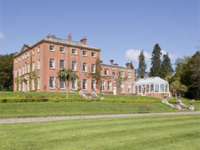
Elvaston Castle in Derbyshire has a grade-II* listing putting it in the top 4% of buildings nationally but that hasn’t stopped it making an entry into the Register this year.  Originally built in 1633 for the Earls of Harrington it was largely rebuilt in a ‘Gothick’ style c.1817 to designs by James Wyatt.  Now owned and managed by Derbyshire County Council (who had a fairly poor record in the 20th-century of demolishing country houses in their ‘care’) it is today mostly vacant and with the Council now claiming it can’t afford to maintain it they are seeking a developer to get them out of a hole of their own making.  Luckily an active local campaigning group – the Friends of Elvaston Castle – have been objecting to these plans and trying to force the Council to face up to their responsibilities – though perhaps there is an opportunity for someone else to come up with a viable plan.

Stone Cross Mansion, Cumbria (Image: HiddenShadow / 28dayslater)
Stone Cross Mansion, Cumbria (Image: HiddenShadow / 28dayslater) - click for more images of the house today

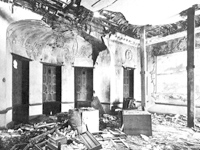
Stone Cross Mansion, Cumbria presents the interesting confusion of a Scots Baronial design in England.  Built in the 1870s by a stubborn man, one Myles Kennedy, who wanted to buy Conishead Priory for £30,000, but who met an equally stubborn vendor who wouldn’t accept less than £35,000.  Mr Kennedy may have come to regret his obstinacy when presented with the final bill which totalled nearly £45,000.  The sum reflected the high quality of the workmanship, particularly the impressive High Victorian Gothic grand hall (scroll down) which originally had a fine staircase which was later removed when the house became a special school to make it easier to play indoor football (seriously, where do they find these people?!).  The house then became a corporate headquarters during which it time it was restored to a high-standard before falling into neglect.  Repeated enabling development proposals have been rejected (not that the council is against it) so this house either needs someone willing to restore the house on the back of a sensitive ED proposal – or, ideally, someone to rescue this house and make it a home again.

Plas Gwynfryn, Wales (Image: SAVE Britain's Heritage)

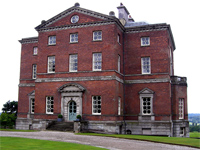
Another house which would make a fantastic home is Plas Gwynfryn in south Wales.  This house has been featured before on this blog (‘Orphan seeks new carers: Plas Gwynfryn, Gwynedd‘) which sparked some passionate debate in the comments about who the owner is – and that same unresolved question is why the house makes an appearance in the BaR this year. Built in 1866 to replace an earlier one, this distinctive house – described in the listing description as ‘romantically assymetrical’ – was a hospital in WWII, before becoming an orphanage and then a hotel before a serious fire in 1982 gutted it.  Although in a derelict condition this house can be restored and would once again be a fine part of the local architectural heritage.

The Register is available from 1 June 2011 priced at £15 (£13 to Friends of SAVE) and can be ordered from the SAVE website. The BaR contains many other types of property so even if your budgets are less lavish than these house might require it is well worth having a look.  Of course, SAVE does superb work across the country to protect our architectural heritage and I would strongly urge everyone to become a Friend to help support their efforts (well, I would say that as I’m on the Committee – but I’d also say it anyway!) which will also give you access to the online version of the BaR register which contains hundreds of other potential future success stories.

——————————————————————————–

A more comprehensive list of country houses currently at risk can be found on my Lost Heritage website: ‘Houses at Risk

If a moat floats your boat: for sale; Playford Hall and Giffords Hall, Suffolk

Baddesley Clinton, Warwickshire (Image: Nala Rewop / flickr)

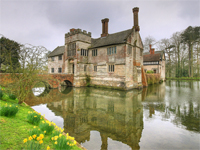
Moated houses are an architectural short cut to a more functional time when where a family lived had to be defensible and not simply a place of relaxation.  Today, of course, we admire them for their ancient charm, the weathered bricks reflected in gently rippling waters.  These houses are an older expression of our love of the natural, which found a more formal form in the later Picturesque movement, their more organic outlines in contrast with the more rigid classicism which followed.

Though once numerous, time has taken its toll and excellent examples are less common – and especially appealing when they come to market, as two have recently. The moated manor house was a result of many factors; the decline of the traditional castle, a more peaceful society, and increased wealth, but still with a need to provide some defence against thieves and attackers.  The latter category was increasingly rare but a moat with gatehouse and even drawbridge had a practical advantage.  However, for families which wished to visually bolster the perceptions of the grandeur of their lineage, a moated house was very evocative of permanence and status, drawing on their architectural ancestry with castles.  As each manor required somewhere for the local owner to stay (sometimes only occasionally if they owned many) each had a house of varying size and status depending on the wealth of the owner.  As each manor often covered a relatively small area this led to the building of thousands of these houses (though not all with moats), particularly in England.

Groombridge Place, Kent (Image: Hans Bernhard / wikipedia)

The organic growth of a moated house often created a pleasing historical collage of styles, such as at Ightham Mote, Kent, though this was sometimes swept away to be replaced by a new house such as at Groombridge Place, also in Kent.  This beautiful house was build in 1662 though in a traditional Jacobean/Elizabethan ‘H’ plan on the footprint of the older, more fortified house – though the diarist John Evelyn thought, following his visit in August 1674, that “…a far better situation had been on the south of the wood, on a graceful ascent.” indicating not everyone found a moat romantic.

Yet not every grand family felt the need to abandon the old house.  The Lygon family (Earls Beauchamp between 1815-1979) have lived at the evocative Madresfield Court, Worcestershire for 28 generations.  At its core, a 15th-century moated manor house, the current building is largely the work of the architect Philip Hardwick in 1865 for the 6th Earl Beauchamp.  The house is a prime example of late Victorian taste; a clever blend of Anglo-Catholic Pugin gothick with extensive Arts-and-Crafts interiors including a wonderful library by C.R. Ashbee of the Cotswold Guild of Handicraft (to read more about this remarkable family and house I can recommend ‘Madresfield: the Real Brideshead‘ by Jane Mulvagh).

Ightham Mote, Kent (Image: Matthew Beckett)

The physical security of a moated house was also a factor in its decline as it limited the space available for expansion as either the family, wealth or ambition of the owner grew. Many a grand country house was constructed elsewhere to replace a smaller manor with the old house either being abandoned, demolished (sometimes for building materials), or used as a secondary or dower house.  Yet, as a harsher economic reality came to pass from the 1880s, and as these smaller houses were lauded in magazines such as Country Life, so their attractiveness grew with many rescued from neglect and sometimes reinstated as a principle house on the estate.

H. Avray Tipping, one of the most influential of the Country Life writers, was a prime supporter of the smaller houses as reflected in his choice of house for the weekly ‘Country Houses and Gardens’ section – nearly a fifth of them in 1910, for example.  This was also a time when John Ruskin was arguing for more honesty in architecture and against the over-enthusiastic renovations of the Victorians which he regarded as ‘ignorant’. This regret at the neglect of manor houses in general can be seen even in the earliest Country Life articles.  Writing in 1897 (the year it was founded), John Leyland writing about Swinford Old Manor, Oxfordshire, said;

“There are manor houses through the length and breadth of the land as charming, it may be, as this, but awaiting, like sleeping beauties, the kiss that is to arouse them to fresh and unsuspected charm, the needed touch of the loving hand invested with creative skill.”

Plumpton Place, Sussex (Image: Knight Frank)

Perhaps one of the best examples of this loving restoration can be seen at Plumpton Place, Sussex for Country Life proprietor Edward Hudson by the architect Sir Edwin Lutyens.  When Hudson bought the it in 1928 the house was semi-derelict though with an intrinsic beauty from its setting on an island in the middle of the uppermost of three lakes.  Lutyens successfully restored and adapted the house to create one of the best current examples of a moated manor house – which was also offered for sale in July 2010 for £8m (and featured in another post: ‘For those who like their houses with pedigree: Plumpton Place, Sussex‘)

So having whetted our collective appetites, those with £3.5m to spare currently have a choice of two historic moated manor houses in Suffolk; Playford Hall, near Ipswich (£3.25m), and Giffords Hall, in Wickhambrook (£3.5m).

Playford Hall, Suffolk (Image: Savills)

Playford Hall has the beauty of the warm red-brick with two wings placed off-centre, hinting at the further wing demolished in the 1750s after a devastating storm in 1721 blew holes in the roof and following a long period of dereliction from 1709 following the death of the owner, Sir Thomas Felton, who had remodelled the house in its current style.  The house then passed by marriage into the estate of the Earls of Bristol, in which it remained until sold after WWII.  The house has been restored and updated – though whoever buys it will probably want to re-do the eye-wateringly pink dining room.

Giffords Hall, Suffolk (Image: Savills)

No such concerns about the wonderful interiors of Giffords Hall – the house abounds with historic woodwork, from the masses of exposed beams to the extensive panelling.  The exterior, in contrast to Playford, is almost entirely timber-framed, with an Arts-and-Crafts style north wing added in 1908 by the owner Mr A. H. Fass who also carefully restored the house following a period of neglect.   Now cleverly brought up-to-date, in co-operation with English Heritage, the house now has a full suite of reception rooms, a new kitchen and a full quota of bathrooms.

So, proving the folly of those who allowed these romantic houses to decay and the wisdom of those who restored them – with thanks to the evangelism of Country Life – another important branch of the nation’s architectural history has been redeemed and now, once again, attracts high valuations which reflect the immediate attraction these houses can exert on us all.

—————————————————————————-

For further reading, the excellent ‘The English Manor House – from the archives of Country Life’ by Jeremy Musson – though unfortunately this appears to be out of print and surprisingly expensive. One for the second-hand bookshop search, I think.

For those looking to visit, a handy list: ‘Manors in England‘ [Britain Express]

A bad omen: the spring country house relaunch

One rather unscientific barometer of the health of the country house market is the thickness of Country Life magazine as it comes through the letterbox each week.  After the thinning of the issue in the run-up to Christmas it’s always pleasing to feel the first weighty edition of the new year.  Yet, though this week’s issue (2 March) boasts ’70 pages of property for sale’ it’s remarkable that the estate agents have so few significant country houses to offer and of those that are there, it seems, along with last week’s issue, the largest houses are relaunches.

Pyrford Court, Surrey (Image: Savills)

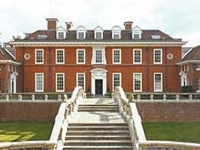
One of the most interesting is grade-II listed Pyrford Court, Surrey.  Originally built in 1910 for the 2nd Lord Iveagh, of the Guinness brewing family, it was one of a group of houses built around that time on the profits of beer (along with Polesden Lacey, Elveden Hall, and Bailliffscourt). The land was sold to Lord Iveagh by his father-in-law, Lord Onslow, whose family had owned the area since the 17th-century.  The house was designed by Clyde Young who had also worked at Elveden, another seat of the Guinness family, though the sensitively designed wings were added in 1927-29 by J.A. Hale of Woking to designs by Lord Iveagh.  The stylish neo-Georgian house is an elegant red-brick composition which originally sat in a 1,000-acre estate – though sadly now reduced to just 21-acres.  Lord Iveagh died in 1967 and the house sat empty until sold in 1977 – apart from a brief burst of fame as a location in the 1976 film ‘The Omen’.  The house then became an old people’s home with all the attendant damage until the current owners started their seven-figure restoration.

Pyrford Court was originally launched on the market in January 2010 for an ambitious £20m, a staggering rise in valuation from the £3.25m paid in 2000 and from the £8m asking price when it was offered for sale in 2002 (reduced, a year later, to £6.5m).  Yet this proved too much for the market to take; even for a ‘super-prime’ house within 25 miles of central London, and despite the high-quality restoration of the impressive interiors.  It subsequently languished and has now been promoted with a double-page advert – though the price is ‘on application’ meaning we won’t yet know quite how far the price has dropped.  However, looking at the other houses Savills have for sale in the area this is by far the most interesting and attractive house.

Brockhampton Park, Herefordshire (Image: Jackson-Stops & Staffs)

Another impressive house is the classically elegant, red-brick Brockhampton Park, Herefordshire.  Although the architect hasn’t been confirmed, the fact that it is virtually identical to Hatton Grange in Shropshire by Thomas Farnolls Pritchard, means it can probably be attributed to him.  The house was built in the late 1750s for Bartholomew Richard Barneby, probably using the £3,000 brought to him through his marriage in 1756 to one Betty Freeman. The Barneby family had owned the estate since the 15th-century and were to own it until 1946 when John Talbot Lutley (who was a descendent of the  Barneby family) left the house and 1,200-acre estate to the National Trust. Col. Lutley was a no-nonsense man who, on hearing of the NT country houses scheme, wrote them a short letter in 1938 saying that as he was a bachelor whose heirs were rather distant, would they be interested?

James Lees-Milne was duly dispatched – and almost rejected it on sight as it wasn’t pure Georgian due to some relatively small Victorian alterations.  However, after a tour of the estate and on seeing the beautiful Lower Brockhampton Manor, he felt that the latter two would be fine additions for the Trust – even if the big house would be a drain. It was duly left to the NT in 1946 following the Colonel’s death. Neither the house nor the contents were of sufficient quality to justify retaining or opening to the public so they sought to let it.  Unfortunately no private tenant wished to take it on, usually citing its remoteness, however in 1985 an insurance company let the house as offices and undertook a comprehensive restoration programme.  After they moved out in 1996 it was again restored as a private home and is now available with just 8-acres but surrounded by the rest of the NT-owned estate.  Interestingly the house is listed under the ‘Sales’ section of the Jackson-Stops & Staff website but I suspect this is due to it being leasehold – again ‘price on application’ so the price of the privilege is unknown, but the house has been advertised since last summer so it may be cheaper than before.

Ebberly House, Devon (Image: Savills)

Perhaps the most surprising house to still be available is the grand Ebberly House, Devon.  Rather than the expected provincial house, this is a house which displays remarkable architectural sophistication. Described by Pevsner as ‘unusual and attractive’, whose distinctive rounded ends ‘hint at the variety of room shapes inside; a provisional echo of the interest of contemporary architects such as Nash and Soane’.  Designed by Thomas Lee of Barnstaple, a pupil of Sir John Soane, the grade-II* house compensates for it’s remoteness with a fantastic house set in a fine 250-acre estate.  Offers in excess of £4m on the back of a postcard to Savills in Exeter.

Perhaps there are some clever marketing plans being hatched at the estate agents which means that rather than pushing their best properties in the first big property edition of Country Life of 2011 they’re saving them for…when?  Bonuses have just been announced and those looking to buy are probably active so perhaps there is just a general scarcity of significant country houses coming to the market.  Does this indicate 2011 will be rather thin for the agents as uncertainty limits buyers to the super-rich looking for somewhere in London or will the market pick up and a slew of new houses soon be released to whet our appetites?

Back from the brink: country houses rescued from dereliction

Finedon Hall, Northamptonshire (Image: Stephens Pictures / flickr)

One often forgotten aspect of local newspapers is their ability to draw on their archives and provide reminders of local history. The local paper frequently played an important part in publicising the goings on at the ‘big house’, reporting the successes and scandals with usually equal vigour.  A recent article in the Northamptonshire ‘Evening Telegraph‘ reflects not only on the collapse of the Volta tower, built by the owner of Finedon Hall as a memorial to his drowned son, but also the later dereliction and near loss of the house itself as it slipped from dereliction ever closer to demolition.  Yet, unlike so many hundreds of other country houses which were lost, Finedon Hall was one of the many which have been saved.

c1980 - Finedon Hall, Northamptonshire (Image: Evening Telegraph)

Finedon Hall has 17th-century origins but its current style is the result of what Mark Girouard called “eccentric chunky” alterations by E.F. Law for the owner, William Mackworth-Dolben, in the 1850s.  Built in a Tudor-Gothic style in the local ironstone (which was quarried on their land) the house passed through the family until the last of the family, the spinster Ellen Mackworth-Dolben died in 1912.  With no heirs, the estate was sold off in parcels with the house passing through a number of owners before being bought by developers in 1971.  For over a decade they allowed the house to deteriorate until just ten years later parts of the roof had gone and the exterior was in serious danger of collapse.  Luckily, more enlightened developers stepped in and during the 1990s the house (and estate buildings) were converted into apartments.

One of the largest houses to be converted in this way was Thorndon Hall in Essex.  One of James Paine‘s largest commissions, this Palladian mansion was originally built for the 9th Lord Petre in 1764-7 but was gutted by fire in 1876, leaving only the eastern end of the main block and the eastern pavilion intact.  The Petre family lived in the reduced house until 1919 when they leased it and the estate to a golf club and they moved back to the original family home, Ingatestone Hall.  The house remained a largely ruined shell until it was sold for development in 1976 but was then bought in 1978 by a local builder who created a total of 84 apartments in the house, pavilions and estate buildings.

Ecton Hall, Northamptonshire (Image: Conway Collections / Courtauld Institute of Art)

One of the most accomplished and intelligent of the developers to convert country houses is Kit Martin who has saved several houses and including Ecton Hall in Northamptonshire.  The house was largely remodelled by Ambrose Isted in 1755 in the then relatively new ‘Gothic-Revival‘ style (Horace Walpole had only started his work at Strawberry Hill in the early 1750s and it’s considered one of the earliest houses in the new style).  The house was filled with fine art, books and furniture and passed through the Isteds and then, by marriage, to the Sothebys who owned it until the last died, childless, in 1952. At this point the rot set in; builders called in to remove a large kitchen extension also, apparently, stole the valuable lead from the roof leading to dry and wet rot. Alexander Creswell, visiting in the 1980s, described the scene:

“The rich ochre stone of the garden front is engulfed in Virginia creeper, and sparkles of broken glass litter the terrace.  Inside the house, the drawing room fireplace rises above a heap of plaster that the roof has brought down…At one end of the house the winter storms have toppled a gable, which in falling has crushed the fragile camellia-house below; one surviving camellia blooms among the rubble of ironstone – the only flourishing vestige of Ecton’s former glory” – ‘The Silent Houses of Britain

However, by 1989 Kit Martin had finished his work and the new apartments were advertised for sale in Country Life; a remarkable rescue for this almost lost house.

Gunton Park, Norfolk (Image: Broads Marshman / flickr)

Perhaps Kit’s finest work is Gunton Park in Norfolk.  The house was originally the work of Matthew Brettingham, a competent, if sometimes unimaginative, Palladian who had first achieved recognition with his work executing William Kent and Lord Burlington‘s designs for Holkham Hall.  This work brought him to the attention of other aristocratic clients, particularly in Norfolk, including Sir William Harbord who commissioned him in 1745 to design a replacement at Gunton for an earlier house which had burnt down three years earlier.  Brettingham’s house was to be significantly enlarged c.1785 to designs by James Wyatt.

Sadly, fire struck again; in 1882 the Brettingham portion of the house, including the fine rooms, was almost completely gutted and remained a forlorn shell for the next 100 years.  Kit Martin bought the house in 1981 and sensitively created well-proportioned apartments in the remaining wings. The front of the Brettingham wing (pictured above) become one large house separated from the main block by a large void created by the fire but still linked by the retained façades.  It’s not just the house which has been rejuvenated; the parkland – nearly 1,000 acres – has also been bought or, through agreements, reunited (and in the process winning an award from Country Life magazine) to restore the setting of this elegant house.

Barlaston Hall, Staffordshire (Image: Peter I. Vardy / Wikipedia)

It’s rare for a house, once in a state of dereliction, to be restored as a single family home, yet thankfully it does happen. Barlaston Hall is one example of this – and it’s rescue was down to some bold decisions by the campaigning charity SAVE Britain’s Heritage and their President, the architectural writer Marcus Binney, who was offered this elegant house for £1!  Barlaston Hall is, according to Binney, almost certainly the work of the architect Sir Robert Taylor (b.1714 – d.1788).   The house is a relatively unadorned but sophisticated house, enlivened with unusual octagonal and diamond glazing bars in the sash windows; Taylor’s response to the popularity of Chinese Chippendale furniture and a general fashion for the Rococo.

Dining Room - Barlaston Hall, Staffordshire (Image: Christopher Dalton)

However, the house had been built on several coal seams which threatened the house when they were mined in the 20th-century.  Structurally unsound, it had been abandoned and vandalised but SAVE stepped in to challenge Wedgewood’s application to demolish.  At the subsequent public inquiry, the National Coal Board threw down the challenge that SAVE could buy the house for £1 provided it completed restoration and repairs within six years.  SAVE swung into action, raising money through grants and by forcing the NCB to meet its obligations (which it did after some shameful attempts to avoid doing so), and the house was stabilised, restored, and subsequently sold to a couple who completed the interior and it remains a family home.

Piercefield House, Monmouthshire (Image: darkcell / flickr)
Piercefield House, Monmouthshire (Image: darkcell / flickr) - click to see large version

Sadly there are many country houses still at risk today – though the rescues also continue. Pell Well Hall in Shropshire, a wonderful house by Sir John Soane built in 1822-28, has been restored as a shell after decades of neglect, vandalism and fire, and now requires someone with vision to complete the process.  Bank Hall in Lancashire was featured in the original ‘Restoration’ TV series but has continued to deteriorate with sections collapsing.  However, planning permission is being sought to convert the house into apartments which will enable restoration of the house. One house however has, inexplicably (well, to me), remained unrestored; Piercefield House in Monmouthshire.  This beautiful house, again by Sir John Soane, became uninhabited and was mistreated during WWII by the American troops stationed nearby who used the façade for target practice.  The house, set in 129 acres, has been for sale for several years but despite the architectural provenance and the wonderful setting it remains unsold.

The story of the country house has always been one of changing fortunes, which sadly led to many being demolished. The difference now we have heritage legislation is that whereas before houses were often simply demolished, now their plight is likely to drag on for many years.  Restoration is often the best course of action, preserving as much of the original fabric as possible, and ideally as a single family home, though the less palatable options of conversion are always to be preferred to the complete loss of another of our historic houses.

News story: ‘Fascinating history of Hall‘ [Evening Telegraph]

Anyone restoring a country house?

Blackborough House, Devon (Image: Trouserama / Derelict Places)
Blackborough House, Devon (Image: Trouserama / Derelict Places) - currently for sale with Winkworths

Heritage and the dedicated work of those who seek to rescue it can often be overlooked only to be occasionally thrust into the spotlight of TV – though this can be a useful promotion in these times of austerity.  Sadly, the schedules seem to focus on heritage in bursts, giving us ‘The Restoration Man‘ and ‘Country House Rescue‘ at the same time but it’s good to know that their popularity encourages the programme makers to continue to commission this type of series.  Of course these programmes need material so if you know anyone restoring a UK country house, please read on.

One of the most successful of the heritage programmes was the original ‘Restoration‘, a wonderful series presented by Griff Rhys Jones who has personal experience of restoring his own rural Welsh farmhouse.  This series truly caught the attention of the public and raised awareness of the buildings at risk in their own areas.  Keen to tap this interest again, Endemol, the production company behind ‘Restoration’, have a new series, ‘Restoration Home‘, ready for broadcast in Spring 2011 (and flagged up as a comment already on this blog) – though sadly without Griff as the presenter.  The new series focuses on private owners and follows their restoration of ‘at risk’ houses as modern homes.  Although the intention is that these will be sensitive restorations it will be interesting to see exactly what compromises and sacrifices are made in creating the home the owner wishes to achieve.

As a sign of the confidence that Endemol have in likely popularity of the series, they are already looking for houses to feature in a second series with, ideally, work starting in the next few months and reaching completion around March 2012.  To quote Natasha Evans of Endemol Television:

“Each show will chart the restoration process by the owners of one house, as they restore their home to its former glory. Much as the original series, we’ll bring the property to life, setting it in its cultural and historic context. This is a major aspect of each show and will be interwoven with the restoration. At the same time, we’ll be looking at the different stages of its architectural styles.”

One of the key criteria is that the houses must be owned privately by those who are intending to live in them, that they are currently in need of a bit of love and attention, and that the owners are passionate about their house and specifically interested in the history of their house. So if you are undertaking your own project, or know someone who fits the criteria, please contact Natasha Evans on 0208 222 4326 or by email  natasha.evans@endemoluk.com

——

If you are inspired by these programmes and would like to find your own building at risk then one of the best places to start is the ‘Buildings at Risk Register‘ managed by the architectural heritage charity SAVE Britain’s Heritage.  To access the register you need to subscribe but this will give you full access to the register of hundreds of properties in need of a sensitive owner.

If Blackborough House (pictured above) takes your fancy, it’s currently (January 2011) for sale with Winkworths for between £1m – £1.5m, but will require at least that (and probably more) spent again on it to restore it as a home.

——