For sale for the first time in 1000 years: Shakenhurst Hall, Shropshire

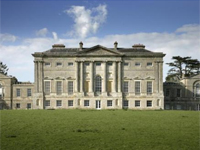
Shakenhurst Hall, Shropshire (Image: Nick Edwards/Panoramio)

It has been estimated that there are approximately 2,000 large country houses in the UK with decent size estates  (over 100 acres) – but very few are still in the hands of the family which originally built them. Yet despite the many sales over the years it’s still possible for a house and land to remain with one family for many hundreds of years – though that is now coming to an end for Shakenhurst Hall in Shropshire, seat of the Meysey family for much of the last 1000 years and now on the market for the first time at £12m.

The lands were first given to a French Baron, Roger de Toeni, for his help in the conquest of Britain in 1066.  It has then passed through inheritance through various members of the Meysey family except when it passed for period to a godson in the 20th-century and then his wife, before being bequeathed to Michael Severne, a descendent of the Meyseys.  On his death in 2007 it passed to his only daughter Amanda who died of cancer in 2008 leaving the house and estate to her husband.

The grade-II listed Georgian house, built in the 1790s but with a 16th-century core, is now up for sale as it faces that age-old difficulty of an estate no longer providing sufficient income to maintain the house – and neither of their two sons are in a position to take it on.  Michael Severne had run a successful plastics business from outbuildings on the estate but with his death the business folded.  Interestingly this mirrors the challenges faced by country house owners in the 19th-century who relied also on a single source of income, agriculture, who were hit particularly hard by the 1870s depression in farm produce prices and land values.

Land has always been regarded as the most important asset (even if mortgaged) and so when faced with the choice of economising, selling land, or selling paintings or books it was usually the latter which went first.  This lead to the rise of the art sales particularly from the 1890s until the 1930s which dealers such as Joseph Duveen exploited as they extracted exquisite Old Master Italian paintings and others by the finest English artists which would then be shipped to the United States. Here a new class of exceptionally wealthy financiers and industrialists such as Hearst, Frick, Morgan, Mellon, Carnegie and Rockefeller would compete to secure the finest works of art before donating them to eponymous public galleries.

Although this did leave significantly smaller collections for some houses it did sometimes provide the finance to either diversify into investments or tide them over until agriculture recovered in the 1930s – although for some it merely delayed the more unpalatable choice of demolition which unfortunately was the outcome for hundreds of houses in the UK.  With demolition now thankfully out of the question an owner is left with few options and it can be easier to simply sell up which is what appears to be the case with Shakenhurst Hall.

Sad though it is that such a long connection is to come to an end, here’s hoping the next owner will respect the 1300-acre estate, the history and the house to create a rewarding new chapter for this elegant ‘minor’ country house.

Property details: ‘Shakenhurst Hall‘ [Savills]

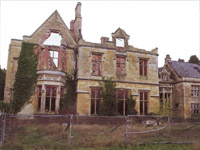
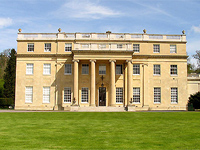
PS: it’s interesting that two houses should be available which look so alike. I was struck by just how similar Shakenhurst Hall is to Peatling Parva Hall in Leicestershire which is currently on the market for £4.75m.  Interestingly the latter only took on it’s current form after alterations in 1910 after the Arts-and-Crafts architect Detmar Blow added two bays to the original house.  Was this just a coincidence of architects thinking alike or had Blow seen either Shakenhurst or something similar?

Property details: Peatling Parva Hall [Knight Frank]
Phoenix for sale: Beaurepaire House, Hampshire

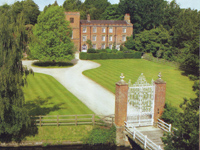
Beaurepaire House, Hampshire (Image: Knight Frank)

Launched this week ( 23 June 2010) in Country Life magazine is a fine, grade-II* listed, moated manor house set in nearly 250 acres of Hampshire.  Open the first set of impressive wrought iron gates and follow the drive down to the ancient moat and through the second, equally impressive, set of white painted gates over the wooden bridge. Before you stands a beautiful red-brick manor house – but why is the house set in one small corner of the island? Why does the drive lead over the moat but unusually not to the middle of the house?  And why does that tower look a bit new?

The answer to all these questions is that Beaurepaire House, as it now stands, is what remains of an important and beautiful manor house which burnt down in 1942 after a chimney fire.    What happened subsequently is an interesting example of how disaster need not lead to the loss of the whole house or the estate.

Beaurepaire House, Hampshire before the fire (Image: Lost Heritage: England's Lost Country Houses)

Beaurepaire House has royal connections having been visited twice, once by Henry VIII in 1531 and then by his daughter Elizabeth I during her visit to The Vyne.  The moat itself dates from 1369 but the original house was built in the 16th-century but was badly damaged during the Civil War and was only rebuilt in 1777.  The design of the new Georgian ‘Gothick’ house followed the rare structure of having a square core with castellated corner turrets.  There are relatively few examples of these houses – and the ones we have today are all ruined to some degree (Ruperra Castle, Wales / Lulworth Castle, Dorset) or lost entirely (Compton Bassett House, Wiltshire).

At the time of the fire the house was owned by one of the richest men in the country, Sir Strati Ralli, but wartime building restrictions prevented restoration. After the war the estate was owned by Lady Sherfield and in 1965 she decided to restore the remaining servant’s wing as a house and commissioned the well-known architect Tom Bird, who had restored many other country houses, to make the house habitable.  Bird decided to add a sympathetic tower, which continued the existing architectural style, to the fire-damaged southern flank of the remaining wing to not only provide structure but also to improve the proportions of what was left.  The addition was less than 10% of what remained but successfully ensured that the house was able to rise again from the ashes of the fire to retain the role it had enjoyed for hundreds of years as the centrepiece to an impressive country estate.

_____________________

Property details: Knight Frank seem to have forgotten to put the details on their website.   Nevermind, here’s a link to all the Hampshire houses they’re selling in the hope that they soon add it in: Knight Frank: Hampshire

Conversion reversion? Wardour Castle, Wiltshire

Wardour Castle, Wiltshire (Image: Strutt & Parker)

With so many country houses lost in the twentieth century, almost any alternative which saved them from the demolition crew was to be welcomed; no matter how drastic.  For some this meant institutional use but for many others of all sizes the solution was conversion into flats and apartments – though with varying degrees of success.  However, as these properties come on to the market, is it perhaps time to consider converting them back into the single, glorious houses they were intended to be?

Launched this week (16 June 2010) in Country Life magazine is the principal apartment in what is considered James Paine’s finest creation; Wardour Castle, a supremely elegant essay in Palladian architecture.

Central stairwell and gallery, Wardour Castle, Wiltshire (Image: Strutt & Parker)

Built from 1770 – 76, for the eighth Lord Arundell the most impressive feature is a breath-taking central stairwell with first-floor gallery which Pevsner called ‘the most glorious Georgian interior of Wiltshire’ and which forms the core of Apartment One which is now for sale.  Wardour Castle house has proved to be adaptable becoming Cranborne Chase School in 1960 until it closed in 1990 when it was then converted into ten apartments.  As the divisions appear to have respected the natural sections of the house this seems to be a good example of where someone could convert the house back to a single home.

There are many examples of houses being rescued by conversion.  SAVE Britain’s Heritage have long campaigned to protect these houses and have worked in conjunction with one of the leading architects, Kit Martin, in supporting conversion.  A 1983 SAVE report entitled ‘The Country House: to be or not to be’, written by Kit Martin and Marcus Binney, includes particularly interesting studies of how these houses could be sensitively converted.  These show that although almost any country house could be sensitively adapted some are naturally more suitable particularly where the overall layout of the house is symmetrical, shallow and long.

The study was an important milestone in the practice of country house conversion and saved many houses from complete loss or inappropriate use including The Hazells in Bedfordshire, the grade-I Northwick Park in Gloucesterhire, Dingley Hall in Northamptonshire.  The sensitive approach they championed now means that it should be possible to consider converting a house back if the right opportunity arose.  It should be said that some houses are never going to be converted back due to a variety of factors including there being too many apartments involved such as at Thorndon Hall in Essex which contains 37 flats, or where not enough land has been retained to make the unified house valuable enough to justify reversion.

Perhaps the idea of reversion becomes more realistic where more than one part of the same house comes on the market at the same time such as recently happened with grade II*-listed Ampthill Park House, Bedfordshire.  Built by the Cambridge architect Robert Grumbold in 1687-9 and completed by John Lumley of Northampton in 1704-6, with major additions by Sir William Chambers in 1769 it is certainly one of the most impressive houses in the county. It was rescued from dereliction by conversion into just four large houses; two of which were put on the market in April 2010, the largest of which includes most of the principal rooms.

Although it’s nice to dream about these houses becoming single homes probably the biggest obstacles are not only being able to secure the other apartments but also that the value of the individual properties may be greater than the value of the unified house.  However, it’s not entirely beyond the bounds of possibility that someone with deep pockets and a desire to restore a house could take on one of these conversion reversions and recreate a superb country house.

Property details: ‘Apartment One – Wardour Castle, Wiltshire‘ [Strutt & Parker] – £2.75m

Detailed architectural description: ‘Wardour Castle, Wiltshire‘ [English Heritage: Images of England]

Anyone with deep pockets? Country houses at risk today

It seems remarkable that between the popularity of country houses as tourist attractions or business or simply as homes that any would be at risk.  Yet as the 2010 SAVE Britain’s Heritage Building’s at Risk Register shows there are still a broad selection of fine houses which, for various reasons, are in need of someone with a desire to restore part of our heritage, lots of dedication, and pretty deep pockets.

Nocton Hall, Lincolnshire (photo copyright: Tom Vaughan)

One of the saddest is the case of Nocton Hall in Lincolnshire – a county which has lost so many of it’s fine old country houses already.  Fire is still one of the main reasons a house can quickly go from being a secure home to an ‘at risk’ shell.  Grade-II listed Nocton Hall is a warm honey-coloured stone house built for the 1st Earl of Ripon in 1841 to replace the original Jacobean house which burnt down in 1834.  After a stint as an RAF hospital in WWII it became a residential home before being bought by a property developer.  Unfortunately no development took place and the house was allowed to slowly deteriorate before a serious fire severely damaged what had been a perfectly good house.  Still sitting in its own gardens and parkland and near the village Nocton Hall cries out to be restored either as a h,otel or ideally as a grand family home.

Barmoor Castle, Northumberland (Photo: SAVE Britain's Heritage)

To look at the photo, Barmoor Castle in Northumberland looks in pretty good shape – but a picture can hide as much as it shows.  The first issue with Barmoor is that it actually is unused and sits in the middle of a caravan park which has been established in the grounds. Inside, there is some water damage as the roof has been leaking – although recent work, part funded by English Heritage, has alleviated this for the moment. Barmoor was built in 1801 around an older tower by the architect John Patterson of Edinburgh in a castellated Gothic Revival style for Francis Sitwell, in whose family it remained until 1979 when it was sold along with 200-acres.  The current owners have operated the caravan park since then but didn’t live in the house or use it leading to it’s current neglected state.  This is a classic example of where a house could be rescued from an inappropriate use, restored and enjoyed as a fine country house as was intended.

St Botolph's Mansion, Wales (Image: SAVE Britain's Heritage)

St Botolphs Mansion in Pembrokeshire was built in the early 1800’s for General Richard Le Hunt is a house in need of a use rather than repair.  The Doric porch and neat window architraves create an interesting facade which would normally ensure that such a house would be jealously fought over if it came to market.  However it is now owned by the nearby oil refinery (the proximity probably ruling out residential use) but they are exploring options as to how to make use of this elegant Georgian house – perhaps as a conference facility might be more appropriate.  Either way, this is a house which shouldn’t be forgotten.

Other country houses of note in the report include the Grade-II* listed Plas Machen nr Newport, the surviving portion of the 15th-century house of the Morgans who moved up in the world to Tredegar House, which is for sale. Also for sale, since 2007, is Benwell Towers in Newcastle which was a country house when built but is now suburban, achieving fame in later life as the set for the kid’s TV series ‘Byker Grove’.

Even if your pockets can’t stretch to a country house there are many other buildings seeking a saviour so do order your copy of ‘Live or Let Die‘ and certainly consider joining SAVE Britain’s Heritage to help to preserve our architectural legacy for future generations.

Converting country houses from commercial to residential: a sound investment?

Benham Valence, Berkshire (Image: wikipedia)

As the pressures of the twentieth century forced more country houses owners to face the reality that they could no longer live as they had and would have to move out of their homes they then had to decide what to do with it.  Unfortunately this meant demolition of hundreds of large houses but some owners were more creative and many houses became commercial premises, either as hotels, schools or institutions, and others became some of the grandest office buildings in the country.  However, recent pressures of this century have now seen some of these offices being converted back into homes or being offered for sale as an opportunity to do so.

In many ways the country house has always had an element of the commercial to it with the estate offices usually being based either in a part of the main house or in a nearby building to enable the owner to deal with business without having to travel far from home. The changes of the twentieth century were on an altogether more comprehensive scale with the entire house being changed to accommodate the demands of business.  This not only meant the conversion of the main house with all that entailed for the interiors but also the building of further offices in the grounds.

Sometimes the development was kept a good distance from the main house such as at Ditton Park in Berkshire.  This became the office of the Admiralty Compass Observatory from 1917 until it was sold in the 1990s to Computer Associates who built a huge office building to the west of the main house (which became a conference centre) leaving the setting intact.

Sometimes though it’s possible for smaller businesses to be accommodated just within the main house such as at Gaddesden Place in Hertfordshire.  The house, built in 1768, is a elegant Palladian villa (similar to the White Lodge in Richmond Park) and was James Wyatt’s first country work.  The site is said to have some of the best views in the home counties and the sensitive use of the house has allowed to remain in splendid seclusion.

However, modern concerns mean that a country house has lost some of it’s appeal as offices.  One key issue is that by their nature the houses are isolated meaning that employees must have cars to reach it leading to more cars on the roads and the need to provide huge areas of parking.  Stronger heritage legislation now also means it’s much harder to alter the houses to meet modern business requirements such as air conditioning and computer networking.  The nature of the houses also means that maintenance costs are higher than for a purpose built office.

This has led to some houses which were formerly offices to be converted back into homes.  Mamhead House in Devon, built between 1827-33 and regarded as one of Anthony Salvin‘s finest designs, it was, for many years, a school before becoming offices for a local building company.  It was bought by a businessman who converted the main part of the house back into being a home whilst still letting out part of the house to the Forestry Commission.

Perhaps the grandest and largest opportunity for many years to restore a house into a home is the mansion at Benham Valence in Berkshire.  This superb house was built in 1772-75 for the 6th Earl of Craven and was designed by Henry Holland in collaboration with his father-in-law, Lancelot (Capability) Brown, the famous landscape architect.  The south front features a grand tetrastyle Ionic portico which looks out over a large lake with views into the parkland.  Inside, there are many fine chimney-pieces bought from the sale at Stowe in 1922, including one from the State Dining Room.  It also features a small circular double-height vestibule adjoining the inner hall, a design later adopted by Sir John Soane.

The house was empty in 1946 and remained so until it was sold in 1983 and converted to use as offices with a large wing to the north east of the house being demolished and replaced, in part, by an ugly 80’s complex providing over 100,000 sq ft of space.  Luckily though the main house was largely spared and remains Grade II* with the 100-acres of Grade-II parkland. Now offered for sale at £6m this is a rare opportunity to create a wonderful country house – providing it’s possible to obtain planning permission to convert it back – which, once restored, could be worth £10-12m.  One key requirement would be the demolition of the office complex and the ripping up of the huge car park – but give me a pickaxe and I’ll be happy to lend a hand.

Full property details: ‘Benham Valance, Berkshire‘ [Strutt & Parker]