Bargains from difficult circumstances: country house reposessions

Sheriff Hutton Hall, Yorkshire (Image: Savills)

An article in the Sunday Times Home section (11 June 2010) includes two houses featured on this blog; one recently and one back in November 2009.  The story this week exposes that both are for sale as some of the grandest repossessions in the country with lenders forcing the sale.

Each of these houses when bought was probably the realisation of an aspiration many have to own a grand country house.  Yet, what goes up can come down and each owner has now been forced out of their dream.  The first house, Sheriff Hutton Hall in Yorkshire is a grade-I listed gem surrounded by 170-acres and indeed featured on this blog entitled ‘If I won the lottery…‘.  Originally built in the early 1600s as a hunting lodge before being remodelled in a lighter brick in 1732.  The outbuildings were constructed using quantities of stone and panelling from nearby Sheriff Hutton Castle, it also features richly decorated ceilings with plasterwork by John Burridge and Francis Gunby, who is also thought to have worked on the Dining Room at Temple Newsam in Leeds.

Sheriff Hutton Hall was sold in 1998 and became the northern branch of the East 15 acting school.  Today however, despite strenuous efforts by the owner, a secondary lender has called in their loan forcing the sale.  Originally for sale, through Savills, at offers over £5m (nearer £6m was apparently hoped for) the price has now dropped to £4.5m.

Sale details: ‘Sheriff Hutton Hall‘ [Savills]

Detailed architectural description: ‘Sheriff Hutton Hall‘ [British Listed Buildings]
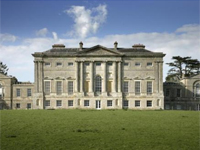
Wardour Castle, Wiltshire (Image: Strutt & Parker)

The second property, Apartment One in Wardour Castle, Wiltshire, was only launched in Country Life magazine a few weeks ago and was featured here with the idea that it might be used as a starting point for the conversion of the house back to a single home (‘Conversion reversion: Wardour Castle‘).  Yet it now appears that it was the original project to convert this Georgian gem that has caused the current vendor’s difficulties.  The house, designed by James Paine, was built in the 1770s for the eighth Baron Arundell and was (and in some ways still is) the grandest and largest house of it’s era in Wiltshire.

After use as a school for thirty years until 1990 it had an uncertain future.  Nigel Tuersley then bought the grade-I listed house for £1m in 1992 and decided to convert the house into ten large apartments with Nigel retaining the largest in the centre of the house for himself.  However with property boom turning to bust the bank was unwilling to continue funding the project.  This first manifested itself when the same apartment, all 23,000 sq ft of it, was put on the market for £7m in 2008 – possibly a bit ambitious even at the time.  With the contents now removed (not that you can really tell as the interior was designed by the famous Minimalist architect John Pawson) the apartment now waits for someone with a more reasonable £2.75m through Strutt & Parker.

The house is another in a small but sadly growing list of ‘posh repossessions’ (those valued at over £1m) which show that dreams, however big, can still be brought down and that perhaps the hardest part of reaching the top is staying there.

Sale details: ‘Apartment One – Wardour Castle‘ [Strutt & Parker]


Credit: original story in the Sunday Times Home section – 11 July 2010.  Story only available online to subscribers.

How to get depressed quickly: the English Heritage Buildings at Risk Register 2010

Winstanley Hall, Lancashire (Image: English Heritage)

This blog has highlighted several country houses which are at risk but the true scale of the issue is unfortunately much larger, as the publication of the 2010 English Heritage Buildings at Risk Register shows.

Country houses all too easily can move from being secure, watertight buildings to having minor problems to becoming seriously at risk due to their size and the high standards required to repair them necessarily making even simple tasks much more expensive.  For the owners this can mean that the burden of looking after their ancestral family home becomes a daily challenge which, rather than facing, can be easier to ignore – especially if they are able to simply shut the door to a wing and forget the damp and leaks.

One of the greatest enemies of the country house is obscurity – particularly when combined with negligent or incapable owners. For some the house is merely an obstacle to redevelopment and so it is in their interest to forgo maintenance and hope that the house quickly and quietly deteriorates to the point where they can apply for permission to demolish.  Unfortunately under-resourced councils are rarely able to regularly survey all the listed buildings in the area meaning that houses can slip through the cracks.  The current economic climate means that it is even more unlikely that councils will be able to fully fund the heritage teams to ensure that they are able to ensure owners meet their obligations.

Melton Constable Hall, Norfolk (Image: English Heritage)

Although English Heritage have had some limited successes (e.g. Sockburn Hall, County Durham) there are still far too many houses at risk – I counted nearly 100 in a couple of searches.  It should be noted that houses are included even where works are planned or under way such as at Clarendon House, Wiltshire which was recently sold (with estate) for a reputed £30m and where restoration is expected to be completed by the end of 2010).  However, other examples include:

Others on the list include:

The head of English Heritage, Simon Thurley, said at the launch:

“Neglect is a slow, insidious process whose costly damage takes time to become clearly visible. Cuts in both private and public spending are currently inevitable but armed with our Heritage at Risk Register, English Heritage is well-equipped to guard against the loss of the nation’s greatest treasures and to suggest effective and economical strategies to protect our national heritage.”

One can only hope that this proves to be the case and that EH are able to fully fulfil their role particularly in relation to country houses and ensure that these beautiful buildings aren’t allowed to quietly slip into dereliction, depriving future generations of wonder of these grand houses.

More details: English Heritage Buildings at Risk 2010 or you can search the 2010 Register

For those who like their houses with pedigree: Plumpton Place, Sussex

Plumpton Place, Sussex (Image: Knight Frank)

One of the greatest of the UK’s country house architects was Sir Edwin Lutyens – a man with undoubted talent who was also able to use thoroughly modern techniques of collaboration and media exposure to boost his career and win business.  His main media connection was the tireless promotion of his work by Country Life magazine which was, in no small part, due to his close friendship with the founder and editor Edward Hudson.  So when Hudson needed to restore and modernise a manor house he’d bought it was inevitable who he would call on.   Plumpton Place in Sussex is now considered to be one of Lutyens’ best country houses and it’s for sale.

Lutyens (b. 1869 – d. 1944) was a master at the creation of houses which evoked what many would have in their minds as the ‘ideal’ country house.  He was able to marry the romanticism of the Arts & Crafts movement to his own clear ideas as to how a house should look both inside and out.  A strong proponent of using local materials he, more importantly, was able to use them in innovative ways which made his houses distinctive.

Marsh Court, Hampshire (Image: Clicks_1000 @ flickr)

A classic example of this was his use of chalk at Marsh Court in Hampshire which gave this house a brilliant white appearance, and which contrasted with small tiles of knapped flint set into the walls and the red-brick chimneys.  Marsh Court (finished in 1904 and for sale in 2007 for around £13m) was the last of Lutyens’ ‘Tudor’ style houses but it would never be considered an old house – again showing his genius of matching local materials with an assured architectural design.

Much of Lutyens’ fame can be attributed to the unstinting support he received from Edward Hudson who had cleverly exploited the growing urban middle-classes interest in a nostalgic view of ‘olde’ England and the country lifestyle.  Founded in 1897 it chronicled not only the best of the grand old country seats but also sought to keep the tradition alive at a time when the lifestyle was beginning to come under threat. One of his writers was the renowned garden designer Gertrude Jekyll who had met Lutyens in 1889 and had collaborated with him to create some of the best regarded house-and-garden compositions in the country.  Jeykll introduced Lutyens to Edward Hudson in 1899 thus creating a life-long friendship between the two.  To Hudson, Lutyens’ ability to create these idealistic visions of country life were the perfect material for his magazine.  Coupled with the extensive use of their distinctive, high-quality black & white photos it provided an unrivalled opportunity for Lutyens to built fame with the middle-classes but also advertise his talents to the aspirational wealthy or the existing gentry.

Hudson was a man to put his money where his magazine was and commissioned Lutyens to work on three houses; Deanery Gardens, Lindisfarne Castle and Plumpton Place – all now considered to be Lutyens’ best work.  Hudson had bought Plumpton, a derelict, moated manor house, in 1928 for £3,300, to be used as a weekend retreat and a place to entertain.  In some ways Lutyens’ work there was a surprising contrast to the grand Classical-style banks and corporate work he was engaged with in London and elsewhere.  Lutyens created a new route to the house which used a theatrical sense of surprise to hide the house except for glimpses through arches and trees.  Inside the most notable addition was that of a music room with huge, almost mullioned, windows with small panes of glasses set into wooden frames rather than the then fashionable steel, flooding the room with light.

The house was bought in 1983 for £800,000 by an American venture capitalist called Tom Perkins who has since lavished ‘millions’ on careful restoration.   So if you have £8m, this is a rare opportunity to live in a genuine Lutyens masterpiece which has played its own part in shaping our national impression as to what a country house should look like.

Property details: ‘Plumpton Place, Sussex‘ [Knight Frank]

For sale for the first time in 1000 years: Shakenhurst Hall, Shropshire

Shakenhurst Hall, Shropshire (Image: Nick Edwards/Panoramio)

It has been estimated that there are approximately 2,000 large country houses in the UK with decent size estates  (over 100 acres) – but very few are still in the hands of the family which originally built them. Yet despite the many sales over the years it’s still possible for a house and land to remain with one family for many hundreds of years – though that is now coming to an end for Shakenhurst Hall in Shropshire, seat of the Meysey family for much of the last 1000 years and now on the market for the first time at £12m.

The lands were first given to a French Baron, Roger de Toeni, for his help in the conquest of Britain in 1066.  It has then passed through inheritance through various members of the Meysey family except when it passed for period to a godson in the 20th-century and then his wife, before being bequeathed to Michael Severne, a descendent of the Meyseys.  On his death in 2007 it passed to his only daughter Amanda who died of cancer in 2008 leaving the house and estate to her husband.

The grade-II listed Georgian house, built in the 1790s but with a 16th-century core, is now up for sale as it faces that age-old difficulty of an estate no longer providing sufficient income to maintain the house – and neither of their two sons are in a position to take it on.  Michael Severne had run a successful plastics business from outbuildings on the estate but with his death the business folded.  Interestingly this mirrors the challenges faced by country house owners in the 19th-century who relied also on a single source of income, agriculture, who were hit particularly hard by the 1870s depression in farm produce prices and land values.

Land has always been regarded as the most important asset (even if mortgaged) and so when faced with the choice of economising, selling land, or selling paintings or books it was usually the latter which went first.  This lead to the rise of the art sales particularly from the 1890s until the 1930s which dealers such as Joseph Duveen exploited as they extracted exquisite Old Master Italian paintings and others by the finest English artists which would then be shipped to the United States. Here a new class of exceptionally wealthy financiers and industrialists such as Hearst, Frick, Morgan, Mellon, Carnegie and Rockefeller would compete to secure the finest works of art before donating them to eponymous public galleries.

Although this did leave significantly smaller collections for some houses it did sometimes provide the finance to either diversify into investments or tide them over until agriculture recovered in the 1930s – although for some it merely delayed the more unpalatable choice of demolition which unfortunately was the outcome for hundreds of houses in the UK.  With demolition now thankfully out of the question an owner is left with few options and it can be easier to simply sell up which is what appears to be the case with Shakenhurst Hall.

Sad though it is that such a long connection is to come to an end, here’s hoping the next owner will respect the 1300-acre estate, the history and the house to create a rewarding new chapter for this elegant ‘minor’ country house.

Property details: ‘Shakenhurst Hall‘ [Savills]

PS: it’s interesting that two houses should be available which look so alike. I was struck by just how similar Shakenhurst Hall is to Peatling Parva Hall in Leicestershire which is currently on the market for £4.75m.  Interestingly the latter only took on it’s current form after alterations in 1910 after the Arts-and-Crafts architect Detmar Blow added two bays to the original house.  Was this just a coincidence of architects thinking alike or had Blow seen either Shakenhurst or something similar?

Property details: Peatling Parva Hall [Knight Frank]

When bling attacks: Ollerton Grange, Cheshire

Ollerton Grange, Cheshire (Image: Knight Frank)

A constant danger for smaller, less historic – but no less attractive – country houses is when the local area becomes more fashionable with an influx of newer, brasher ideas which can be unsympathetic to the original designs. Ollerton Grange in Cheshire, now for sale for an eye-watering £30m with Knight Frank, could be seen as a example of what happens when a small country house meets a large amount of money.

From the picture the house has echoes of the early East Anglian Prodigy houses such Blicking Hall with the neat gables and rambling roofline, built in 1619-27.  Yet Ollerton Grange is a fairly modern construction, built in 1901 by the Manchester architect John Brooke for Cyril Lowcock.  The neo-Tudor style was popular in the Arts & Crafts period with it’s evocation of ancient history which the newly rich were keen to adopt.  The octagonal tower with its ogee cap is the main feature of the entrance front with the gables, mullioned windows, and tall, diagonally-set chimneys following its lead.

The house, plus 141 acres, was bought in 2000 by the heir to the Matalan empire, Jamey Hargreaves for between £5m-10m and he has since spent an estimated £20m over the last ten years.  To his credit he has spared no expense on restoring the main house with fine quality Arts & Crafts panelling set off by some excellent quality antiques.  This reflects the fact that he confesses to having been a reader of Country Life magazine since the age of eight – despite the inevitable joking from his family in the terrace house where he grew up.

Plunge pool, Ollerton Grange, Cheshire (Image: Knight Frank)

Yet if this was the only work to have taken place all would be well.  However, the house is situated in the area of Cheshire known as the ‘Golden Triangle’ inhabited by footballers and their girlfriends.  The prevailing interior style is brash and flashy with an emphasis on gadgets and gimmicks.  At Ollerton Grange this has manifested itself in a huge pleasure complex to the north of the house which more than doubles the original size of the house. This features a full spa, a pool with retractable roof, a red-tiled plunge pool with sculpted aluminium ceiling [pictured], sauna, steam room – with the ability to seal all this off from the main house with a steel shutter during the big house parties.

Credit to Mr Hargreaves for not butchering the original house to fit it in these facilities but is it right that now fully half the space of the new extended house is this modern ‘pleasure-dome’? The photos of the exterior of the house all focus on the original house because, I suspect, the exterior of the new wing will not match the careful architectural composition of John Brooke’s original.  This is not to be snobby but merely to highlight that although a house can be restored to within an inch of it’s life, that doesn’t mean that other alterations may not compromise the overall setting.  Planners have to tread a fine line between allowing necessary and hoped for alterations but perhaps there should be a greater emphasis on ensuring that any new extension continues using the architectural vocabulary of the original house to harmonise the overall look of the property.

Property details: ‘Ollerton Grange‘ [Knight Frank]

Source credit: original story ‘Tangerine Dream’ in the Home section of The Sunday Times – 27 June 2010.