The Royal country house honeymoon

So the happy Royal couple, our new Duke and Duchess of Cambridge, have taken just the long weekend for their honeymoon leaving an interesting question as to whether they are breaking with the tradition of spending their first days of marriage in an British country house?  With the twin demands of luxury and privacy, the country houses of the UK have often proved particularly attractive, though Royal palaces even more so.

Hampton Court Palace, Surrey (Image: Gail Johnson / flickr)

In an earlier age, the Royal family would often simply use one of their own palaces as a convenient venue.  Already secure and well-established for the great demands of catering and supporting a King or Queen, they had a natural advantage.  One often used has been Hampton Court Palace, in Surrey, one of the finest Royal residences ever built and a worthy equal to the splendour of Versailles.  Construction started in 1514 by Thomas Wolsey, an Archbishop of York, who built a palace which rivalled any that King Henry VIII then possessed.  With over a 1,000 rooms and accommodation for 280 guests, Wolsey wisely answered, when asked by the King in 1526 why he had built such a magnificent house, “To show how noble a palace a subject may offer to his sovereign.”

Having now taken ownership, Henry then embarked on his own ambitious programme, adding a third courtyard and stamping his mark on all aspects of the palace. It was in this sprawling residence which he enjoyed at least two of his honeymoons; with Jane Seymour, his third wife, in 1537, and with Kathryn Howard, his sixth, who he married at Hampton Court in 1543.  Due to his unhappiness with the looks of his fourth wife, Anne of Cleves, and the very short marriage (Jan-July 1540), it seems unlikely that he would have made any significant arrangements and so possibly used Hampton Court as his most convenient palace near London.

Henry VIII’s daughter, Mary I, also spent her honeymoon with Philip I at Hampton Court  in 1544. It was used again by King James I on his marriage to Henrietta Maria in 1625 and then by Charles II and Katherine of Braganza in 1662.

Rycote Park (Palace), Oxfordshire (Image: Thame History)

Henry VIII obviously had several opportunities to honeymoon, though his first was more a working tour as, following his marriage to Catherine of Aragon in 1501, he was sent to Ludlow Castle to preside over the Council of Wales and the Marches. His second, with Anne Boleyn in 1533, was at Shurland Hall, Isle of Sheppey in Kent, which has recently become the 70th building to be rescued by The Spitalfields Trust (and which is currently for sale).  His honeymoon with Catherine Howard, his fifth wife, in 1540, was spent at Rycote Park, in Oxfordshire. It’s not entirely clear who originally built this Tudor mansion but it certainly of a status to attract the Royal couple.  The house suffered a devastating fire in 1745, but was rebuilt before being emptied in a contents sale in 1779, and then sold for materials in 1807.

The tradition of the Royal family using their own houses has largely continued, though in more recent times they have also used suitable private houses as the retinues required have shrunk making it unnecessary to require a palace.
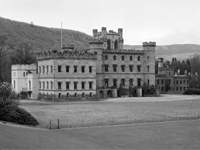
Taymouth Castle, Scotland (Image: RCAHMS)
Taymouth Castle, Scotland (Image: RCAHMS) - click for more images of interior

Queen Victoria and HRH Prince Albert enjoyed only a mini-honeymoon of three days in 1840, which was spent at Windsor Castle. The Queen, unwilling to ignore her duties and responsibilities as monarch which require frequent contact with her ministers, wished to stay close to London – even if her husband might have preferred a quieter break further away.  They did take a belated honeymoon in 1842 to Scotland where they stayed at the impressive Taymouth Castle, seat of the Marquesses of Breadalbane, owners of one of the largest estates covering 450,000-acres, which took over 40 years to build and had only recently been completed but to standard above almost any other seat in Scotland.  Designed by James Gillespie Graham, it was a convalescence home in WWII and a school but is currently unused whilst negotiations continue about turning it into a ‘seven star’ hotel.

Polesden Lacey, Surrey (Image: Matthew Beckett)

In the early part of the 20th-century, King George VI and his new bride, later the Queen Mother, stayed in 1923 with the remarkable society hostess, Mrs Ronald Greville, at her country retreat Polesden Lacey in Surrey (now National Trust).  An accomplished hostess, Mrs Greville and her staff were well used to catering for the cream of society.  Once home to Richard Brinsley Sheridan, after his death it was largely demolished and rebuilt by Thomas Cubitt in 1821 as, essentially, a neo-classical seaside villa.  After being bought by the Grevilles in 1906, she employed Mewes and Davis, architects of the Ritz, to remodel the interior.  The new opulence was matched by with an equal measure of intimacy, with rooms flowing between each other and the outside to create a fluid social space lined with portraits by Lely, Raeburn and Reynolds and cabinets full of Meissen china – a perfect venue for a Royal honeymoon.  Continuing the tradition started by Queen Victoria, they also spent time in Scotland at Glamis Castle, ancestral home of the Earls of Strathmore, and that of the future Queen Mother.

Balmoral Castle, Scotland (Image: Stuart Yeates / flickr)

On her marriage in 1947, our current monarch, Her Majesty Queen Elizabeth II, continued this practice and stayed at Broadlands in Hampshire, one of the best mid-sized Georgian houses, which largely appears to day as it was when it was finished in 1766. Elizabeth II also stayed at the family’s Scottish estates at Balmoral Castle and Birkhall, which were also destinations for the Prince and Princess of Wales in 1981 along with Birkhall which also used by Prince Edward and Sophie Wessex in 1999 and by the Prince of Wales and Camilla in 2005.

Alternatively, if they do wish to go abroad, they have the examples of the Duke and Duchess of Windsor who, in 1937, who spent three months at Castle Wasserloenburg in Austria, or Princess Anne who, in 1973, chose to spend her honeymoon cruising in the West Indies.  So, seeking peace and security, perhaps we’ll see the Duke and Duchess of Cambridge take a short break in a smaller country house before spending time in Scotland – or perhaps jetting off, but either way is in keeping with a long history of Royal honeymoons.

For sale: ‘Shurland Hall, Kent‘ [Jackson-Stops & Staff]

Thanks to Andrew for his help.
Country House Rescue: spectacular spats – Hill Place, Hampshire

Hill Place, Hampshire (Image: Historic Houses Association)

The challenges of inheritance have been a recurring theme throughout Country House Rescue.  The obvious challenges are perhaps more tangible; taking on the new house, contents, gardens and the related discoveries – for good or ill.  Yet part of the nature of inheritance is often the bequeathing of disappointment to others who expected to benefit or who disagree with the choices of the new owners.  Country House Rescue this week (17 April) visits Hill Place in Hampshire where Ruth Watson’s skills seem to be in demand to placate some disgruntled aunts rather than to simply identify business opportunities.

Hill Place is an elegant, grade-II listed Georgian villa, built in 1791 on the back of wealth made in India.  The architect is unknown but there is a beautiful simplicity to it, with each side five bays wide with a canted three-bay projection on the entrance front and a graceful three-bay bow front to the south.  The style is in the fine traditions of Sir John Soane and there are even suggestions that it may have been by the man himself.   At some stage, a mansard roof was added and then later removed, leaving an unfortunate flat roof with the stub end of the staircase still rising to a small access extension.  Overall, this is a particularly neat example of the smaller country villa which was to prove so popular at that time.  However, what is of particular interest that the current owner, Will Dobson, inherited the house due to his grandparent’s commitment to the tradition of primogeniture – that of the eldest male inheriting, which, in Will’s case, meant the bypassing of his grandparent’s four daughters, which is the cause of the strife in the programme.

The rules of inheritance in the UK have ensured that ownership of country houses, estates and contents can be passed down as a unified possession.  This has ensured a multi-generational continuity which has benefited the country by embedding a very long-term perspective to plans and that a culture of paternalism was fostered; the spirit of noblesse oblige. Ironically, in France, the Napoleonic code demands equal shares for all potential inheritors, forcing the break-up and sale of large estates, preventing the same depth of connection between the nobility and society.  Yet, for this culture to be preserved it is important that the estate is kept together – especially as it usually has to fulfil its traditional role of funding the main house.

Knighton Gorges, Isle of Wight (Image: wikipedia)

Yet inheritance has caused incredible friction for hundreds of years between those favoured by those who inherit and those who do not, leading to extreme outcomes and court cases.  One example of the former was Knighton Gorges, a manor house on the Isle of Wight, where, in 1821, the owner George Maurice Bisset had the entire ancient house demolished to ensure that his heir (his daughter or nephew – accounts vary) wouldn’t be able to cross his threshold even after his death, their having angered him through an unauthorised marriage.  In Kent, Lynsted Park was originally a huge Elizabethan E-plan house built for Sir John Roper, later Lord Teynham, in 1599, but an inheritance dispute between two Roper brothers in the 1800s led to the one living there demolishing all but the entrance porch (later Georgian additions created the current house) as he thought he would lose the case and have to give the house to his brother.

Gopsall Hall, Leicestershire (Image: Lost Heritage)

Perhaps the most famous litigation from inheritance was that surrounding William ‘the Rich’ Jennens which reputedly took nearly 120 years before the cases finished being heard and was also thought to be the inspiration for Jarndyce v Jarndyce in Charles Dickens’ Bleak House – though recent scholarly opinion now discounts that. The Jennens family had created a huge family fortune as ‘ironmasters’ in Birmingham but due to a lack of heirs and, more importantly, a will, when William died intestate in 1798, his fortune (including houses such as Gopsall Hall, Leicestershire and Acton Place, Suffolk) was passed to three distant – though very aristocratic – relatives.  This was the catalyst for a small cottage industry of claimants who all thought themselves related and therefore due a share of the inheritance.  This was partly due to a popular fad at the time for novels to feature an unexpected inheritance – though, in real life, it was usually just the lawyers who became richer.

So, inheritance can often be a mixed blessing, laden with expectations and complications.  A recent survey by Country Life magazine (6 April 2011) found that 61% of current owners were concerned that estates stay in the family – with only 25% not bothered if their heir were to sell (it would be interesting to see if there was a correlation between whether those in the latter group were also those whose family had owned for the least time).  For some, it’s particularly important to ensure that the family name is preserved. In the same Country Life article, David Fursdon, whose family have been on the Fursdon estate in Devon since 1289, highlights that after 750 years in single ownership the pressure is on to ensure that a male heir is produced to provide that continuity (though with three sons he should be OK).

Holker Hall, Cumbria (Image: andrew_j_w / flickr)

Primogeniture, or full inheritance by the eldest son, has been the rule for hundreds of years.  It was expected that all other children either had to marry or make their own fortune or living with the second son often going into the Army and the third to the clergy.  The strict rules may now be relaxing with parents choosing the child most inclined and best equipped to take on the inheritance – the Country Life article highlights how Holker Hall in Cumbria will be inherited by the middle child, Lucy Cavendish, who has moved back to the estate to learn the ropes before her parents ‘retire’ and move out in a few years time.

The challenge for families such as the Dobson’s is ensuring that the one who inherits feels they have complete ownership and is able to take decisions for the good of the house and estate without sniping from other quarters.  It is no light responsibility to be the owner of a country house and the Dobson’s should be thanked for taking on such a lovely home when others might have simply sold up and enjoyed the spoils.  Here’s hoping they can truly make a success of the house as a business to ensure that they can also pass it on to future generations.

Country House Rescue: ‘Hill Place‘ [Channel 4]

Country House Rescue: see complete previous episodes

Official website: ‘Hill Place

If a moat floats your boat: for sale; Playford Hall and Giffords Hall, Suffolk

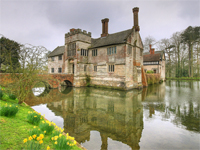
Baddesley Clinton, Warwickshire (Image: Nala Rewop / flickr)

Moated houses are an architectural short cut to a more functional time when where a family lived had to be defensible and not simply a place of relaxation.  Today, of course, we admire them for their ancient charm, the weathered bricks reflected in gently rippling waters.  These houses are an older expression of our love of the natural, which found a more formal form in the later Picturesque movement, their more organic outlines in contrast with the more rigid classicism which followed.

Though once numerous, time has taken its toll and excellent examples are less common – and especially appealing when they come to market, as two have recently. The moated manor house was a result of many factors; the decline of the traditional castle, a more peaceful society, and increased wealth, but still with a need to provide some defence against thieves and attackers.  The latter category was increasingly rare but a moat with gatehouse and even drawbridge had a practical advantage.  However, for families which wished to visually bolster the perceptions of the grandeur of their lineage, a moated house was very evocative of permanence and status, drawing on their architectural ancestry with castles.  As each manor required somewhere for the local owner to stay (sometimes only occasionally if they owned many) each had a house of varying size and status depending on the wealth of the owner.  As each manor often covered a relatively small area this led to the building of thousands of these houses (though not all with moats), particularly in England.

Groombridge Place, Kent (Image: Hans Bernhard / wikipedia)

The organic growth of a moated house often created a pleasing historical collage of styles, such as at Ightham Mote, Kent, though this was sometimes swept away to be replaced by a new house such as at Groombridge Place, also in Kent.  This beautiful house was build in 1662 though in a traditional Jacobean/Elizabethan ‘H’ plan on the footprint of the older, more fortified house – though the diarist John Evelyn thought, following his visit in August 1674, that “…a far better situation had been on the south of the wood, on a graceful ascent.” indicating not everyone found a moat romantic.

Yet not every grand family felt the need to abandon the old house.  The Lygon family (Earls Beauchamp between 1815-1979) have lived at the evocative Madresfield Court, Worcestershire for 28 generations.  At its core, a 15th-century moated manor house, the current building is largely the work of the architect Philip Hardwick in 1865 for the 6th Earl Beauchamp.  The house is a prime example of late Victorian taste; a clever blend of Anglo-Catholic Pugin gothick with extensive Arts-and-Crafts interiors including a wonderful library by C.R. Ashbee of the Cotswold Guild of Handicraft (to read more about this remarkable family and house I can recommend ‘Madresfield: the Real Brideshead‘ by Jane Mulvagh).

Ightham Mote, Kent (Image: Matthew Beckett)

The physical security of a moated house was also a factor in its decline as it limited the space available for expansion as either the family, wealth or ambition of the owner grew. Many a grand country house was constructed elsewhere to replace a smaller manor with the old house either being abandoned, demolished (sometimes for building materials), or used as a secondary or dower house.  Yet, as a harsher economic reality came to pass from the 1880s, and as these smaller houses were lauded in magazines such as Country Life, so their attractiveness grew with many rescued from neglect and sometimes reinstated as a principle house on the estate.

H. Avray Tipping, one of the most influential of the Country Life writers, was a prime supporter of the smaller houses as reflected in his choice of house for the weekly ‘Country Houses and Gardens’ section – nearly a fifth of them in 1910, for example.  This was also a time when John Ruskin was arguing for more honesty in architecture and against the over-enthusiastic renovations of the Victorians which he regarded as ‘ignorant’. This regret at the neglect of manor houses in general can be seen even in the earliest Country Life articles.  Writing in 1897 (the year it was founded), John Leyland writing about Swinford Old Manor, Oxfordshire, said;

“There are manor houses through the length and breadth of the land as charming, it may be, as this, but awaiting, like sleeping beauties, the kiss that is to arouse them to fresh and unsuspected charm, the needed touch of the loving hand invested with creative skill.”

Plumpton Place, Sussex (Image: Knight Frank)

Perhaps one of the best examples of this loving restoration can be seen at Plumpton Place, Sussex for Country Life proprietor Edward Hudson by the architect Sir Edwin Lutyens.  When Hudson bought the it in 1928 the house was semi-derelict though with an intrinsic beauty from its setting on an island in the middle of the uppermost of three lakes.  Lutyens successfully restored and adapted the house to create one of the best current examples of a moated manor house – which was also offered for sale in July 2010 for £8m (and featured in another post: ‘For those who like their houses with pedigree: Plumpton Place, Sussex‘)

So having whetted our collective appetites, those with £3.5m to spare currently have a choice of two historic moated manor houses in Suffolk; Playford Hall, near Ipswich (£3.25m), and Giffords Hall, in Wickhambrook (£3.5m).

Playford Hall, Suffolk (Image: Savills)

Playford Hall has the beauty of the warm red-brick with two wings placed off-centre, hinting at the further wing demolished in the 1750s after a devastating storm in 1721 blew holes in the roof and following a long period of dereliction from 1709 following the death of the owner, Sir Thomas Felton, who had remodelled the house in its current style.  The house then passed by marriage into the estate of the Earls of Bristol, in which it remained until sold after WWII.  The house has been restored and updated – though whoever buys it will probably want to re-do the eye-wateringly pink dining room.

Giffords Hall, Suffolk (Image: Savills)

No such concerns about the wonderful interiors of Giffords Hall – the house abounds with historic woodwork, from the masses of exposed beams to the extensive panelling.  The exterior, in contrast to Playford, is almost entirely timber-framed, with an Arts-and-Crafts style north wing added in 1908 by the owner Mr A. H. Fass who also carefully restored the house following a period of neglect.   Now cleverly brought up-to-date, in co-operation with English Heritage, the house now has a full suite of reception rooms, a new kitchen and a full quota of bathrooms.

So, proving the folly of those who allowed these romantic houses to decay and the wisdom of those who restored them – with thanks to the evangelism of Country Life – another important branch of the nation’s architectural history has been redeemed and now, once again, attracts high valuations which reflect the immediate attraction these houses can exert on us all.

—————————————————————————-

For further reading, the excellent ‘The English Manor House – from the archives of Country Life’ by Jeremy Musson – though unfortunately this appears to be out of print and surprisingly expensive. One for the second-hand bookshop search, I think.

For those looking to visit, a handy list: ‘Manors in England‘ [Britain Express]

Make a date: the strange world of the calendar house

Knole, Kent (Image: Matthew Beckett)

One of the main satisfactions of having a house built is that, as it’s your money, you get to decide the style, design, scale and detail according to your whims.  With many of the stranger flights of fancy now curtailed by cost or planning controls it’s interesting to look at earlier houses built without such restraints and, in particular, those which incorporated horological elements creating the phenomena of the ‘calendar house’; that is, where the architecture was influenced according to the number of days, weeks or months in a year.

The genesis of the calendar house appears to have been in the intellectually fertile Elizabethan period when the elite of society revelled in the advances of science,  mathematics and astronomy.  They also had a great love of the ‘device’ which in the 16th-century meant any ingenious or original shape or concept. Mark Girouard, in his excellent book ‘Elizabethan Architecture – Its Rise and Fall, 1540 – 1640‘, states that although there are precursors to the idea of an entire building as a device – which can be seen in the designs of Henry VIII’s forts and and contemporaries’ gatehouses – this was its extent.

Under the Elizabethans, this idea can be seen to grow – from gatehouses to entrance fronts to courtyards (before they disappear) and the whole house is the device.  Yet for all the intellectual attraction, the idea of the form of a house being dictated by the calendar is actually quite rare.   In fact, Girouard’s book doesn’t mention the idea at all, as technically the first house to incorporate these principles, Knole in Kent, was built in 1604 by one of her courtiers, Thomas Sackville, 1st Earl of Dorset, a year after Elizabeth I‘s death.

The principle of the calendar house is that the number of external doors, windows or panes of glass, chimneys, or staircases etc should total either 4 (the number seasons), 7 (days in a week), 12 (months in a year), or 365 (days in a year).  So in Knole’s case, the calendar is represented through the 365 rooms, 52 staircases and 7 courtyards.  It is this choice of the number of which elements that provides the variation to the theme and can lead to the creation of palaces such as Knole. It also helps explain the relative scarcity of these houses as they require a certain commitment from the owner to complete the build and not compromise on the plans for fear of spoiling the totals.

Scout Hall, Yorkshire (Image: boxfriendly / urbexforums)

One of the most compact of the calendar houses was built in 1681 – Scout Hall in Yorkshire. This wonderful house – which would give Hardwick Hall a run for its money for the phrase ‘more glass than wall’ – was built for a local silk merchant, John Mitchell, by an unknown designer and includes 365 panes of glass and 52 doors.  Considering the rarity of calendar houses, it’s interesting to consider how this concept suddenly appeared over 70 years after the first and several hundred miles north.  Perhaps Mitchell’s trade had taken him south and he had been to, or heard of, Knole.  Who knows?  What we do know is that this grade-II* house has been on the ‘buildings at risk register‘ for many years and has been derelict since the 1980s.

aberdeenshire-cairnesshouse
Cairness House, Aberdeenshire

The next appearance of a calendar house is in the far north at Cairness House in Aberdeenshire, designed by the renowned architect James Playfair and built between 1791-97 for Charles Gordon of Cairness and Buthlaw as the centrepiece of his 9,000-acre estate.  What’s particularly remarkable about the house is that it resolutely neo-classical in design – a very unlikely style to marry with such a whim.  Yet Charles Gordon had something of the Elizabethan love of the ‘device’ as the design contains numerous Masonic and pagan symbols with even the overall layout of the house making the initials ‘CH’.

Holme Eden Hall, Cumbria (Image: Smiths Gore estate agents)

It would be another forty years before the idea would be used again – this time in Cumbria in the construction of Holme Eden Hall in 1837. Built in a Tudor gothic style for a local cotton mill owner, Peter Dixon, to designs by John Dobson, a prolific local architect responsible for the remodelling of Newcastle-upon-Tyne and who worked on over one hundred country houses.  Dobson had the rare facility of being able to competently design in many styles so it’s possible that the idea of the calendar house came from the owner; this time featuring 365 panes of glass, 52 chimneys, 12 passageways, 7 entrances and 4 storeys.  The choice of the number of which elements was probably dictated by the budget as Dixon couldn’t have afforded to construct a house on the scale of Knole.  After becoming a convent, the house fell into some decay but was converted by intelligent developers who kept the theme going and created 12 apartments, each named after a month.

Balfour Castle, Isle of Shapinsay, Scotland (Image: Balfour Castle)

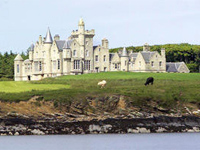
The next house appears in Scotland again; Balfour Castle on the Isle of Shapinsay. This was a remodelling of an existing house by the famous Scottish architect David Bryce, who did so much to popularise the ‘Scots Baronial’ style we now associate with the country.  The owner was David Balfour whose grandfather had originally purchased the house and estate in 1782. The Bryce alterations were completed in just two years from 1847 and the calendar theme this time produced 365 panes of glass, 52 rooms, 12 exterior doors, and 7 turrets.

Bradgate House, Leicestershire - dem. 1925 (Image: Lost Heritage)

Bradgate House, Leicestershire was built in 1854 for the extravagant George Harry Grey, the 7th Earl of Stamford, though it was only to survive 70 years before being demolished in 1925.  A gentleman sportsman with a liking for the Turf, the 7th Earl was probably inspired by the contemporary Victorian fashion of connecting families with their real (or sometimes imagined) ancestral past and building an Elizabethan style house would remind everyone that the Grey family had first been elevated to the peerage by Queen Elizabeth I.  Exactly why he chose a calendar scheme is unknown but the house included 365 windows, 52 rooms and 12 main chimneys.

The Towers, Didsbury, Lancashire (Image: Paul F Hamlyn)

Although perhaps not strictly a country seat, The Towers, in Didsbury, Lancashire was built between 1868-72 as a rural escape for the proprietor and editor of the Manchester Guardian, John Edward Taylor.  Designed by Thomas Worthington in a bold gothic style, it was reputed to have cost £50,000 to build – equivalent to around £3.3m today, and features 365 windows, 52 rooms and 12 towers.  Pevsner appears conflicted about it describing it as both ‘…grossly picturesque in red brick and red terra cotta’ but also as ‘the grandest of all Manchester mansions’.  It was subsequently purchased in 1920 for just £10,000 and became the headquarters for the British Cotton Industry Research Association and became known as the Shirley Institute, before becoming rental offices sadly surrounded by bland office blocks.

Bedstone Court, Shropshire was designed in a completely different style – mock Elizabethan – but again followed the pattern with 365 windows, 52 rooms, 12 chimneys and 7 external doors.  The house was designed for Sir Henry Ripley by Thomas Harris, and had survived largely intact despite changing from use as a home to a school, until a serious fire in 1996 severely damaged large sections of the house necessitating extensive restoration.

Avon Tyrrell, Hampshire (Image: Avon Tyrrell Activity Centre)

Avon Tyrrell, Hampshire, completed in 1891 and now grade-I listed, was, as far as is known, the last calendar house to be built in the UK and incorporates 365 windows, 52 rooms, 12 chimneys, and 7 external entrances. Designed by the distinguished Arts & Crafts architect W.R. Lethaby, a founding member of the architectural conservation charity the Society for the Protection of Ancient Buildings, he was also particularly interested in architectural theory and design, so it is likely that he would have suggested the idea of the calendar house to Lord Manners. The client was a wealthy racehorse owner who built the house on the back of his winnings from a famous bet he made in 1881, that he could buy, train and ride the winner of the 1882 Grand National – which he did.  Lord Manners donated the house to the “Youth of the Nation” and it is now an activity centre.

Considering that the idea of the calendar house was essentially Elizabethan in conception, it’s interesting to note that only one was built in that time, with the next in the late 17th-century, one in the 18th-century, but that it was the Victorians who produced the most.  Perhaps this was a reflection of their interest in time, order and structure but also a revival in the Elizabethan delight in science and challenges.  As a distinct group of houses they deserve to be better known – and in the case of Scout Hall, it deserves to be treated as a priority for rescue and restoration before it runs out of time.

—————————————————————————————–

Two other houses may also be calendar houses but I haven’t been able to reliably confirm this:

  • Kinmel Hall, north Wales – said to have 365 windows on the front elevation, 52 chimneys and 12 external doors.
  • Welcombe House, Warwickshire – now a hotel and has undergone significant alterations but is supposed to have 365 windows, 52 chimneys, 12 fireplaces and 7 entrances.

Can anyone confirm these? Thanks, Matthew

Going to the country: more country houses of UK Prime Ministers – Part 2

The first part of this series, highlighted the aristocratic background of our early Prime Ministers – Earls and Dukes abound.  This meant that a country house was just where they had been brought up and simply regarded as home rather than the aspirational purchase.  It also highlighted that the architectural tastes of the PMs reflected their political beliefs with a strong preference for the Classical, representing structure and order.

So, to continue the tour of country houses of Prime Ministers, this time those who served  under George III (1760–1820):

Luton Hoo, Bedfordshire (Image: ickle_angel/Flickr)

The first was John Stuart, 3rd Earl of Bute. Originally a man of rather limited means who only acquired great wealth following his marriage to the rich heiress, Mary Wortley Montagu. The family seat was Mount Stuart on the Isle of Bute; at the time a small Queen Anne house which burnt down in 1877 to be replaced by the Gothic palace we see today.  With his later wealth and prominence the Earl created two fine new country houses.  On his retirement as PM, he bought Luton Hoo, Bedfordshire in 1763 and in 1767 commissioned Robert Adam to create a large neoclassical mansion which, although this was never fully realised, the resulting house (now a hotel) is still sizable.  The wings are a later addition but faithful to Adam’s original conception. Ill health later forced a move to the Dorset coast and having bought a clifftop position he built High Cliff “to command the finest outlook in England.“.  Unfortunately it was a little to fine, the crumbling cliff not only necessitated the demolition of the house in the late 1790s, it also led to the Earl’s death in 1792 due to a fall whilst picking plants.

He was succeeded as PM in 1763 by George Grenville who was born, and lived, at the family seat, Wotton House, Buckinghamshire.  He is one of only nine PMs who did not become a peer on leaving office.

Wentworth Woodhouse, Yorkshire (Image: geograph.co.uk)

If there was a competition for the most impressive house of Prime Ministers then Charles Watson-Wentworth, 2nd Marquess of Rockingham would be feeling rather confident.  His family home, Wentworth Woodhouse, Yorkshire, is one of the largest private country houses in Britain with a main front extending to over 600ft. Built over a 25-year period, the house exemplifies the grand palaces which became possible in Georgian England. Faced with the usual pressures on later owners, plus vindictive coal mining, the family moved out and the house was leased as a teacher training college but since 1999 it has been the home of architect Clifford Newbold and his family who have been undertaking a massive and very impressive restoration programme.

William Pitt the Elder, 1st Earl of Chatham was brought up in great comfort from the proceeds of the sale of the Regent Diamond by his father.  As the younger son, Pitt would not inherit the family seat and so made his own way, choosing politics and becoming PM in 1766.  His country residence was the relatively modest Hayes Place in Kent, which he had built after he bought the estate in 1757.  He later sold it in 1766 to Horace Walpole who encased the house in white brick and enlarged it before selling back to Pitt in 1768 on his retirement.  The house survived until 1933 when it was demolished and houses built on the land.

Euston Hall, Suffolk (Image: David Robarts / flickr)

Another Prime Ministerial seat to suffer later loss was Euston Hall in Suffolk seat of Augustus FitzRoy, 3rd Duke of Grafton who succeeded William Pitt.  The Dukes of Grafton were very wealthy with extensive land holdings in Suffolk, Norfolk, Northamptonshire and London.  Euston Hall had been extensively remodelled by the Palladian architect Matthew Brettingham for the 2nd Duke between 1750-56.  The house suffered a devastating fire in 1902 which destroyed the south and west wings, which were subsequently rebuilt on the same plan but then demolished again by the 10th Duke in 1952.  It should also be noted that the Dukes also owned the splendid Wakefield Lodge in Northamptonshire, designed by William Kent, though it was tenanted and therefore the Dukes never lived there.

William Petty-FitzMaurice, 2nd Earl of Shelburne had the splendid fortune to be brought up in one of the finest of Georgian country houses, Bowood House in Wiltshire, which also became a scandalous loss when it was demolished in 1955/56.  Remodelled for the 1st Earl by Henry Keene between 1755-60, the house also featured interiors by Robert Adam, who also altered Keene’s original portico to create a much grander version.  Afterwards the stables were converted to function as the main house where the 9th Marquess of Lansdowne (as the Earls became) still lives today.

Welbeck Abbey, Nottinghamshire (Image: Mr Nibbler / flickr)

The next PM, William Cavendish-Bentinck, 3rd Duke of Portland inherited Welbeck Abbey, Nottinghamshire, which had also been the home of an earlier PM, his relative Thomas Pelham-Holles, 1st Duke of Newcastle.  As stated in Part 1, this is a fascinating house which has often been overlooked due to the fact that it has been rarely open to the in the last 100 years, public tours having finished in 1914. Extensive work was carried out between 1742-46 by the relatively unknown architect John James who reconstructed the south wing and remodelled the west front for Henrietta, Countess of Oxford.  The west front was subsequently changed again in 1790 to designs by Sir Humphry Repton.  The Dukes of Portland also had a southern seat at Bulstrode Park in Buckinghamshire, though this house was replaced in 1865 by the 12th Duke of Somerset who by then owned the estate.

In contrast to the vast wealth and aristocratic status of the preceeding PM, William Pitt the Younger was able to bring political heritage; his father also having served in the same role. In stark contrast to the size and splendour of Welbeck, his country home was Holwood House in Kent, a modest mansion set in 200-acres for which Pitt paid £7,000 in 1783 before commissioning Sir John Soane to alter and enlarge it in 1786 and 1795.  Soane’s work here led to Pitt recommending him for the work to build what was to be one of Soane’s masterpieces; the Bank of England building which was so sadly demolished in the 1920s.  Holwood was also to be demolished, in 1823, to be replaced by a much grander house designed by Decimus Burton.

The country houses of Henry Addington 1st Viscount Sidmouth have both largely now vanished under the sprawl that is Reading University.  Addington had a low-key record as PM and his houses were equally modest.  Although on becoming PM Addington moved into the beautiful White Lodge in Richmond, his main seat was Woodley House, Berkshire, which had been built in 1777 before being bought by Addington in 1789. At the same time, he also bought the neighbouring estate of Bulmershe Court which was then tenanted, before falling into disrepair in the 19th century leading to two-thirds of it being demolished. Woodley House was used by the Minstry of Defence during WWII but subsequent dereliction led to its demolition in 1960.

William Wyndham Grenville, 1st Lord Grenville, as well as abolishing slavery, also created one of the most elegant of the houses in this series; Dropmore House in Buckinghamshire.  Built in 1795 and designed by Samuel Wyatt (b.1737 – d.1807) with later work by Charles Heathcote Tatham (b.1772 – d.1842), it was Grenville’s refuge, describing it as ‘deep sheltered from the world’s tempestuous strife‘. The grounds were also lavished with attention with Grenville planting 2,500 trees, and creating numerous walks which took in the superb views and even going as far as to remove a hill which blocked the view to Windsor Castle.  Tragically, devastating fires in 1990 and 1997 left a ruined shell but it has been recently rebuilt as a series of luxury apartments.

The only PM to be assassinated, Spencer Perceval, never really had a country seat of his own but had grown up in Enmore Castle, Somerset though he would never inherit as he was the second son of second marriage.  Only a small section of the main house now remains after it was largely demolished in 1833, but originally Enmore, built c1779, was one of the largest houses in the county.  In later life, Perceval lived in a large house called Elm Grove on the south side of Ealing Common in London – though at the time this would have been quite a rural area but not quite enough to classify this as a true country house.

The final PM under George III was Robert Banks Jenkinson, 2nd Earl of Liverpool who again chose to live close to London, though in a country house, at Coombe House in Kingston upon Thames in Surrey.  Originally Tudor, this brick house was replaced with a Georgian mansion which was later altered by Sir John Soane, including the addition of a library.  The house survived until 1933 when it was demolished with houses now covering the site.

So although the Gothic revival movement had started in the 1740s and was the main alternative to the dominant Classical architectural style, even by the 1820s, it did not reflect the tastes of any of the Prime Ministers.  Considering the system still echoed the exclusions of the Reformation with its explicit rejection of all things ‘catholic’ (architectural, theological, political) it was unlikely to change, especially as the Catholic Emancipation Bill wasn’t passed until 1828.  Architecture was taken an expression of belief and so to favour the Gothic could potentially have given the wrong signals.

Next: Prime Ministers under George IV and William IV

List of UK Prime Ministers