‘The National Trust can have it’: why the NT can’t accept all offers

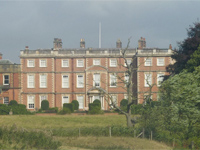
Seaton Delaval Hall, Northumberland

In an ideal world no country house would ever be at risk but poor finances, often caused by pernicious death duties, and insufficient income from the estate or investments leaves families facing the reality of being unable to stay in their ancestral home.  When this situation arises the cry has often been for the National Trust to step in and ‘save’ the house.  Yet the financial complexities of taking on a house and the responsibilities of the many others they already care for mean that it’s unlikely the National Trust would be able to unless it meets their necessarily strict conditions – a marked contrast to the rather more ad hoc approach of the early years of country house acquisitions.

The National Trust owns over 330 houses though only about half would be considered true country houses.  The first, Barrington Court, Somerset was acquired in 1907, though it wasn’t until the 1940s that the National Trust began to acquire houses in any significant numbers.  Instrumental in the early acquisitions was James Lees-Milne, the Secretary of the Country Houses Committee between 1936-51 (see also this fascinating reflection on JLM and the NT).  A complex man from a well-to-do family who got progressively poorer, but with his good looks and manners, and a certain charm, he was able to lay the ground for many of the later acquisitions through his aristocratic contacts.

The National Trust was initially focussed on the countryside with any houses being taken on as rescue missions to save them from demolition.  This changed after an impassioned speech in 1934 by Philip Kerr, Lord Lothian, who argued that our country houses were a unique and valuable heritage and worthy of being saved. Following this, the Trust established the Country Houses Committee with James Lees-Milne at the important first Secretary who set the tone for years to come.  In the early years, Lees-Milne would travel the country meeting the many owners and starting a gentle conversation leading to more hard-headed negotiations – though some would approach the NT begging for them to take their houses such were their financial straits.

For many owners faced with the dramatic social changes after the wars, and their own impoverishment, the options were fairly stark; soldier on in an increasingly dilapidated house, rent or sell to a new resident owner, sell for demolition, or hand it over to the National Trust.  For many owners who were the latest in a line stretching back over hundreds of years the latter option was often the most appealing (especially as they could often continue living there), though many chose to take the other options leading to mass demolitions, particularly in the 1930s and 1950s.  Yet, as Lees-Milne acknowledged, his own enthusiasm meant, “I have to guard against a collector’s acquisitiveness.  It isn’t always to the advantage of a property to be swallowed by our capacious, if benevolent, maw.” (Diaries, 1 June 1945).  However, it was never an easy task as the rest of his entry for that day notes, “The lengths to which I have gone, the depths which I have plumbed, the concessions which I have (once most reluctantly) granted to acquire properties for the National Trust, will not all be known by that ungrateful body.  It might be shocked by the extreme zeal of its servant if it did.  Yet I like to think that the interest of the property, or building, rather than the Trust has been my objective.“. (Amusingly he finishes with “These pious reflections came to me in the bath this morning.“)

The troubled acquisition of Barrington Court had a profound impact on how the National Trust dealt with later offers.  Merlin Waterson in ‘The National Trust – The First Hundred Years‘ highlights that even thirty years later those with fears about unexpected costs for repairs and maintenance were citing Barrington Court in evidence.  Caught between the rock of their own very high standards and the hard place of not having limitless funds, the National Trust began insisting that any house they took on came with a sufficient endowment.  This was formalised in 1968 as the ‘Chorley formula’ (after Roger Chorley who created it and later served as chairman from 1991-1995) which calculates the endowment required, taking in to account expected high-level maintenance and repairs, likely revenues, workers wages and many other factors.

Initially though this meant that a strange paradox developed whereby the NT would only be able to accept houses from wealthy owners – who were unlikely to want or need to hand them over.  However, in 1937, Parliament enabled the National Trust to make money from its properties by allowing it to accept additional property, cash or securities to provide income producing endowments.  One of the first to do so was Philip Kerr himself who, in 1941, bequeathed Blicking Hall in Norfolk along with its content, more than one hundred other houses and cottages, and over 4,700-acres of woodland.  By the end of WWII, the NT owned 23 houses including West Wycombe Park and Cliveden in Buckinghamshire, and Polesden Lacey in Surrey, each of which had come with generous endowments.

Kedleston Hall, Derbyshire

However, where owners didn’t have the money other sources had to be found, as the protracted negotiations around Kedleston Hall in Derbyshire proved.  This stunning neo-classical mansion of the Curzon family was designed by Robert Adam in the 1760s and has one of the finest collections of Chippendale furniture in the world.  Faced with crippling death duties and a need to pay the grandson a ten-percent inheritance (which he demanded regardless of the threat this posed to the house and estate), the 3rd Viscount Scarsdale opened negotiations with the Trust who determined that it would need a £6m endowment plus another £2.5m for immediate repairs.  Faced with the breakup and sale of the house and its collections, English Heritage, the National Trust, American donors, and the Curzon’s themselves all contributed. This neatly demonstrated the broad spectrum of public and private sources that now had to be called upon to meet obligations such as this – and the difficulties of marshalling such a diverse range each time an opportunity presented itself.

The Trust has been consistent in this policy even when offered fine houses such Heveningham Hall, designed by Sir Robert Taylor with interiors by Wyatt, which had been accepted by the Goverment from the Vanneck family in lieu of inheritance tax in 1970.  Without endowment the Trust refused to take ownership but were happy to manage it for five years whilst the Government found a buyer.  Conversely, when the Dryden family were looking to offload the 16th-century Canons Ashby in 1981 the newly established National Heritage Memorial Fund was able to provide the endowment to fund the family’s gift.

These cases have now formed the model for subsequent campaigns such as the impressive Tyntesfield in Somerset and recently Seaton Delaval Hall in Northumberland where a combination of grants and generous local support enabled them to raise £7m to repair and endow the property.

For many within the National Trust the thinking is now that they have enough houses – for them, current campaigns are mostly around the protection of landscape.  Yet, their obvious financial and political power means that when the need arises they are able to step up to ‘save’ a house.  However, as it is usually preferable that a house remain with the family, hopefully the careful trust arrangements many now have in place mean that increasingly they are able to stay in their home.  Perhaps more houses could have been saved if the National Trust had accepted more of those offered to it, but in reality it is difficult to see how they would have been able to fund so many, especially where the existing owners had proved just how difficult it was to stay financially afloat.  Rather than just saying ‘the National Trust can have it’ we all must be aware that it is not a simple solution and that the long-term care of our country houses requires exceptional planning and commitment – and, ideally, very deep pockets.

The National Trust’s policy on acquisitions [National Trust]
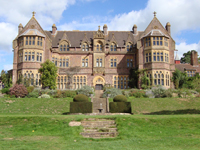
A restoration or a recreation: Knightshayes Court, Devon

Knightshayes Court, Devon (Image: Matthew Beckett)

For all the wonderful work the National Trust has done over the last hundred years saving numerous country houses from demolition, one criticism that has been levelled at it is the almost artificial atmosphere it has created inside.  A recent visit to Knightshayes Court in Devon has also highlighted an interesting series of judgements as to how far an interior should be restored, even to the point of creating a room which was planned but never executed.

Knightshayes Court sits in an elevated and enviable position above the market town of Tiverton where the Heathcoat Amory family had the factory which generated their wealth.  The family fortune was created by the Loughborough-based John Heathcoat (b.1783 – d.1861) inventor of a revolutionary industrial lace-making machine who moved to Tiverton in 1816 after all 55 machines were smashed by drunken Luddites.  A caring man, he ensured the workers were well-housed and the children educated, and the factory became the largest lace-making factory in the world, employing 1,100 workers.

Knightshayes Court, however, was built by his grandson, John Heathcoat Amory (b.1829 – d.1914), whose father had married the only daughter of John Heathcoat, and had added his father-in-laws surname on inheriting. Although politically active, being knighted in 1874, he had sufficient time to indulge the usual pastimes of the wealthy Victorian aristocrat, particularly hunting.   So why would a provincial hunting gent commission a house from an eccentric medievalist, such as William Burges?

Burges (b.1827 – d.1881) has been described by Mark Girouard as ‘one of the most Gothic of the Gothicists‘.  His spectacular remodelling of Cardiff Castle, and the creation of the fantastical Castell Coch, both for the immensely wealthy 3rd Marquess of Bute, allowed him free reign to indulge his bold and imaginative decorative schemes.  Burges worked to a relatively simple philosophy that “No rule can be deduced except the golden one; whatever looks best is best‘ which combined with his other aphorism ‘Money is only a secondary concern in the production of first rate works…There are no bargains in art‘, meant that his work was never going to be cheap.  Yet Heathcoat Amory chose him – but the suspicion is that it was his wife Henrietta who made the choice, perhaps on the back of family connections which included the 2nd Lord Carrington for whom Burges had remodelled Gayhurst in Buckinghamshire (now flats), in the late 1850s-early 1860s.

Perhaps John Heathcoat Amory had only given broad instructions as to what he wanted and had left his wife to chose the aesthetics – either way, as paymaster, Sir John would later regret not taking perhaps a closer interest in the choice of architect.   Construction of the house started in 1869 and the exterior of the house was built almost exactly to Burges’ original design, with the exception of the reduced height of the great tower and a re-orientation of the billiard room.  With the shell completed in July 1870, at a cost of £14,080 (approx. £1m today), the Architect magazine observed that for completion ‘…the actual cost will be something more.‘ – a classic in the canon of architectural understatements as Burges had reserved his most incredible work for the interior.

In 1873, Burges presented the family with a 57-page album of detailed drawings which depicted everything from floor to ceiling.  Faced with such a grand and lavish scheme the Heathcoat Amorys abandoned Burges’ scheme, apart from the stone and wood carving, and, in 1874, brought in the cheaper but very talented John Diblee Crace.  Crace was the fifth generation of architectural decorators and between 1875 and 1882 he completed the interior of the house in his own more restrained but still colourful designs. The last additions to the house were an extra floor to the service wing in 1885 and a Smoking Room in 1902.

However, in the 1930s and 1950s, when appreciation for Victorian exuberance was at its lowest, the Heathcoat Amorys retreated from the bold colour schemes, removing fireplaces, screen and bookcases and covering or repainting ceilings and walls.  So when the National Trust took over in 1973 the house was very different, and less architecturally interesting, than the one of a century earlier.  The guide book, to its credit, does an admirable job of spelling out what is original, what was originally planned, what Burges executed, what Crace did, and what the National Trust has restored – and, perhaps more controversially, has recreated.

The obvious question when deciding on restoration is what particular period you pick as the ‘authentic’ period.  The National Trust took over Kedleston Hall in Derbyshire in 1987, easily one of the finest Adam houses in the country, but by 1994 the then Lord Scarsdale was complaining that the NT had decided that anything post-1760 had to go.  This led to the emptying of rooms, the repainting of others to how they thought Adam had painted them, and the removal in the grounds of anything not thought to have been put there by the first Lord Scarsdale and Robert Adam.

This is in contrast to the principles of the Society for the Protection of Ancient Buildings (SPAB) who state: “In the architectural context “restoration” means work intended to return an old building to a perfect state. It can be the unnecessary renewal of worn features or the hypothetical reconstruction of whole or missing elements; in either case tidy reproduction is achieved at the expense of genuine but imperfect work.“[source].

The Burges Room - Knightshayes Court, Devon (Image: Britain's Finest)

So was the National Trust wrong to strip back the layers of changes?  In view of the fascinating end result and the relative rarity of Burges country houses it can be argued that this work rescued what remained and cleverly exposed the earlier work.  But whose earlier work?  The guidebook explains that most of the interior is by Crace, and it’s his work which has been restored.  Yet upstairs in ‘The Burges Room’, the National Trust took it a step further and took Burges unexecuted plan for that room and created it as it imagined it would have looked.

So is this mere architectural theme park-ism?  Perhaps as it has be made clear what has been created from scratch there is less risk of confusion, but considering how few read the guidebook in detail (or at all), the National Trust has the unenviable choice between respecting all the changes or presenting a more visually interesting house but with necessary compromises in architectural integrity. On balance, there has to be a very strong case to take such a course of action otherwise we risk seeing recreations of idealised or imagined versions of houses rather than the rich and varied buildings which have honestly adapted and changed as family homes over time.

Visitor information: ‘Knightshayes Court, Devon‘ [National Trust]

Rent a doll’s house: Gunby Hall, Lincolnshire

Gunby Hall, Lincolnshire (Image: Gardens-Guide)

Sitting on a small rise, just off the A158 on the road to Skegness in Lincolnshire sits one of the prettiest of the National Trust’s many country houses; Gunby Hall. However, unlike the others, where we can only ever dream of moving in, Gunby is currently available to rent for the bargain rate of £10,000 per year – but do remember to add an estimated £100,000 for the annual running costs.

Gunby Hall was built in 1700 (commemorated with the date on the rainwater heads) for Sir William Massingberd by an unknown architect but one who was obviously familiar with the work of Sir Christopher Wren.  Built of warm plum-red bricks the sophisticated 3-storey exterior shows the elegant use of stone dressings which elevates this grade-I listed house to being one of the finest of the smaller country houses.  Although showing stylistic links with Wren it was almost certainly by a skilled provincial imitator or local builder.  Wren designed very few country houses – Tring Park in Hertfordshire, Winslow Hall and, according to John Harris, contributed designs for Wimpole Hall in Cambridgeshire, and Houghton Hall in Norfolk – all for patrons who were somehow connected to Wren.  So unless someone discovers a link between Sir William and Sir Christopher it is likely that the local ‘architect’ had only been shown Wren’s designs.

Newby Hall, Yorkshire (Image: johnet/flickr)

When Gunby Hall was built it would have been regarded as very fashionable as Baroque style houses had only become popular in the 1680s.  Newby Hall in Yorkshire is one of the best examples and was rated as the finest house in Yorkshire when it was completed c.1690 (remember the houses we regard as the finest today in Yorkshire such as Castle Howard, Wentworth Castle, and Wentworth Woodhouse amongst others hadn’t yet been built).  In many ways, Gunby Hall and Newby Hall are architectural ‘cousins’ – closely stylistically related but distinct, particularly in size; reflecting the relative wealth of the owners .  Similarities can also be seen with other Yorkshire houses such as the earlier Ribston Hall, built in 1674, and the wonderful but now sadly demolished Wheatley Hall built in 1680, and the later Bolton Hall.

Gunby Hall was later altered c.1730 and extended in 1873 and 1900 to very successfully add a Dining Room, Servants’ Hall and Service Wing.  The later additions blend very neatly with the existing building creating the harmonious look which is so attractive today.  Gunby has long been admired with the famous poet Lord Alfred Tennyson reputedly using it as his inspiration when he wrote during one visit:

. . . an English home – gray twilight

On dewy pastures, dewy trees

Softer than sleep – all things in order stored,

A haunt of ancient peace.

The house was also admired by James Lees-Milne who described it as ‘an Augustan squire’s domain, robust, unostentatious, dignified and a little prim.’.  Lees-Milne was a regular visitor and was instrumental in not only bringing the house to the National Trust, as he did many other houses, but also saving it from outright demolition during WWII.  This terrible prospect came about in 1943 when the Air Ministry wished to extend the airfield they had built at Great Steeping only later discovering that Gunby Hall inconveniently blocked the proposed path of the longer runway.  Luckily the combined forces of James Lees-Milne and the impressively named owner, Field Marshal Sir Archibald Montgomery-Massingberd, persuaded them to re-route the runway thus saving the house.  In thanks, the family immediately made over the house to the National Trust becoming one of the few houses to be taken on during the war.

So if you fancy living in one of the prettiest stately homes in the country and don’t mind a few tourists having a look round occasionally, get in contact with the Savills Lincoln office.

More details: ‘Stately home can be yours for just £10k a year… plus another £100k for the staff‘ [This is Lincolnshire]

Property details: ‘Gunby Hall‘ [Savills]

The ‘artocracy’ expands: West Acre High House, Norfolk

West Acre High House, Norfolk (Image: Strutt & Parker)

In any age, once someone is successful they often seek the traditional status symbols – with a country house being high on the list.  For footballers it seems that the modern, bling-laden mansions are the favoured style but for an increasing number of modern artists it’s the historic houses which are finding favour.  The news that Anthony Gormley has bought West Acre High House in Norfolk adds him to a distinguished roll-call of artists who are forming what has been glibly named, the ‘artocracy’.

Artists moving to the country to help their work has a long history including  Peter Paul Rubens buying the Castle of Steen Manor House in the Netherlands in 1635 which led to some of his finest landscape paintings. West Acre High House was regarded as one of the prize estates when it came up for sale in 2008 for £9.5m with 1,000-acres.  Yet, it languished on the market despite the nearby 1,600-acre Kelling estate being sold which was listed at the same time.

West Acre High House was built in 1756 by Edward Spelman (d. 1767), a writer and translator and known eccentric, who had inherited the estate from the Barkhams.  The design raised eyebrows, particularly for that part of the world, with its novel piano nobile arrangement which was also being used around that time in the construction of Holkham Hall and Houghton Hall.  A visitor in that year, Caroline Girle, reported:

“I paid a droll visit to see an odd house, of a still odder Mr Spelman, a most strange bachelor of vaste fortune but indeed I’ll not fall in love with him.  We were introduced to him in the library where he seemed deep in study (for they say he’s really clever) sitting in a Jockey Cap in stiff white Dog’s Gloves. On seeing Mr Spelman one no longer wonders at the oddity of the edifice he has just finished.”

The house is also unusual in that the south front is 7 bays with the central 5 deeply recessed, but the north front is 13 bays due to the flanking wings being built level with the main block.  The wings were built by Anthony Hamond (b.1742 – d. 1822), a nephew of Richard Hamond who had bought the estate from Spelman in 1761.  The next major change was put in effect by Anthony’s second son, another Anthony, who, in c.1829, employed the well-known country house architect, W.J. Donthorn, who refaced the whole house in pale oatmeal Holkham brick, crenellated it and created the spectacular internal double-flight staircase.  The staircase leads to a picture gallery modelled on the one in Buckingham Palace and is formed of five perfect cubes of 18ft.

The house was bought by Henry Birkbeck in 1897 who might have inherited it having  married Anthony Hamond’s daughter in 1849 but, for reasons unknown, purchased it instead.  It remained in the Birkbeck family until the sale to Gormley, who has bought the house plus 100-acres for just £3m having had the price reduced by wanting less land and after factoring in the £1.5m cost of restoration.

Toddington Manor, Gloucestershire (Image: Images of England/Heritage Gateway)

The restoration costs may well turn out to be much higher – as Damien Hirst, another of the ‘artocrats’, has found out.  He has admitted recently that he has been affected by the recent economic turmoil and in addition to closing down his studios, he has paused the vast, £10m restoration programme he is undertaking at his equally vast country house, Toddington Manor in Gloucestershire, which he bought in 2005 for £3m.  Built in 1819-35 for Charles Hanbury-Tracy, later 1st Baron Sudeley, using his own very accomplished designs. He drew his inspiration from the Perpendicular architecture of Oxford and Pugin‘s work, to create an important Gothic-revival building at a cost of £150,000 (equivalent to £15m in today terms).  The design clearly influenced Sir Charles Barry in his design for Highclere Castle in Berkshire (built between 1838-78) and the Houses of Parliament (started in 1840) – but perhaps Barry was playing to the audience with the latter as Hanbury-Tracy was also on the committee which chose the design for the new Parliament.  After being empty for 20 years until Hirst bought it, the house was a cause for serious concern with outbreaks of dry-rot and a pressing need to replace the acres of roof.  After being saved from becoming a hotel, Hirst bought the grade-I listed house as both a home but also to eventually become a gallery for his work.

Another artist seeking the country life is Anish Kapoor who was apparently interested in taking the lease on Ashdown House in Berkshire – though it eventually went to Pete Townshend of The Who.  One of our prettiest country houses, and now owned by the National Trust, leasing it would have given him the status without the huge restoration costs.

One of the most encouraging aspects of both Gormley and Hirst’s purchases has been the willingness and ability to finance the necessary huge restoration projects.  For Hirst, this has involved covering the whole of Toddington Manor in some ‘Christo’-esque scaffolding with the expectation that the restoration will be a lifetime’s work.  Any restoration has an element of being a labour of love but, in exchange, their houses will give them status, but most importantly, a home – these are houses to be lived in, albeit on a much grander scale than most.

Property listing: ‘West Acre High House‘ [Strutt & Parker] – marked as ‘Sold’ so may not be on the website for long.

Detailed architectural listing: ‘West Acre High House‘ [British Listed Buildings]

More images: ‘Toddington Manor‘ [aerial-cam photography]

After the fire, the difficult choices: Raasay House, Scotland

Raasay House, Scotland (Image: BBC News)

When Raasay House on the Isle of Skye Raasay was largely destroyed by a huge fire in January 2009 just days before it was due to reopen following a £4m refurbishment, the locals and owners vowed to quickly rebuild the house as it was.  Fire has always been one of the major threats to our country houses and when it strikes the responses to the destruction can vary greatly – particularly in the modern era.

For many country house owners in the 16th-19th-centuries immediate rebuilding was the favoured response if funds allowed – either to re-create the original house or sometimes to build an entirely new one.  Raasay House was built in 1746 for the clan Macleod after the previous house, built in the 1500s, was deliberately burnt down in 1745 in the wave of retribution which followed the Battle of Culloden.  The house, extended in the 1870s, was run as an outdoor pursuits centre and was an important part of the economy on the Isle of Skye Raasay.  This meant the response was largely on the basis of local economics which required the house to be rebuild to support the business, apparently not for its intrinsic architectural value.  However, the Scottish grade-A listing (equivalent to the English grade-I) means that the ‘new’ Raasay will be a faithful recreation of the original house as it was before the fire.

Although country house owners have long rebuilt, the principle that the house will be strictly rebuilt exactly as it was is, in some ways, a modern response as heritage legislation requires full salvage of any architectural fragments with the presumption of restoration.  Insurance companies also pay out for recreation of the old building, not the construction of a new one.  So responses now are sometimes based on the architectural or heritage value, and sometimes due to the constraints placed on the owners.  The wishes of the owners also play an important part with some looking to recreate whilst others follow the principles of the Society for the Protection of Ancient Buildings who state:

Although no building can withstand decay, neglect and depredation entirely, neither can aesthetic judgement nor archaeological proof justify the reproduction of worn or missing parts. Only as a practical expedient on a small scale can a case for restoration be argued.

– SPAB manifesto

The 1992 fire at Windsor Castle destroyed large sections of the State Apartments including the Crimson and Green Drawing Rooms, the Queen’s Private Chapel and St George’s Hall.  It was quickly decided by the Restoration Committee (headed by Prince Philip) that many of the rooms would be restored to as close as possible their original state with only a few modern rooms and the Queen’s Private Chapel to be restored in a modern style.

However, no lesser organisation than the National Trust also has firmly followed the faithful re-creation approach, particularly following the devastating 1989 fire at Uppark, Sussex.  Although the dramatic pictures of the fire would suggest total loss, brave efforts by staff saved the majority of the contents of the house and the fire was found to have only destroyed the attic and first floors whilst severely damaging the ground floor.  It was then announced by Martin Sekers, the National Trust’s Regional Director for the Southern Region, that “We feel that enough survives to justify total restoration.”.  So how much has to survive to warrant re-creation?  A spirited public debate at the time brought forward opposing views such as that expressed by the respected architecture critic Deyan Sudjic who argued in an article in the Sunday Correspondent (17 Sept 1989) that:

“…it won’t actually be Uppark no matter how skilful the work of the 20th Century craftsman who seek to recreate it. What tourists come to see will, in fact, be a replica, one which could be said to diminish those fragments which actually are authentic…”

However, other eminent architectural historians such as Dan Cruikshank came out strongly in favour of recreation principally from the point that it provided the opportunity to re-learn old techniques and provide a model in their use.  Andor Gomme argued that a recreated Uppark would be the only appropriate way to show the rescued contents in an appropriate setting.  Gomme also highlighted that in previous cases where a house owned by the National Trust had burnt down (the incomparable Coleshill, Berkshire in 1953 and Dunsland House, Devon in 1967) the decision at the time to demolish what remained was later deeply regretted.

So for public organisations the clear preference is strongly in favour of re-creation despite the claims of the modernist and the SPAB that such an approach is to miss an opportunity or is simply fake.  Yet, for private country house owners, their long-held preference has been to simply restore as much as possible – even if just the walls were left standing.

When Knepp Castle, Sussex was gutted by fire in 1904, work started in 1905 to recreate John Nash’s original design.  Similarly after fires at Bramham Park in 1828, Duncombe Park in 1879, Stourhead in 1902, Monzie Castle in 1903 and Sledmere in 1911, the owners all worked to faithfully recreate the houses to the state as they had been.  For houses such as Lees Court in Kent which was almost completely destroyed in 1911 (scroll to last image) the house was just rebuilt using what remained of the outer walls.

So is restoration the best approach?  Although there is danger that the new work might be a poor pastiche of the earlier work, to just discard what has been salvaged and what remains and to only allow modern work would seem to be overly dogmatic.  However, it will only work if any restoration is of the highest quality to avoid any chance that what is produced is merely a lifeless reproduction.  Owners over the last 400-years when faced with a greater or lesser degree of loss have often sought to restore and to continue that tradition today is to draw on a much longer history than to rely only on the intellectual restrictions of the later purists.

Full story: ‘Fire damaged Raasay House to rise from ashes‘ [BBC News]