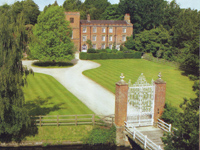
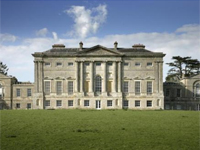
Aristocratic tenants of the National Trust; Shugborough House, Staffordshire

Shugborough Hall, Staffordshire (Image: Neilsvrx via flickr)

The news that the area of Shugborough House open to the public is to ‘double in size’ with the inclusion of the Lichfield family apartment, is a reminder of just how advantageous some of the deals were for the owners who gave their houses to the National Trust.  The Trust today is perhaps almost best known for its country houses which form an important part of its work.  However the houses were not simply museums but, due to the often very generous terms under which the families ‘gifted’ the houses, they were often able to stay on in private apartments.

When founded in 1895, the original aims of the National Trust were very much focussed on the preservation of countryside with houses only coming later. The first house the NT acquired was Barrington Court, Somerset in 1907 but the unexpectedly high cost of maintenance and repairs meant that another wasn’t acquired for over 30 years.  With the first crisis period of the country house in the 1930s, leading to many demolitions, there was a growing realisation that the National Trust was well placed to rescue some of the threatened homes.  In 1936 they set up a ‘Country House Committee’ in response to the suggestion of Philip Kerr, the 11th Marquess of Lothian at the 1934 AGM that the NT should be able to accept the gift of country houses, with endowments in land or capital, free of tax. This new regime was then given legislative powers through the National Trust Act of 1937 with Lothian then providing the first donation of one of his four great houses, Blickling Hall with its 4,760 acres, in 1940. To help guide them, Country Life magazine was asked to draw up a list of those properties (which totalled 60 larger and 600 smaller houses) which ought to be saved for the nation.

Having created the legislative backing the NT was well placed in the second period of crisis in the immediate post-war period when the tireless, if not faultless, Secretary of the Committee, James Lees-Milne, travelled up and down the country persuading owners to part with their inheritance.  He was helped by the pernicious, and still highly damaging, death duties which, since 1904 had risen from 8% (for estates valued at over £1m) to 50% by 1934, leading to massive sales of land and contents to fund the demands of the ever-grasping Exchequer.  The multiple sets of duties levelled against the aristocratic families who had sometimes lost father and then son in WWI (and who had been particularly vulnerable as they were often officers and so first over the top) meant estates were inherited by an uncle with no deep connection to a house and estate who would happily sell up.  However, for some who were loathe to simply sell, the National Trust seemed to offer an attractive alternative where someone else would pay the maintenance bills whilst they were still able to live in the house.

The degree to which the family remained in the house was sometimes simply down to how well the family had negotiated with the NT and dependent on the chips they had to bargain with.  For some such as Lord Faringdon at Buscot Park where he retains ownership of the contents, this is powerful position as the house would be severely diminished without the collection of furniture and art.  For others such as Throckmorton family at Coughton Court and the Dashwoods at the glorious West Wycombe Park, long leases (250-300 years) ensure their continued presence.  For some, the pre-eminent importance of the house gave them the edge with Sackvilles at Knole, an Elizabethan treasure-house, living in a large section of the house and still owning vital parts of the house and the entire 1000-acre parkland.  At other houses, the family remain living in the almost the whole house but with almost all the rooms open to the public such as at Anthony where the Carew-Pole family have just a small kitchen and sitting room as their own.  For others such as the Hyde-Parkers at Melford Hall they were retained by the NT as the paid administrators of their own family home which is almost completely open.  Other families like the Lucy’s at Charlecote Park have just a private wing or simply a flat in a wing such as the Drewe’s at Castle Drogo.

For the grade-I listed Shugborough House, begun in 1695, the elegant enlargement and magnificent plasterwork and decoration by James ‘Athenian’ Stuart between 1760-70, ensured that the house would always be on the list of ‘major’ houses to be saved.  When the then Lord Lichfield gave the house and 900-acre estate to the NT in 1966 in lieu of death duties the agreement regarding the house only included the state rooms on the ground floor and a small section of the first floor with the rest was leased as private apartment for the family.  The rooms to now be opened include the Boudoir with original real silver leaf wallpaper dating from 1794, and the impressive Bird room which was Lord Lichfield’s private drawing room.  The 6th Earl of Lichfield has now surrendered the lease allowing Staffordshire County Council, who run the house on behalf of the NT, to include the rest of the ground and entire upper floors.

It may seem like a strange anachronism to have the donor family still living and enjoying the family seat (although they pay rent) whilst having the National Trust pick up most of the bills for maintenance. However, the family add a rich layer of history and their commitment to the care of the houses is second-to-none with their residence helping the houses avoid the awful fate highlighted by Philip Kerr that ‘nothing is more melancholy than to visit these ancient houses after they have been turned into public museums’.

Full press release: ‘Shugborough mansion is set to double in size‘ [Shugborough Hall]

Superb post by Fugitive Ink on ‘James Lees-Milne and the National Trust‘ [fugitiveink.wordpress.com]

Thanks to Andrew for original link.

A justifiable replacement? Parkwood House, Surrey

Parkwood House, Surrey (Image: Peter Lind & Co)

There is a long tradition of replacing country houses going back hundreds of years ever since the first non-fortified mansions were built in the early Tudor period. Since 1974 when the V&A exhibition ‘The Destruction of the Country House’ did so much to highlight the hundreds which had already been lost across the UK and particularly in England the presumption has rightly been against the demolition of country houses – a position which this blog very firmly supports.  Yet to stop the replacement entirely could be seen as preventing the improvement of existing estates and seems to presume that no modern architect could match the skill of those who went before.  The case of Parkwood House in Surrey could be a useful case study in showing that replacement can be ‘creative destruction’.

Since 1800, of the nearly 1,800 English country houses which have been lost, over 150 have been replaced by a new house.  In the austere times of the post-WWII era, the new house was often smaller and easier to manage.  However, before 1930, houses which were demolished were often replaced by much larger houses to reflect the newly established status of the modern captains of industry and finance or to mark an inheritance.

Fonthill Splendens, Wiltshire (Image: RIBA)

This process of renewal could strike again and again – I think the record is held by the Fonthill estate in Wiltshire which has had seven principal houses of varying sizes including the infamous Fonthill Abbey which replaced the superb Fonthill Splendens. James Wyatt’s Fonthill Abbey is widely regarded as one of the most interesting (if ultimately unsuccessful) houses ever built in the UK – yet its creation led to the destruction of the old house.  Do we deny country house architects the ability to develop and improve just to preserve every older country house regardless of its merits?  Is it worse to stagnate estates with unsuitable (or unsightly) houses or must new houses only be built where a house has already been lost or on greenfield sites?

Parkwood House in Surrey is unlisted – and probably rightly so.  Built in the late nineteenth-century, it is, in the words of the architects of the new house “…an unremarkable and diluted essay in the ‘Old English’ or ‘Arts and Crafts’ style of the time” – but of course they would say that.  However, looking at it architecturally, there does seem little to recommend it – a rambling house, pebble-dashed, with an unexciting entrance front with an only slightly more interesting garden front.  The house is not connected with any noted architect, nor any particularly notable family (the only one of interest is the Australian 1st Baron Ballieu who was living there in the 1950s). The house then became the Rank Hovis conference and training centre with all that damage that entails during institutional conversion.

Proposed Parkwood House, Surrey (Image: Candy & Candy)

Planning permission was originally submitted in September 2007 and approved in November 2007 – a remarkably quick approval which might indicate that the planners had few qualms about the loss of the house.  In fact it might be said that Parkwood is simply a big house a countryside setting – and ‘big’ does not automatically mean it is of merit.  However, if the new house designed by the eminent Robert Adam Architects was not of such a high quality would the presumption fall on the side of retaining the old house?  The new house is an elegant essay in the use of the Palladian vocabulary to create a design which obviously provides the space and comfort that someone who would live in such a house would demand but is also architecturally interesting.  This is no mere cobbling together of a few weak ideas – this is a house which would rightly enter the list of good country houses in Surrey.  Robert Adam Architects are one of the leading practices in the country working in the Classical style and have completed other similar projects such as this house in Surrey which also replaced an earlier country house or this house in Sussex.

So if we can be confident that the new house would be high quality replacement is it justified to demolish the existing house?  In this case, as the earlier property is so unremarkable it would seem that the 91-acre estate would be better served through the keeping alive of the tradition of country house replacement – but this can only be justified where the original house is unlisted and of a poor design and the new house would be of the highest quality.  Demanding the destruction of one house to provide another has a long tradition but is a very risky path and any such application must be open closely scrutinised to ensure that we are not simply throwing away architecturally interesting houses just to build hideous ‘McMansions‘ where bigger is automatically assumed to be better.

Credit: thanks to Andrew for flagging this up.

More details and images: ‘Parkwood Estate, Surrey‘ [Candy & Candy]

More work by Robert Adam Architects: Residential portfolio

For sale for the first time in 1000 years: Shakenhurst Hall, Shropshire

Shakenhurst Hall, Shropshire (Image: Nick Edwards/Panoramio)

It has been estimated that there are approximately 2,000 large country houses in the UK with decent size estates  (over 100 acres) – but very few are still in the hands of the family which originally built them. Yet despite the many sales over the years it’s still possible for a house and land to remain with one family for many hundreds of years – though that is now coming to an end for Shakenhurst Hall in Shropshire, seat of the Meysey family for much of the last 1000 years and now on the market for the first time at £12m.

The lands were first given to a French Baron, Roger de Toeni, for his help in the conquest of Britain in 1066.  It has then passed through inheritance through various members of the Meysey family except when it passed for period to a godson in the 20th-century and then his wife, before being bequeathed to Michael Severne, a descendent of the Meyseys.  On his death in 2007 it passed to his only daughter Amanda who died of cancer in 2008 leaving the house and estate to her husband.

The grade-II listed Georgian house, built in the 1790s but with a 16th-century core, is now up for sale as it faces that age-old difficulty of an estate no longer providing sufficient income to maintain the house – and neither of their two sons are in a position to take it on.  Michael Severne had run a successful plastics business from outbuildings on the estate but with his death the business folded.  Interestingly this mirrors the challenges faced by country house owners in the 19th-century who relied also on a single source of income, agriculture, who were hit particularly hard by the 1870s depression in farm produce prices and land values.

Land has always been regarded as the most important asset (even if mortgaged) and so when faced with the choice of economising, selling land, or selling paintings or books it was usually the latter which went first.  This lead to the rise of the art sales particularly from the 1890s until the 1930s which dealers such as Joseph Duveen exploited as they extracted exquisite Old Master Italian paintings and others by the finest English artists which would then be shipped to the United States. Here a new class of exceptionally wealthy financiers and industrialists such as Hearst, Frick, Morgan, Mellon, Carnegie and Rockefeller would compete to secure the finest works of art before donating them to eponymous public galleries.

Although this did leave significantly smaller collections for some houses it did sometimes provide the finance to either diversify into investments or tide them over until agriculture recovered in the 1930s – although for some it merely delayed the more unpalatable choice of demolition which unfortunately was the outcome for hundreds of houses in the UK.  With demolition now thankfully out of the question an owner is left with few options and it can be easier to simply sell up which is what appears to be the case with Shakenhurst Hall.

Sad though it is that such a long connection is to come to an end, here’s hoping the next owner will respect the 1300-acre estate, the history and the house to create a rewarding new chapter for this elegant ‘minor’ country house.

Property details: ‘Shakenhurst Hall‘ [Savills]

PS: it’s interesting that two houses should be available which look so alike. I was struck by just how similar Shakenhurst Hall is to Peatling Parva Hall in Leicestershire which is currently on the market for £4.75m.  Interestingly the latter only took on it’s current form after alterations in 1910 after the Arts-and-Crafts architect Detmar Blow added two bays to the original house.  Was this just a coincidence of architects thinking alike or had Blow seen either Shakenhurst or something similar?

Property details: Peatling Parva Hall [Knight Frank]

Phoenix for sale: Beaurepaire House, Hampshire

Beaurepaire House, Hampshire (Image: Knight Frank)

Launched this week ( 23 June 2010) in Country Life magazine is a fine, grade-II* listed, moated manor house set in nearly 250 acres of Hampshire.  Open the first set of impressive wrought iron gates and follow the drive down to the ancient moat and through the second, equally impressive, set of white painted gates over the wooden bridge. Before you stands a beautiful red-brick manor house – but why is the house set in one small corner of the island? Why does the drive lead over the moat but unusually not to the middle of the house?  And why does that tower look a bit new?

The answer to all these questions is that Beaurepaire House, as it now stands, is what remains of an important and beautiful manor house which burnt down in 1942 after a chimney fire.    What happened subsequently is an interesting example of how disaster need not lead to the loss of the whole house or the estate.

Beaurepaire House, Hampshire before the fire (Image: Lost Heritage: England's Lost Country Houses)

Beaurepaire House has royal connections having been visited twice, once by Henry VIII in 1531 and then by his daughter Elizabeth I during her visit to The Vyne.  The moat itself dates from 1369 but the original house was built in the 16th-century but was badly damaged during the Civil War and was only rebuilt in 1777.  The design of the new Georgian ‘Gothick’ house followed the rare structure of having a square core with castellated corner turrets.  There are relatively few examples of these houses – and the ones we have today are all ruined to some degree (Ruperra Castle, Wales / Lulworth Castle, Dorset) or lost entirely (Compton Bassett House, Wiltshire).

At the time of the fire the house was owned by one of the richest men in the country, Sir Strati Ralli, but wartime building restrictions prevented restoration. After the war the estate was owned by Lady Sherfield and in 1965 she decided to restore the remaining servant’s wing as a house and commissioned the well-known architect Tom Bird, who had restored many other country houses, to make the house habitable.  Bird decided to add a sympathetic tower, which continued the existing architectural style, to the fire-damaged southern flank of the remaining wing to not only provide structure but also to improve the proportions of what was left.  The addition was less than 10% of what remained but successfully ensured that the house was able to rise again from the ashes of the fire to retain the role it had enjoyed for hundreds of years as the centrepiece to an impressive country estate.

_____________________

Property details: Knight Frank seem to have forgotten to put the details on their website.   Nevermind, here’s a link to all the Hampshire houses they’re selling in the hope that they soon add it in: Knight Frank: Hampshire

Conversion reversion? Wardour Castle, Wiltshire

Wardour Castle, Wiltshire (Image: Strutt & Parker)

With so many country houses lost in the twentieth century, almost any alternative which saved them from the demolition crew was to be welcomed; no matter how drastic.  For some this meant institutional use but for many others of all sizes the solution was conversion into flats and apartments – though with varying degrees of success.  However, as these properties come on to the market, is it perhaps time to consider converting them back into the single, glorious houses they were intended to be?

Launched this week (16 June 2010) in Country Life magazine is the principal apartment in what is considered James Paine’s finest creation; Wardour Castle, a supremely elegant essay in Palladian architecture.

Central stairwell and gallery, Wardour Castle, Wiltshire (Image: Strutt & Parker)

Built from 1770 – 76, for the eighth Lord Arundell the most impressive feature is a breath-taking central stairwell with first-floor gallery which Pevsner called ‘the most glorious Georgian interior of Wiltshire’ and which forms the core of Apartment One which is now for sale.  Wardour Castle house has proved to be adaptable becoming Cranborne Chase School in 1960 until it closed in 1990 when it was then converted into ten apartments.  As the divisions appear to have respected the natural sections of the house this seems to be a good example of where someone could convert the house back to a single home.

There are many examples of houses being rescued by conversion.  SAVE Britain’s Heritage have long campaigned to protect these houses and have worked in conjunction with one of the leading architects, Kit Martin, in supporting conversion.  A 1983 SAVE report entitled ‘The Country House: to be or not to be’, written by Kit Martin and Marcus Binney, includes particularly interesting studies of how these houses could be sensitively converted.  These show that although almost any country house could be sensitively adapted some are naturally more suitable particularly where the overall layout of the house is symmetrical, shallow and long.

The study was an important milestone in the practice of country house conversion and saved many houses from complete loss or inappropriate use including The Hazells in Bedfordshire, the grade-I Northwick Park in Gloucesterhire, Dingley Hall in Northamptonshire.  The sensitive approach they championed now means that it should be possible to consider converting a house back if the right opportunity arose.  It should be said that some houses are never going to be converted back due to a variety of factors including there being too many apartments involved such as at Thorndon Hall in Essex which contains 37 flats, or where not enough land has been retained to make the unified house valuable enough to justify reversion.

Perhaps the idea of reversion becomes more realistic where more than one part of the same house comes on the market at the same time such as recently happened with grade II*-listed Ampthill Park House, Bedfordshire.  Built by the Cambridge architect Robert Grumbold in 1687-9 and completed by John Lumley of Northampton in 1704-6, with major additions by Sir William Chambers in 1769 it is certainly one of the most impressive houses in the county. It was rescued from dereliction by conversion into just four large houses; two of which were put on the market in April 2010, the largest of which includes most of the principal rooms.

Although it’s nice to dream about these houses becoming single homes probably the biggest obstacles are not only being able to secure the other apartments but also that the value of the individual properties may be greater than the value of the unified house.  However, it’s not entirely beyond the bounds of possibility that someone with deep pockets and a desire to restore a house could take on one of these conversion reversions and recreate a superb country house.

Property details: ‘Apartment One – Wardour Castle, Wiltshire‘ [Strutt & Parker] – £2.75m

Detailed architectural description: ‘Wardour Castle, Wiltshire‘ [English Heritage: Images of England]