What goes around; the use of rotunda in UK country houses

The UK aristocracy brought back many souvenirs from their grand tours to Italy – pictures, sculpture, drawings etc – but also a delight in the architecture inspired by the ancient ruins.  This fascination manifested itself in country houses across the UK with a profusion of arches,  Serlian windows, porticos and pediments.  However, one device, despite its impressiveness, has been notable by its relative rarity; the rotunda – that grand circular space often featuring a parade of columns leading the eye up to a spectacular dome.  So why would this grand centrepiece be so infrequently used inside our country houses?

Italy - Villa Capra or 'La Rotonda' (Image: Marco Bagarella / Wikipedia)
Italy – Villa Capra or ‘La Rotonda’ (Image: Marco Bagarella / Wikipedia)

The most famous rotunda, and that which was so influential on the Anglo-Palladians, was the Pantheon in Rome.  Built in AD 124, this vast space under a 142ft diameter dome was closely studied by Andrea Palladio and became a key destination for UK architects who later travelled to Rome.  Palladio then developed the use of the rotunda as the central circulation space in his residential villas, most famously with the Villa Capra or “La Rotonda” in Vicenza, begun in 1567.

Palladio was not the first to use a rotunda in a residential setting; the artist Mantegna built his own home in Mantua in the 1470s using a layout and scale very similar to that later used at Villa Capra, using a design probably suggested by the architect-engineer Francesco di Giorgio.  Palladio then modified it and used it to great success to create what is regarded as one of his finest houses.  The rotunda would have neatly solved the challenge of the Villa Capra in that a visitor may at any front, thus negating the traditional linear plan which assumed only one main entrance.
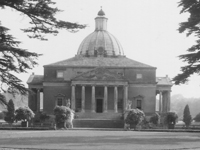
Mereworth Castle, Kent

Looking through Colen Campbell‘s ‘Vitruvius Britanicus’ – a highly regarded collection of plans and prints of the best Georgian houses published between 1715-1725 – that over the three volumes a rotunda is only used twice.  The first is in a proposed (but never executed) design for Goodwood House in Sussex for the Earls of March designed by Colen Campbell in 1724 which featured a 40ft diameter space.  The second is the 35ft diameter version which forms the dramatic central hall of Mereworth Castle in Kent.  Mereworth (built 1722-25) was one of only four Georgian houses to be built in the UK which closely followed the design of the Villa Capra; the others being Chiswick House, Middlesex (1726-29), Foots Cray Place, Kent (1754 – demolished 1949), and Nuthall Temple, Nottinghamshire (1757 – demolished 1929).

A later use of the rotunda was at the slightly eccentric Ickworth House, Suffolk. Built in 1795 and based on the designs of Mario Asprucci, an Italian architect;  it was later adapted by Francis and his brother Joseph Sandys who also oversaw construction.  This later use of the rotunda showed how it could be employed as a single dramatic centrepiece in its own right, not hidden in the centre of the house.

Central stairwell and gallery, Wardour Castle, Wiltshire (Image: Strutt & Parker)
Central stairwell and gallery, New Wardour Castle, Wiltshire (Image: Strutt & Parker)

Yet, if it was hidden, it could form a dramatic and surprising irregularity to the procession of square and rectangular rooms which often dominated houses.  One example of this is at Kedleston Hall in Derbyshire where Robert Adam was inspired by his own 1764 study of the ‘Ruins of the Palace of the Emporer Diocletian at Spalatro [Split]’ which paired the circular rotunda with a square vestibulum. Adam also later proposed to convert the courtyard at Syon Park into a huge rotunda. Perhaps one of the most impressive and beautiful expressions of the rotunda is the central staircase at New Wardour Castle in Wiltshire, designed by James Paine, and built between 1769-1776 and later described by Pevsner as ‘the most glorious Georgian interior of Wiltshire’.

So, despite its impressiveness why are most entrances and staircases so determinedly right-angled?  Simple finance can explain it in part; it would be more expensive to create a rotunda as they are more complex, require more space and also usually compromises in the floor plan to include the curvature.

Fashion can also play its part. As architectural taste moved in the Victorian era towards a preference for the gothic, so the opportunities for the use of the rotunda diminished. With its origins in the temple ruins of Classical ancient Rome, the most famous Gothic Revival architect, A.W.N. Pugin (b.1812 – d.1852) considered it part of a more pagan tradition – and therefore completely antithetical to his belief that gothic represented the only true expression of Christianity through architecture. And where Pugin led, others followed.

Or perhaps the answer is more pragmatic.  One of the primary purposes of the country house was to impress visitors.  Often a political power base, the grandest houses were designed to create an impression even before the visitor actually met the owner.  As one of the principal spaces in a house, entrance halls have often played an important role in this domestic ‘theatre’ – and the use of a rotunda requires perhaps too many compromises.

Traditionally the grand rooms where visitors would be met were often on the ground floor and would be processed through, with only the most important visitors reaching the best rooms.  Elizabethan houses changed this with the principal rooms moving to upper floors, such as at Hardwick Hall in Derbyshire, requiring more impressive staircases which, through the use of heraldic and political symbolism in the carving on balusters and handrail could make many a statement before the guest reached the required floor.

Palladian designs continued this with the preference for the piano nobile which moved the principle rooms to a raised ground floor.  The large empty wall spaces of the staircase also formed a useful space for the display of paintings including family portraits or a large selection to show the owner’s taste and style.  The staircase also provided a way to make a dramatic entrance – think ladies in their evening gowns gliding down to join the party.  Yet if a house used a rotunda it compromised both these features.  A curved wall made it difficult to hang the largest and most impressive works of art and staircases were usually spiral and tucked into the walls in the corners, meaning those coming down would only be seen when they emerged at the ground floor – which would never do.
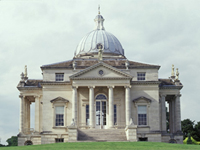
Henbury Hall, Cheshire (Image: Country Life Picture Library)

Yet, the rotunda has not died out and those with the vision and wealth can still create these dramatic spaces.  One of the most impressive has to be Henbury Hall in Cheshire, built between 1984-86 for Sebastien de Ferranti and designed by the architect Julian Bicknell from a painting by the artist Felix Kelly. A faithful recreation of Villa Capra, the dome rises to 15m with the principal rooms radiating from the central hall.  Nigel Anderson at Adam Architects also designed a replacement country house in Surrey which, according to them, is based (I’d say loosely – at least externally) on Villa Capra.  Another fine example is that at Tusmore Park in Oxfordshire, winner of the best new building in the classical tradition award from the Georgian Group in 2004 where the scagliola columns in the central rotunda are said to rival those of the imperial palaces of St Petersburg.

These examples show that, although comparatively rare, the impressive traditions of the rotunda are being continued by architects and clients determined to create the most dramatic interiors in contemporary country houses despite the compromises which have perhaps unfairly limited their use in previous centuries.
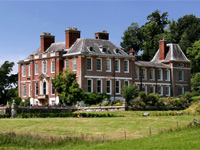
An autumn flutter: country houses currently for sale

Country houses are often launched on the market to catch either bonus money early in the year or those looking to move before the summer.  However, circumstances or owner preference can lead to some interesting houses being given a promotional push in the autumn (usually through Country Life magazine) to catch those who fancy Christmas in front a different log fire.  So, here’s a quick round-up of some of the better country houses currently for sale.

Upton Pynes, Devon (Image: Upton Pynes website)

Easily one of the most impressive houses is one that has always been a sign for me that I’m nearly home when travelling back to Devon on the train.  Just outside Exeter is the beautiful grade-II* listed Upton Pynes, which, despite the very English sounding name, bears a striking resemblance to a French chateau.  Built c.1700 by Hugh Stafford with very sympathetic later additions, this large but elegant house sits in a commanding position in the Exe Valley, perfectly positioned to catch the sun throughout the day, giving the red-brick façades a warm glow.  Described by Pevsner as “…an excellent example of the stately double-pile house that became popular after the Restoration but is relatively rare in Devon.”, the interior features a particularly grand entrance hall created as part of alterations in 1852 by the architect Ambrose Poynter for Sir Stafford Henry Northcote (later the Earl of Iddesleigh).  The main interiors of the house, including an enfilade of rooms on the south front and a notable library, largely dates from 1700.  The house also has the claim that it was the one Jane Austen had in mind when describing ‘Barton House’ in ‘Sense & Sensibility’.  The house still requires some restoration but will definitely reward whoever completes this grand project.

> More information: ‘Upton Pynes, Devon‘ £3.25m, 37-acres [Savills]

Crendle Court, Dorset (Image: Savills)

Sometimes a grand house designed by an interesting architect can remarkably remain unlisted, as is the case with the Edwardian Crendle Court in Dorset which was designed by Walter H. Brierley (b.1862 – d.1926) who has been described as ‘the Yorkshire Lutyens’.  A prolific architect, he designed over 300 buildings including schools, churches and several country houses including the elegant neo-Georgian Sion Hill Hall in Yorkshire.  Brierley was a versatile architect able to work successfully in various styles though with a preference for ‘Wrenaissance’ – a modern re-working of the architectural language of Sir Christopher Wren.  Crendle Court was built in 1909 and features elaborate ornamental plasterwork in the main reception rooms by George Bankart, and sits, well, more luxuriates, in 270-acres of grounds.  Considering the architect and the quality English Heritage ought to send someone round to evaluate and spot list it before it gets ruined by someone with more money than taste.

> More information: ‘Crendle Court, Dorset‘ £6.95m, 270-acres [Savills]

Rudby Hall, Yorkshire (Image: Carter Jonas)

Other significant houses available were launched earlier but are now being promoted following price cuts.  One such house is the grade-II* listed Rudby Hall in Yorkshire, which was originally given a guide price of £3.5m but now is offered at £2.75m.  Designed by Anthony Salvin in 1838 for the 10th Viscount Falkland, who originally called it Leven Grove, but by the late 19th-century it was known as Skutterskelfe Hall before being given its present name by the company which owned it in the 1990s.  The house was restored in the 1980s and comprises the main house but with the ancillary buildings converted into let accommodation bringing in a handy £50,000 p/a – so long as you don’t mind sharing your gardens, grounds and woodlands with them.

> More information: ‘Rudby Hall, Yorkshire‘ £2.75m, 10-acres [Carter Jonas]

Blairquhan Castle, Ayrshire, Scotland (Image: Blairquhan Castle website)

For those who fancy something more baronial, then Blairquhan Castle in Ayrshire, Scotland may be perfect.  The core of the property is a tower house built in 1346 but was later given a new front by William Burn in 1820-24 to provide the imposing if slightly stern façade we see today.  The estate was noted for it beauty with Lord Cockburn writing in 1844: “I rose early…and surveyed the beauties of Blairquhan. It deserves its usual praises. A most gentleman-like place rich in all sorts of attractions – of wood, lawn, river, gardens, hill, agriculture and pasture.”.  What more could a squire desire?

> More information: ‘Blairquhan Castle, Scotland‘ £4.85m, 670-acres [Savills]

Beaurepaire House, Hampshire (Image: Knight Frank)

Most of these houses seem to be with Savills so to even things up, and to include a house I’m surprised hasn’t sold already, is Beaurepaire in Hampshire.  The house was featured on the blog in more detail (‘Phoenix for sale: Beaurepaire House, Hampshire‘) when it was first launched in June this year.  The house is what remains after a devastating fire in 1942 destroyed the main block of the house, leaving the current service wing which was extensively refurbished and remodelled after WWII to give the elegant house which is for sale today.  Approached down a long drive, what guest couldn’t fail to be impressed by the wonderful gates designed by Sir John Soane which guard the entrance over the moat?  Sitting in a 250-acre estate, the £8m price tag is probably justified for the area – and the owner is apparently in no rush to sell so don’t expect any big price cut soon.

> More information: ‘Beaurepaire, Hampshire‘ £8m, 250-acres [Knight Frank]

Conran collects another Georgian gem: Wardour Castle, Wiltshire

Wardour Castle, Wiltshire (Image: Strutt & Parker)

The recent financial crisis has forced many properties onto the market and easily one of the grandest was the main apartment of Wardour Castle in Wiltshire which has now been bought by the fashion designer Jasper Conran.

The Apartment (as it’s imaginatively known) includes the wonderful central staircase, described by Pevsner as ‘the most glorious Georgian interior of Wiltshire’, plus the other major state rooms which were restored with the assistance of John Pawson, the high priest of Minimalism.  This particular property has featured twice in this blog, once for suggested conversion back to being a single family home, but also later with the news that the property was one of the grandest repossessions in the country.

Ven House, Somerset (Image: Mike Searle/wikipedia)

What is interesting about Conran’s purchase is that he appears to be collecting fine Georgian houses in the same way one might collect furniture or paintings.  In 2007 he bought the incredibly elegant Ven House in Somerset for just less than the £8.5m asking price. At the time the house had languished on the market for two years before Conran took it on.  Although more famous as a fashion designer, Conran has a good track record with property restoration having bought Walpole House in Chiswick, London for £7.25m which was sold following refurbishment for £12.5m in 2008 or Flemings Hall in Suffolk which he sold for £2m in 2006. Ven required comparatively little work and has remained his country home, opening it up for use by local organisations for charity fund-raisers.

It seems fashion designers have a taste for Georgian as Jasper’s father Terence Conran lives in Barton Court, an elegant red-brick villa-style house in west Berkshire which he bought in the 1970s and has carefully restored.  On a much larger scale, the American fashion designer Leon Max famously bought the magnificent Easton Neston in Northamptonshire for £15m in 2005.  The grade-I listed house, designed by Nicholas Hawksmoor and built between 1695-1710, was the home of the Hesketh-Fermor family for nearly 500-years before the current Lord Hesketh decided to sell up. Leon Max purchased the house with the intention of converting a fire-damaged wing into a base for his fashion company.

Perhaps the natural grace and light of the best of the Georgian homes appeals just as much to the aesthetic eye of the designer as it does to most of us, confirming their broad appeal.  Happily for Wardour Castle it seems that has caught the eye of someone who has a good track record of looking after the wonderful homes he has bought.  Perhaps he might be open to suggestions for others that need some attention: Melton Constable Hall perhaps?

Full story: ‘Conran captures the repossessed castle: Fashion designer Jasper snaps up £7m ‘Billy Elliot’ house – for just £2.75m‘ [Daily Mail]

Conversion reversion? Wardour Castle, Wiltshire

Wardour Castle, Wiltshire (Image: Strutt & Parker)

With so many country houses lost in the twentieth century, almost any alternative which saved them from the demolition crew was to be welcomed; no matter how drastic.  For some this meant institutional use but for many others of all sizes the solution was conversion into flats and apartments – though with varying degrees of success.  However, as these properties come on to the market, is it perhaps time to consider converting them back into the single, glorious houses they were intended to be?

Launched this week (16 June 2010) in Country Life magazine is the principal apartment in what is considered James Paine’s finest creation; Wardour Castle, a supremely elegant essay in Palladian architecture.

Central stairwell and gallery, Wardour Castle, Wiltshire (Image: Strutt & Parker)

Built from 1770 – 76, for the eighth Lord Arundell the most impressive feature is a breath-taking central stairwell with first-floor gallery which Pevsner called ‘the most glorious Georgian interior of Wiltshire’ and which forms the core of Apartment One which is now for sale.  Wardour Castle house has proved to be adaptable becoming Cranborne Chase School in 1960 until it closed in 1990 when it was then converted into ten apartments.  As the divisions appear to have respected the natural sections of the house this seems to be a good example of where someone could convert the house back to a single home.

There are many examples of houses being rescued by conversion.  SAVE Britain’s Heritage have long campaigned to protect these houses and have worked in conjunction with one of the leading architects, Kit Martin, in supporting conversion.  A 1983 SAVE report entitled ‘The Country House: to be or not to be’, written by Kit Martin and Marcus Binney, includes particularly interesting studies of how these houses could be sensitively converted.  These show that although almost any country house could be sensitively adapted some are naturally more suitable particularly where the overall layout of the house is symmetrical, shallow and long.

The study was an important milestone in the practice of country house conversion and saved many houses from complete loss or inappropriate use including The Hazells in Bedfordshire, the grade-I Northwick Park in Gloucesterhire, Dingley Hall in Northamptonshire.  The sensitive approach they championed now means that it should be possible to consider converting a house back if the right opportunity arose.  It should be said that some houses are never going to be converted back due to a variety of factors including there being too many apartments involved such as at Thorndon Hall in Essex which contains 37 flats, or where not enough land has been retained to make the unified house valuable enough to justify reversion.

Perhaps the idea of reversion becomes more realistic where more than one part of the same house comes on the market at the same time such as recently happened with grade II*-listed Ampthill Park House, Bedfordshire.  Built by the Cambridge architect Robert Grumbold in 1687-9 and completed by John Lumley of Northampton in 1704-6, with major additions by Sir William Chambers in 1769 it is certainly one of the most impressive houses in the county. It was rescued from dereliction by conversion into just four large houses; two of which were put on the market in April 2010, the largest of which includes most of the principal rooms.

Although it’s nice to dream about these houses becoming single homes probably the biggest obstacles are not only being able to secure the other apartments but also that the value of the individual properties may be greater than the value of the unified house.  However, it’s not entirely beyond the bounds of possibility that someone with deep pockets and a desire to restore a house could take on one of these conversion reversions and recreate a superb country house.

Property details: ‘Apartment One – Wardour Castle, Wiltshire‘ [Strutt & Parker] – £2.75m

Detailed architectural description: ‘Wardour Castle, Wiltshire‘ [English Heritage: Images of England]

If you thought ‘The Restoration Man’ projects a bit small-fry; try Overstone House

Overstone Hall, Northamptonshire (Image: Martin Sutton on flickr)

Although hated by Samuel Loyd who commissioned it, Overstone House is fondly remembered by the generations of girls who were taught there after it became a school.  A vast, rambling property, it was sold to an obscure evangelical religious group who lived there until a devastating fire in April 2001 destroyed the main part of the house – although Loyd might have been quite relieved.

Overstone House replaced the earlier Overstone Hall and was built in 1862 for the banker Samuel Loyd, who became Lord Overstone for services to finance.  His wife  was keen to have a property commensurate with their status and so her husband decided to rebuild on a grand scale.  However, he inexplicably picked the unknown architect William Milford Teulon (brother of the more famous Gothic revivalist Samuel Sanders Teulon) who was instructed to design with a mixture of Elizabethan and Renaissance features.  This choice led to the creation of one of the most derided houses created in the Victorian era.

Both Girouard and Pevsner were uncomplimentary with the latter describing it as ‘drearily asymmetrical’.  However, the most damning verdict  came from Samuel Loyd himself, who, in what could be regarded as a wonderfully amusing piece of architectural criticism, said:

“The New House I regret to say, is the cause of unmitigated disappointment and vexation.  It is an utter failure – We have fallen into the hands of an architect in whom incapacity is his smallest fault.  The House tho’ very large and full of pretension – has neither taste, comfort nor convenience.  I am utterly ashamed of it … the principal rooms are literally uninhabitable – I shall never fit them up … I grieve to think that I shall hand such an abortion to my successors.”

As if this wasn’t enough, Loyd’s wife died before the project was finished leaving him with this rather large problem – which he promptly ignored by going and living with his daughter at Lockinge house in Berkshire where she had become Lady Wantage. Loyd must have eventually finished it as, on his death in 1883, it passed to Lady Wantage who, along with her husband, used it regularly during the hunting season until 1901.  After her death it was tenanted until sold to become a girls school in 1929.

It remained a girls school until 1979 when the pressures of looking after such a vast pile became too much and it was eventually sold to the New Testament Church of God for £100,000 in 1980 who are the current vendors.  The devastating fire in 2001 destroyed approximately 60% of the building including all the principal rooms and the impressive carved staircase.  Parts of the grade-II listed house remained in use as an old people’s home but the rest became a concern, leading to it being added to the ‘Buildings at Risk’ register.

However, the house is now for sale as a grand project with the opportunity to create a truly palatial home – the original house contained 119 rooms totalling around 20,000 sq ft.  The local council’s preference is that it become a single house – but to do so would require someone with big ideas and very deep pockets, willing to spend at least £5-10m on restoration on top of the £1.5m to buy the house and 50-acres.  However, as the main cause of Loyd’s distress has now been destroyed, this is great opportunity for someone to perhaps create a house which might meet with greater approval.

For anyone with the necessary funds and Kevin McCloud on speed-dial, please call Robert Godfrey of Bidwells (01604 605050).

A detailed history of the house is available on the Overstone School for Girls website.

More details: ‘Property restoration project: Overstone Hall, Northampton‘ [Daily Telegraph]