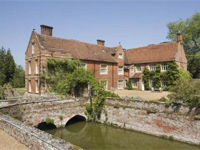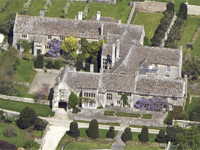
Conran collects another Georgian gem: Wardour Castle, Wiltshire

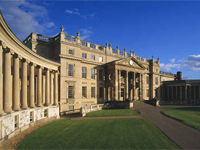
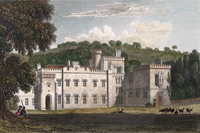
Wardour Castle, Wiltshire (Image: Strutt & Parker)

The recent financial crisis has forced many properties onto the market and easily one of the grandest was the main apartment of Wardour Castle in Wiltshire which has now been bought by the fashion designer Jasper Conran.

The Apartment (as it’s imaginatively known) includes the wonderful central staircase, described by Pevsner as ‘the most glorious Georgian interior of Wiltshire’, plus the other major state rooms which were restored with the assistance of John Pawson, the high priest of Minimalism.  This particular property has featured twice in this blog, once for suggested conversion back to being a single family home, but also later with the news that the property was one of the grandest repossessions in the country.

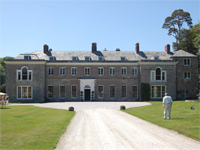
Ven House, Somerset (Image: Mike Searle/wikipedia)

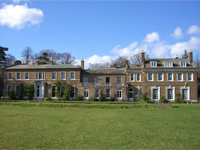
What is interesting about Conran’s purchase is that he appears to be collecting fine Georgian houses in the same way one might collect furniture or paintings.  In 2007 he bought the incredibly elegant Ven House in Somerset for just less than the £8.5m asking price. At the time the house had languished on the market for two years before Conran took it on.  Although more famous as a fashion designer, Conran has a good track record with property restoration having bought Walpole House in Chiswick, London for £7.25m which was sold following refurbishment for £12.5m in 2008 or Flemings Hall in Suffolk which he sold for £2m in 2006. Ven required comparatively little work and has remained his country home, opening it up for use by local organisations for charity fund-raisers.

It seems fashion designers have a taste for Georgian as Jasper’s father Terence Conran lives in Barton Court, an elegant red-brick villa-style house in west Berkshire which he bought in the 1970s and has carefully restored.  On a much larger scale, the American fashion designer Leon Max famously bought the magnificent Easton Neston in Northamptonshire for £15m in 2005.  The grade-I listed house, designed by Nicholas Hawksmoor and built between 1695-1710, was the home of the Hesketh-Fermor family for nearly 500-years before the current Lord Hesketh decided to sell up. Leon Max purchased the house with the intention of converting a fire-damaged wing into a base for his fashion company.

Perhaps the natural grace and light of the best of the Georgian homes appeals just as much to the aesthetic eye of the designer as it does to most of us, confirming their broad appeal.  Happily for Wardour Castle it seems that has caught the eye of someone who has a good track record of looking after the wonderful homes he has bought.  Perhaps he might be open to suggestions for others that need some attention: Melton Constable Hall perhaps?

Full story: ‘Conran captures the repossessed castle: Fashion designer Jasper snaps up £7m ‘Billy Elliot’ house – for just £2.75m‘ [Daily Mail]

After the fire, the difficult choices: Raasay House, Scotland

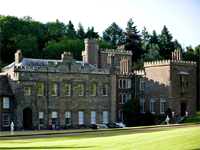
Raasay House, Scotland (Image: BBC News)

When Raasay House on the Isle of Skye Raasay was largely destroyed by a huge fire in January 2009 just days before it was due to reopen following a £4m refurbishment, the locals and owners vowed to quickly rebuild the house as it was.  Fire has always been one of the major threats to our country houses and when it strikes the responses to the destruction can vary greatly – particularly in the modern era.

For many country house owners in the 16th-19th-centuries immediate rebuilding was the favoured response if funds allowed – either to re-create the original house or sometimes to build an entirely new one.  Raasay House was built in 1746 for the clan Macleod after the previous house, built in the 1500s, was deliberately burnt down in 1745 in the wave of retribution which followed the Battle of Culloden.  The house, extended in the 1870s, was run as an outdoor pursuits centre and was an important part of the economy on the Isle of Skye Raasay.  This meant the response was largely on the basis of local economics which required the house to be rebuild to support the business, apparently not for its intrinsic architectural value.  However, the Scottish grade-A listing (equivalent to the English grade-I) means that the ‘new’ Raasay will be a faithful recreation of the original house as it was before the fire.

Although country house owners have long rebuilt, the principle that the house will be strictly rebuilt exactly as it was is, in some ways, a modern response as heritage legislation requires full salvage of any architectural fragments with the presumption of restoration.  Insurance companies also pay out for recreation of the old building, not the construction of a new one.  So responses now are sometimes based on the architectural or heritage value, and sometimes due to the constraints placed on the owners.  The wishes of the owners also play an important part with some looking to recreate whilst others follow the principles of the Society for the Protection of Ancient Buildings who state:

Although no building can withstand decay, neglect and depredation entirely, neither can aesthetic judgement nor archaeological proof justify the reproduction of worn or missing parts. Only as a practical expedient on a small scale can a case for restoration be argued.

– SPAB manifesto

The 1992 fire at Windsor Castle destroyed large sections of the State Apartments including the Crimson and Green Drawing Rooms, the Queen’s Private Chapel and St George’s Hall.  It was quickly decided by the Restoration Committee (headed by Prince Philip) that many of the rooms would be restored to as close as possible their original state with only a few modern rooms and the Queen’s Private Chapel to be restored in a modern style.

However, no lesser organisation than the National Trust also has firmly followed the faithful re-creation approach, particularly following the devastating 1989 fire at Uppark, Sussex.  Although the dramatic pictures of the fire would suggest total loss, brave efforts by staff saved the majority of the contents of the house and the fire was found to have only destroyed the attic and first floors whilst severely damaging the ground floor.  It was then announced by Martin Sekers, the National Trust’s Regional Director for the Southern Region, that “We feel that enough survives to justify total restoration.”.  So how much has to survive to warrant re-creation?  A spirited public debate at the time brought forward opposing views such as that expressed by the respected architecture critic Deyan Sudjic who argued in an article in the Sunday Correspondent (17 Sept 1989) that:

“…it won’t actually be Uppark no matter how skilful the work of the 20th Century craftsman who seek to recreate it. What tourists come to see will, in fact, be a replica, one which could be said to diminish those fragments which actually are authentic…”

However, other eminent architectural historians such as Dan Cruikshank came out strongly in favour of recreation principally from the point that it provided the opportunity to re-learn old techniques and provide a model in their use.  Andor Gomme argued that a recreated Uppark would be the only appropriate way to show the rescued contents in an appropriate setting.  Gomme also highlighted that in previous cases where a house owned by the National Trust had burnt down (the incomparable Coleshill, Berkshire in 1953 and Dunsland House, Devon in 1967) the decision at the time to demolish what remained was later deeply regretted.

So for public organisations the clear preference is strongly in favour of re-creation despite the claims of the modernist and the SPAB that such an approach is to miss an opportunity or is simply fake.  Yet, for private country house owners, their long-held preference has been to simply restore as much as possible – even if just the walls were left standing.

When Knepp Castle, Sussex was gutted by fire in 1904, work started in 1905 to recreate John Nash’s original design.  Similarly after fires at Bramham Park in 1828, Duncombe Park in 1879, Stourhead in 1902, Monzie Castle in 1903 and Sledmere in 1911, the owners all worked to faithfully recreate the houses to the state as they had been.  For houses such as Lees Court in Kent which was almost completely destroyed in 1911 (scroll to last image) the house was just rebuilt using what remained of the outer walls.

So is restoration the best approach?  Although there is danger that the new work might be a poor pastiche of the earlier work, to just discard what has been salvaged and what remains and to only allow modern work would seem to be overly dogmatic.  However, it will only work if any restoration is of the highest quality to avoid any chance that what is produced is merely a lifeless reproduction.  Owners over the last 400-years when faced with a greater or lesser degree of loss have often sought to restore and to continue that tradition today is to draw on a much longer history than to rely only on the intellectual restrictions of the later purists.

Full story: ‘Fire damaged Raasay House to rise from ashes‘ [BBC News]

History repeating: the National Trust for Scotland

Culzean Castle, Scotland (Image: StaraBlazkova/Wikipedia)

The National Trust for Scotland (NTS) is one of the largest landowners north of the border with 130 properties, including 26 castles, palaces and country houses, and over 78,000-acres. Yet like a feckless son who has inherited plenty but isn’t living up to his responsibilities and squandering his inheritance, so the NTS has been ignoring its duties and now has to face the financial reality of their mistakes – with possibly far-reaching consequences for its country houses.

For many landowners, the 1920s and 30s were a lavish time. Yet, often the land which provided the income was heavily mortgaged and although this could cover expenses it usually left little in reserve. Landowners were ranked according to their acres which led to many to over-extend themselves – leaving them vulnerable if a crisis arose. Although the First World War had had a devastating impact on the lives of many both in the big house and on the estate, for those who came through it must have seemed that life might be able to be resumed from before the war. However, life had changed and although some owners were able to see this and adapt, others refused to face financial facts leading to lavish and unsustainable overspending. This later manifested itself with the massive land and art sales of the 1930s as financial recklessness raced right up to the front door of the main house and forced out the owners.

The National Trust for Scotland (NTS) was formed in 1931, over 30 years after its southern sibling.  It now runs 130 attractions which include some of the finest country houses in Scotland such as Haddo HouseCulzean Castle, and Pollok House.  However, in marked contrast to the National Trust for England and Wales, the NTS hit a £13m financial blackhole in 2009 which led to staff redundancies, the selling of their Edinburgh HQ, and worst of all, the mothballing of various properties.  A formal, independent review of the NTS has just been published which makes it clear that they had been living in much the same way as the country house owners of the early 20th-century and now largely faces the same choices they had.

Like those dissolute owners in the 1920s and 30s who initially refused to face reality, the NTS have finally admitted that they have been living beyond its means and would now require a significant cash injection to cover its debts. For the country house owner in the 1920s and 30s they could always hope to marry an American heiress – but with this option denied to the NTS they’ll have to beg from the public.

Interestingly the NTS has also admitted that just 12 of its 130 properties are fully endowed, leaving the other attractions to have to make up the shortfall. The southern National Trust have, since 1968, used a complex calculation known as the ‘Chorley Formula’ which takes account of the probable cost of repairs and maintenance, likely revenues, wages costs etc to assess what level of endowment they would have to receive from the donor before they could agree to accept a house and has led to them rejecting many on that basis.

It seems that the NTS have abandoned this sound practice and over-extended themselves. It has also admitted it doesn’t even have a complete asset register of what properties it actually owns or a list of the necessary repairs to maintain the properties.  So like the owners of the houses who suddenly faced a dramatic downturn in the economy and their income, they are faced with some stark choices which the struggling owner in the 1930s would recognise well: sell or turn over some properties to other uses.

The owner in the 1930s also had the option to demolish or abandon a house and many hundreds were lost over the next couple of decades. Thankfully this option is not open to the NTS so what’s likely to happen? Unlike the National Trust for England and Wales, not all the Scottish properties are ‘inalienable’ meaning they could be sold.  The NTS have however said that no property of architectural significance would be – so we are unlikely to see Culzean Castle in the local estate agents window but some of the smaller country houses may be tenanted on a long term basis.  Some may also turned over to other organisations for community use – though this has a naturally detrimental impact on the fabric of the house through increased wear and tear.

The NTS has shown that, as usual, it’s the owner who’s the problem not the houses.  Even an organisation which has admittedly done much to preserve and protect country houses in Scotland over the last 80 years can become part of the problem.   Let’s hope that they take this opportunity to reform the ‘byzantine’ governance structure which has led them into this crisis and that it creates a leaner, more financially stable organisation better able to look after the country house treasures they have inherited.

More details: ‘NTS to be told: sell treasures or go bust‘ [The Scotsman]

Aristocratic tenants of the National Trust; Shugborough House, Staffordshire

Shugborough Hall, Staffordshire (Image: Neilsvrx via flickr)

The news that the area of Shugborough House open to the public is to ‘double in size’ with the inclusion of the Lichfield family apartment, is a reminder of just how advantageous some of the deals were for the owners who gave their houses to the National Trust.  The Trust today is perhaps almost best known for its country houses which form an important part of its work.  However the houses were not simply museums but, due to the often very generous terms under which the families ‘gifted’ the houses, they were often able to stay on in private apartments.

When founded in 1895, the original aims of the National Trust were very much focussed on the preservation of countryside with houses only coming later. The first house the NT acquired was Barrington Court, Somerset in 1907 but the unexpectedly high cost of maintenance and repairs meant that another wasn’t acquired for over 30 years.  With the first crisis period of the country house in the 1930s, leading to many demolitions, there was a growing realisation that the National Trust was well placed to rescue some of the threatened homes.  In 1936 they set up a ‘Country House Committee’ in response to the suggestion of Philip Kerr, the 11th Marquess of Lothian at the 1934 AGM that the NT should be able to accept the gift of country houses, with endowments in land or capital, free of tax. This new regime was then given legislative powers through the National Trust Act of 1937 with Lothian then providing the first donation of one of his four great houses, Blickling Hall with its 4,760 acres, in 1940. To help guide them, Country Life magazine was asked to draw up a list of those properties (which totalled 60 larger and 600 smaller houses) which ought to be saved for the nation.

Having created the legislative backing the NT was well placed in the second period of crisis in the immediate post-war period when the tireless, if not faultless, Secretary of the Committee, James Lees-Milne, travelled up and down the country persuading owners to part with their inheritance.  He was helped by the pernicious, and still highly damaging, death duties which, since 1904 had risen from 8% (for estates valued at over £1m) to 50% by 1934, leading to massive sales of land and contents to fund the demands of the ever-grasping Exchequer.  The multiple sets of duties levelled against the aristocratic families who had sometimes lost father and then son in WWI (and who had been particularly vulnerable as they were often officers and so first over the top) meant estates were inherited by an uncle with no deep connection to a house and estate who would happily sell up.  However, for some who were loathe to simply sell, the National Trust seemed to offer an attractive alternative where someone else would pay the maintenance bills whilst they were still able to live in the house.

The degree to which the family remained in the house was sometimes simply down to how well the family had negotiated with the NT and dependent on the chips they had to bargain with.  For some such as Lord Faringdon at Buscot Park where he retains ownership of the contents, this is powerful position as the house would be severely diminished without the collection of furniture and art.  For others such as Throckmorton family at Coughton Court and the Dashwoods at the glorious West Wycombe Park, long leases (250-300 years) ensure their continued presence.  For some, the pre-eminent importance of the house gave them the edge with Sackvilles at Knole, an Elizabethan treasure-house, living in a large section of the house and still owning vital parts of the house and the entire 1000-acre parkland.  At other houses, the family remain living in the almost the whole house but with almost all the rooms open to the public such as at Anthony where the Carew-Pole family have just a small kitchen and sitting room as their own.  For others such as the Hyde-Parkers at Melford Hall they were retained by the NT as the paid administrators of their own family home which is almost completely open.  Other families like the Lucy’s at Charlecote Park have just a private wing or simply a flat in a wing such as the Drewe’s at Castle Drogo.

For the grade-I listed Shugborough House, begun in 1695, the elegant enlargement and magnificent plasterwork and decoration by James ‘Athenian’ Stuart between 1760-70, ensured that the house would always be on the list of ‘major’ houses to be saved.  When the then Lord Lichfield gave the house and 900-acre estate to the NT in 1966 in lieu of death duties the agreement regarding the house only included the state rooms on the ground floor and a small section of the first floor with the rest was leased as private apartment for the family.  The rooms to now be opened include the Boudoir with original real silver leaf wallpaper dating from 1794, and the impressive Bird room which was Lord Lichfield’s private drawing room.  The 6th Earl of Lichfield has now surrendered the lease allowing Staffordshire County Council, who run the house on behalf of the NT, to include the rest of the ground and entire upper floors.

It may seem like a strange anachronism to have the donor family still living and enjoying the family seat (although they pay rent) whilst having the National Trust pick up most of the bills for maintenance. However, the family add a rich layer of history and their commitment to the care of the houses is second-to-none with their residence helping the houses avoid the awful fate highlighted by Philip Kerr that ‘nothing is more melancholy than to visit these ancient houses after they have been turned into public museums’.

Full press release: ‘Shugborough mansion is set to double in size‘ [Shugborough Hall]

Superb post by Fugitive Ink on ‘James Lees-Milne and the National Trust‘ [fugitiveink.wordpress.com]

Thanks to Andrew for original link.

The danger of interpretation: Abbotsford House, Scotland

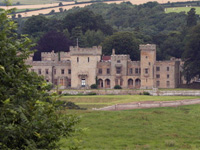
Abbortsford House, Scotland (Image: The Scotsman)
Abbotsford House, Scotland (Image: The Scotsman)

For Abbotsford House in Scotland, home of the famous author Sir Walter Scott, the recent news that it was to receive a £4.85m Heritage Lottery Fund grant is the sort of news which should be welcomed as that level of funding can usually remedy any necessary maintenance or repairs.  However, the grant is not actually to be spent on the house (despite headlines such as ‘Lottery cash means Walter Scott’s beloved Abbotsford will get £10m facelift‘ [The Scotsman]) but mainly on a new, separate visitors centre.

Sir Walter Scott (b.1771 – d.1832) played a key part creating a literary context for the developing Picturesque movement which sought to reject the rigid formality of the Georgians and create a more organic architecture, which he developed in the construction of his own house.

The theory of the Picturesque raised the importance of how one ‘felt’ about a scene or view – a definite break with the austere, ‘correct’ classicism which so dominated.  The exploration of more fluid forms had started in the 1750s and had been adopted by such noted figures as Sir Horace Walpole for his own house at Strawberry Hill in Surrey.  However it was a local Surrey parson, the Rev. William Gilpin, whose guidebooks were to lead the way for those who came afterwards such as Herefordshire squires Sir Uvedale Price and Richard Payne Knight who had the funds to realise these ideas.

Inspired in part by the idealised landscapes of the artists Nicholas Poussin or Claude Lorrain, architects sought to provide an almost ‘arcadian’ vision of buildings integrating naturally with an environment, forcing them to think of the building and environment as a whole rather than simply viewing their particular work in isolation. This also affected the plan of the house, with rooms now being aligned along the best viewing lines rather than simply lined up. One architect who took on this new style was John Nash who met Uvedale Price in about 1790 during Nash’s time in Wales.  Price was at the time building a small summer house and Nash, after meeting him, proposed a typical villa – a design antithetical to Price’s own philosophy.  Price instead guided Nash to design a new house where rooms followed views, and the overall design echoed its rocky coastal location; as he wrote ”The form of it is extremely varied from my having obliged him [Nash] to turn the rooms to different aspects‘.  Castle House, sadly demolished in 1897, was a watershed in the rejection of the dominant Georgian style and Nash quickly developed new designs based on these radical principles which became his distinctive ‘cottage orne‘ style.

Sir Walter Scott didn’t set out to link literature and architecture – in fact his ‘Waverley’ novels were simply a quick way to make some money after financial difficulties.  The books, which he initially wrote anonymously, were the first truly successful historical fiction, and brought Scott considerable wealth and, once his authorship was known, praise.  It was this wealth that enabled him to set about creating his ideal house.  Raised in the Scottish borders he had a close affinity for the natural landscape and so the Picturesque style would have appealed.  However, Scott ensured the existing designs for Abbotsford House had a distinctly Scottish twist, creating what is known today as the ‘Scots Baronial’ style so closely associated with our romantic notions of Scotland today.

Scott bought a small farmhouse in 1811 and engaged William Atkinson (b.c1774 – d.1839) who, between 1814-24, created the house we see today.  Atkinson was not considered one of the best ‘Gothick’ architects, with Howard Colvin thinking that his designs lacked the elegant charm of the 18th-century work and the scholarly accuracy of the 19th-century.  However at Abbotsford, the architectural vocabulary he employed – steeply pitched slate roofs, turrets, bartizans, and crowstepped gables – became the standard language of Scots country houses for anyone not following the Classical style.

So Abbotsford House is an architectural genesis – the first of it’s kind.  It seems a shame to lavish millions on a separate interpretation centre in a modern design which will only compete with the existing architecture of the house and estate.  It’s also a competition the new building is unlikely to win.  Perhaps it would be better for the money to be spent on sensitively incorporating the displays and materials from Scott’s life and work into the home he so lovingly and thoughtfully created.

More details: ‘Lottery cash means Walter Scott’s beloved Abbotsford will get £10m facelift‘ [The Scotsman]

Official website: ‘Abbotsford House

Background: the Picturesque movement [Wikipedia]

What may come? Ireland’s country house property crash

Bellamont Forest, Ireland (Image: Knight Frank)

One side effect of the exceptionally buoyant Irish property market which made areas of Dublin as expensive as central London was a similar rise in value of their country houses.  Now with the drastic drop in property values, Irish country houses have proven to be far from immune and offer a useful indicator of what might happen in a similar situation on this side of the Irish sea.

The country house market in Ireland truly rode the boom when property became a sure-fire route to riches in the republic.  Houses which had been neglected for many years were suddenly ‘discovered’, bought and lavishly refurbished as private houses for the newly wealthy.  This is actually unsurprising as a key aspiration for anyone acquiring riches over the last 400 years has been to establish themselves in a rural domain.  Owning land was the route to power since time immemorial with greater acreage giving greater influence.  Despite the breaking of that link in the UK between 1870 and 1920 (and most decisively with the passing of the Lords Reform Bill of 1911) the idea of the country estate as the acme of achievement had become embedded as the ultimate status symbol.  Therefore any boom in the economy has usually led to a rush to the country.

Ireland’s situation was slightly different in that, unlike in the UK with it’s stricter planning laws, the purchase of a country house was also viewed with residential development potential in mind. For those projects which completed this meant that the house was simply a means to an end leaving fine houses stranded in the middle of a new suburb (many of which are now half-empty) thus ruining a perfectly good house. This also meant that some houses were bought with over-inflated ‘development value’ built into the price.

So now the crash has hit, what has happened to the houses?  For those owners who were simply in the family home and managed to sell a few acres for development they have ‘won’ as they still have their house and estate but also gained money to sustain the estate and complete much needed restoration and improvements.  For others who didn’t capitalise there must be a certain disappointment as they’ve gone from lying in bed thinking about how the house is now worth ten times what it was a few years ago, back to lying awake wondering how to pay the bills again.

Worse though are those who paid hyped prices and now are stuck either with a home they may have paid for but which is now worth much less than they paid for it – country houses prices can race ahead of the trend in a bull market but can easily do the same when it falls.  On a positive note, for those owners who can afford to, they are likely to stay longer than otherwise they might, providing stable ownership and perhaps a commitment to invest in the estate to sustain what value they can.  For those who bought on finance or who now lack the funds to meet the running costs they may now be forced to sell at a loss.  Declines of 30-50% aren’t unheard of, even for the very best properties.  The Lyons Demesne, one of the finest estates in Ireland and former home of Tony Ryan, founder of Ryanair, is currently for sale with 600-acres at €50m, down from its former valuation of €80m.  Even on the less stratospheric level, Bellamont Forest, the first Palladian house in Ireland (and ridiculously beautiful) was initially marketed at €10m but is now offered at €7.5m.

So what could happen over here?  UK country houses prices, certainly for the best properties, have risen dramatically over the last 10-20 years.  However, that rise has been on the back of a broader boom in the economy which, despite some aspects turning out to be smoke and mirrors, did actually generate real money. In addition, the commodity value of UK farmland which has risen from £2,000 per acre to around £7,000 per acre has also provided a stronger capital base for the estates.  The natural British caution does have its advantages.

The dangers are where owners are left with over-priced houses unable to meets the cost of maintenance and there is the risk that basic tasks are put off leaving the houses at risk from any number of ailments such as water ingress due to blocked gutters.  Unfortunately government austerity means that at a time when local councils need to be most vigilant they are going to be less likely to fund the necessary heritage conservation staff.

Country houses are never immune from the challenges of the wider economy but they can also be insulated if the owner has the resources to weather the storm.  Luckily for the UK, many owners are in a strong position but there is always the danger that the over-excited may get carried away and over-pay leading to problems if the property market weakens. The situation in Ireland should be watched as a useful case study in the dangers of an over-heated market.

Full story: Crash-landed gentry [ft.com]

In need of resuscitation: Firbeck Hall, Yorkshire

Firbeck Hall, Yorkshire (Image: Paul Eggleston/English Heritage)

Some houses languish for years slowly deteriorating, much to the annoyance of interested locals who care about their architectural heritage.  For some houses, the obstacle in the way can sometimes be a difficult owner, for others it’s just the sheer scale of the job. Certainly falling into the latter category is Firbeck Hall near Rotherham in South Yorkshire; once palatial home, then a country club, a hospital, and now a cause for serious concern.

Firbeck Hall was originally built in 1594 for William West, a wealthy lawyer who was also connected between 1580 to 1594 to Gilbert Talbot, 7th Earl of Shrewsbury.  After his death in 1598 it passed through various branches of the family via inheritance until bought by Henry Gally in the late 18th-century.  It was his son, Henry Gally-Knight, who, in 1820, substantially remodelled and extended Firbeck in the Elizabethan style we see today. Sold in the mid-19th-century it passed through the Ecclesiastical Commissioners who sold it to Mrs Miles of Bristol who left it to the Jebb family who remained there until 1909 when it was put up for sale.  The early 20th-century was a particularly hard time for country house owners with falling rental and agricultural income affecting all landowners but particularly those caring for the architectural extravagances of previous owners.

Firbeck Hall was badly damaged by fire in 1924 but it’s fortunes improved when it was eventually sold in 1934 to businessman Cyril Nicholson who invested £80,000 (approx £4m – 2008 values) who created the premier country club in the nation, visited by royalty and celebrities.  World War II put an end to the gilded lifestyle and it became a hospital in 1943, a role it was to fulfil until c.1990 when it eventually closed.

Firbeck Hall, Yorkshire (Image: Rookinella @ Pretty Vacant)

Since then the house has deteriorated significantly – despite it’s grade-II listing it has suffered from lead theft from the roofs, neglect, and a series of failed plans to rescue what is still one of the largest houses in the area with over 200 rooms.  It’s this last fact which is the root cause of the difficulties with any plans for conversion and restoration requiring significant financial resources which banks are unwilling to provide in these tough economic times.  Too large for private solutions, the house is also probably too large for our stretched national heritage organisations to take on (such as English Heritage did with Apethorpe Hall, Northamptonshire) – especially as the institutional use has degraded the interior.

The house was bought by a local construction firm in 1996 but little seemed to happen apart from further thefts and vandalism and with little reaction initially from Rotherham Council and active interest from a local conservation group, the ‘Friends of Firbeck Hall‘. However, a major theft in 2005 prompted a complete change of heart from the owner who forged links with a new conservation officer leading to new plans for conversion, active security and some remedial restoration works.  Although progress was slow, at least it was progress – until July 2009 when a fire broke out during works on the roof causing serious damage.  More bad news followed when the construction firm went into liquidation in May 2010 – joining the ranks of developers with grand plans who have been beaten by the scale of the task, as seen at Gwrych Castle in Wales.

There does seem to be a gap in the provision of solutions for larger houses where private initiatives are insufficient.  A more active local conservation department may have slowed the decay in the early stages but the longer houses of this size continue to be unused the greater the cost of restoration, reducing the chances that they can be saved.  Hopefully there is some hope for Firbeck Hall as the house was sold again in July 2010 – but as yet there’s no news as to future plans, or more importantly, how they will be financed.

Campaign group: ‘Friends of Firbeck Hall

Detailed architectural description: ‘Firbeck Hall, Yorkshire‘ [Heritage Gateway]

Cash in the attic: Chatsworth House sale

Chatsworth House, Derbyshire (Image: Rob Rendell/Wikipedia)

Usually during times of economic hardship all areas of life suffer as disposable income is held rather than spent.  However, paradoxically the art market is currently on something of a high which has produced record prices at recent auctions.  For the country house owner faced with ever higher bills there has rarely been a better time to re-evaluate collections and contents and see if they too can raise some much needed funds or, as in the case of Chatsworth House in Derbyshire, to make space.

The Dukes of Devonshire have always enjoyed a privileged position as one of the UK’s premier aristocratic families.  Their fortune was set with the four advantageous marriages of Bess of Hardwick (b. 1527 – d. 1608) following the early deaths of her rich husbands. OF particular note was her second husband, the 6th Duke of Devonshire, who in 1811 had inherited not only the title but eight major houses and estates including Chatsworth, Hardwick Hall (now National Trust), Devonshire House in London (demolished 1924), Chiswick House (now English Heritage), Lismore Castle (still owned by the Devonshires) and Bolton Abbey (owned by Devonshire family trust), Burlington House (now the Royal Academy of Arts), and Londesborough Hall in Yorkshire (demolished in 1819), totalling some 200,000 acres.  Chatsworth was considered her principal seat and has been for the Devonshire family ever since.  This meant that when earlier economically austere times led to the selling of other family properties such as Chiswick House and Devonshire House in London the contents of these houses were largely packed up and brought back to Chatsworth.

The current, 12th, Duke has now decided to follow the recently well-trodden path of the asset-rich aristocracy and clear out some of the accumulated contents of the storage areas and raise some welcome capital which will be ploughed back into the running of the estate.  The 20,000 items include a rare William Kent mantelpiece which is expected to go for around £300,000.  Recently up to £100m of art has been sold including an earlier sale by the Duke of Devonshire for £10m of a bronze statue, Ugolino Imprisoned with his Sons and Grandsons (around 1549), by Leonardo’s nephew Pierino da Vincia, a record-breaking Turner watercolour, Modern Rome—Campo Vaccino, from the Earl of Rosebury which made £29.7m, a 1.3-metre long, 81kg wine cooler from the Marquis of Lothian, a variety of works including a Rubens from Earl Spencer, and other sales by the Earl of Wemyss and March, the Earl of Jersey, and Lord Northbrook.

Whilst the current situation continues with rising costs not being met by investment income or from the revenue from opening up houses and estates it’s likely that we will continue to see a steady trickle of art flowing from the galleries of our stately homes into the private collections of the billionaires currently willing to pay record-breaking prices for the finest works.  Although this is in some respects regrettable, as long as the money is spent on the restoration and maintenance of our wonderful country houses then there is little cause for concern.  However, once the attics are empty or all the ‘non-core’ pictures have been sold then we may need to be worried as to what will be sold next. The worst outcome would be to have houses without estates or that we have a fine collection of stately homes in which visitor’s footsteps merely echo around empty state rooms.

More about the Chatsworth sale: ‘Chatsworth’s ‘lost’ treasures up for sale‘ [BBC News]

More about recent art sales: ‘Who is behind the great stately home art sell-off‘ [The Art Newspaper]

How to get depressed quickly: the English Heritage Buildings at Risk Register 2010

Winstanley Hall, Lancashire (Image: English Heritage)

This blog has highlighted several country houses which are at risk but the true scale of the issue is unfortunately much larger, as the publication of the 2010 English Heritage Buildings at Risk Register shows.

Country houses all too easily can move from being secure, watertight buildings to having minor problems to becoming seriously at risk due to their size and the high standards required to repair them necessarily making even simple tasks much more expensive.  For the owners this can mean that the burden of looking after their ancestral family home becomes a daily challenge which, rather than facing, can be easier to ignore – especially if they are able to simply shut the door to a wing and forget the damp and leaks.

One of the greatest enemies of the country house is obscurity – particularly when combined with negligent or incapable owners. For some the house is merely an obstacle to redevelopment and so it is in their interest to forgo maintenance and hope that the house quickly and quietly deteriorates to the point where they can apply for permission to demolish.  Unfortunately under-resourced councils are rarely able to regularly survey all the listed buildings in the area meaning that houses can slip through the cracks.  The current economic climate means that it is even more unlikely that councils will be able to fully fund the heritage teams to ensure that they are able to ensure owners meet their obligations.

Melton Constable Hall, Norfolk (Image: English Heritage)

Although English Heritage have had some limited successes (e.g. Sockburn Hall, County Durham) there are still far too many houses at risk – I counted nearly 100 in a couple of searches.  It should be noted that houses are included even where works are planned or under way such as at Clarendon House, Wiltshire which was recently sold (with estate) for a reputed £30m and where restoration is expected to be completed by the end of 2010).  However, other examples include:

Others on the list include:

The head of English Heritage, Simon Thurley, said at the launch:

“Neglect is a slow, insidious process whose costly damage takes time to become clearly visible. Cuts in both private and public spending are currently inevitable but armed with our Heritage at Risk Register, English Heritage is well-equipped to guard against the loss of the nation’s greatest treasures and to suggest effective and economical strategies to protect our national heritage.”

One can only hope that this proves to be the case and that EH are able to fully fulfil their role particularly in relation to country houses and ensure that these beautiful buildings aren’t allowed to quietly slip into dereliction, depriving future generations of wonder of these grand houses.

More details: English Heritage Buildings at Risk 2010 or you can search the 2010 Register

For those who like their houses with pedigree: Plumpton Place, Sussex

Plumpton Place, Sussex (Image: Knight Frank)

One of the greatest of the UK’s country house architects was Sir Edwin Lutyens – a man with undoubted talent who was also able to use thoroughly modern techniques of collaboration and media exposure to boost his career and win business.  His main media connection was the tireless promotion of his work by Country Life magazine which was, in no small part, due to his close friendship with the founder and editor Edward Hudson.  So when Hudson needed to restore and modernise a manor house he’d bought it was inevitable who he would call on.   Plumpton Place in Sussex is now considered to be one of Lutyens’ best country houses and it’s for sale.

Lutyens (b. 1869 – d. 1944) was a master at the creation of houses which evoked what many would have in their minds as the ‘ideal’ country house.  He was able to marry the romanticism of the Arts & Crafts movement to his own clear ideas as to how a house should look both inside and out.  A strong proponent of using local materials he, more importantly, was able to use them in innovative ways which made his houses distinctive.

Marsh Court, Hampshire (Image: Clicks_1000 @ flickr)

A classic example of this was his use of chalk at Marsh Court in Hampshire which gave this house a brilliant white appearance, and which contrasted with small tiles of knapped flint set into the walls and the red-brick chimneys.  Marsh Court (finished in 1904 and for sale in 2007 for around £13m) was the last of Lutyens’ ‘Tudor’ style houses but it would never be considered an old house – again showing his genius of matching local materials with an assured architectural design.

Much of Lutyens’ fame can be attributed to the unstinting support he received from Edward Hudson who had cleverly exploited the growing urban middle-classes interest in a nostalgic view of ‘olde’ England and the country lifestyle.  Founded in 1897 it chronicled not only the best of the grand old country seats but also sought to keep the tradition alive at a time when the lifestyle was beginning to come under threat. One of his writers was the renowned garden designer Gertrude Jekyll who had met Lutyens in 1889 and had collaborated with him to create some of the best regarded house-and-garden compositions in the country.  Jeykll introduced Lutyens to Edward Hudson in 1899 thus creating a life-long friendship between the two.  To Hudson, Lutyens’ ability to create these idealistic visions of country life were the perfect material for his magazine.  Coupled with the extensive use of their distinctive, high-quality black & white photos it provided an unrivalled opportunity for Lutyens to built fame with the middle-classes but also advertise his talents to the aspirational wealthy or the existing gentry.

Hudson was a man to put his money where his magazine was and commissioned Lutyens to work on three houses; Deanery Gardens, Lindisfarne Castle and Plumpton Place – all now considered to be Lutyens’ best work.  Hudson had bought Plumpton, a derelict, moated manor house, in 1928 for £3,300, to be used as a weekend retreat and a place to entertain.  In some ways Lutyens’ work there was a surprising contrast to the grand Classical-style banks and corporate work he was engaged with in London and elsewhere.  Lutyens created a new route to the house which used a theatrical sense of surprise to hide the house except for glimpses through arches and trees.  Inside the most notable addition was that of a music room with huge, almost mullioned, windows with small panes of glasses set into wooden frames rather than the then fashionable steel, flooding the room with light.

The house was bought in 1983 for £800,000 by an American venture capitalist called Tom Perkins who has since lavished ‘millions’ on careful restoration.   So if you have £8m, this is a rare opportunity to live in a genuine Lutyens masterpiece which has played its own part in shaping our national impression as to what a country house should look like.

Property details: ‘Plumpton Place, Sussex‘ [Knight Frank]