HS2 Northern Extensions, Part 1 – Birmingham to Leeds: good for some, bad for others

One of the major UK infrastructure projects of the next 20-30 years, assuming it gets the go-ahead, will be the construction of the long-awaited High-Speed 2 (HS2) railway line, linking London with some of the major cities of the North.  Any construction project on this scale was always going to upset someone, and the initial route for the first phase managed to rile not just those in the towns and cities but also those who care about the rural areas and our wonderful country houses, which faced being blighted by the new trains rushing through their once peaceful idylls.  With the announcement of the route of the next sections beyond Birmingham, have the planners learnt their lessons?

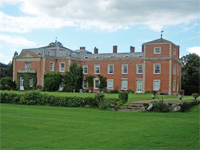
Edgcote House, Northamptonshire (Image: Bacab) - threatened by the initial London-Birmingham plan with a serious visual impact, the route was moved in the final announcement
Edgcote House, Northamptonshire (Image: Bacab) – threatened by the initial London-Birmingham plan with a serious visual impact, the route was moved in the final announcement

There are undoubted merits in encouraging the use of greener transport options such as rail over other forms such as cars or planes. However, by their nature, high-speed trains rely on longer straight stretches and the easiest way to achieve this is by picking the most efficient route.  The particular challenge arises when that route involves beautiful countryside and an adverse impact on some of our finest country houses – and it was always going to cause a row.  An initial examination of the route in an earlier post (‘The price of progress: country houses and the High Speed 2 rail project‘) highlighted how surprisingly damaging some of the route choices had been.  When the final announcement came, although not perfect, the route was much improved and had mitigated many of the earlier concerns (‘The axe falls: route of High Speed 2 rail line announced‘).

The good news is that the route for the new HS2 Birmingham to Leeds route shows a greater sensitivity than was shown in the first phase and, after skirting past the sites of the long-vanished Hams Hall (dem. 1920) and Willesley Hall (dem. 1953), it wisely follows existing major roads, minimising the blight to areas already affected.

However, there are a number of houses which are significantly affected as the line moves north and the meanderings of the road network are ironed out into straighter lines for the high-speed trains.  One of the first is the smaller Grade-II* manor house of Pooley Hall, on the edge of Polesworth, as the line cuts to the south of the motorway it takes it within a hundred metres, sacrificed to save the Pooley Fields country park.
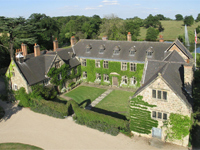
Langley Priory, Derbyshire (Image: Langley Priory)

The first significant country house to be affected is the attractive Grade-II* Langley Priory, near Diseworth, with the line cutting a rather dramatic slash through their 500-acre parkland, barely 200-metres to the west of  the main house.  Even the addition of a significant railway cutting, the close proximity of the house will inevitably have an adverse impact on what is currently a secluded and rural estate.  This will be an interesting test case for the generosity of the compensation scheme and how tightly it draws its boundaries and criteria for deciding the level of awards.

Further north, the line slices off the tail end of the western parkland at Thrumpton Hall, a wonderful Jacobean house with links to the Gunpowder Plot, which is the family home of the writer Miranda Seymour.  The house itself faces north and with the line passing nearly a kilometre to the west, the effect on this house should be minimal – and if one was to worry about existing blights, look south-west and the rather dramatic bulk of the Ratcliffe Soar power station dominates the skyline.

As HS2 emerges from Long Eaton, the route thankfully passes far to the west of the spectacular Wollaton Hall, but nearby, two smaller country houses which have so far escaped the ravaging pressures of urban development will now be drastically affected by this new development.  The first is Trowell Hall, originally built as a rectory in 1846 in a Jacobean Revival style, possibly by the architect Thomas Chambers Hine, it was then sold to a racehorse breeder in 1927.  It later became a dormitory for the workers at the M1 service station before again becoming a private home.  The new line will pass within 500-metres, though a high embankment may mitigate some of the effects. (Listing description: Trowell Hall, Nottinghamshire)

Strelley Hall, Nottinghamshire (Image: Strelley Hall website)

For Strelley Hall, a rather elegant smaller manor house, tucked away next to the local church, and now used as serviced offices, the route lines up almost straight past their back door but will dive into a tunnel just over the road.  Unfortunately for them, it appears that their newly built B&B business lies directly in the path of the new ‘cut & cover’ tunnel and so will have to be demolished.  Hopefully, once the work is over, and the trees and other planting have taken effect, the disturbance from the trains should be lessened but the disruption during the construction will be significant, especially with the loss of the B&B business.

The line now weaves a path through the outer edges of Nottingham passing far to the west of the impressive former home of Lord Byron, Newstead Abbey, but a bit closer to that long ‘At Risk’ country house, Annesley Hall, though still far enough to not be a concern.
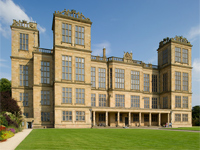
Hardwick Hall, Derbyshire (Image: Xavier de Jauréguiberry via flickr)

The next section sees a routing decision which seems highly likely to be motivated by a desire to protect a country house.  Considering the scale of the project it would have to be a special house and it is; the line switches from the east side of the M1 [PDF] to continue on the west side, thus avoiding the need to go near the wonder that is Hardwick Hall, the incredible Grade-I listed seat of Bess of Hardwick, and which was famously immortalised in rhyme as ‘Hardwick Hall, more window than wall‘ (Pevsner preferred that version). Now owned by the National Trust, they must be relieved the planners have not chosen to pick a battle with them (unlike with parts of the first phase of HS2).

The line now heads out past the forlorn but still discernible grandeur of Sutton Scarsdale before nipping between the village of Renishaw and the railway line, thankfully preserving the parkland to the west of Renishaw Hall, seat of the famous Sitwell family and portrayed so beautifully by John Piper. After Sheffield, the village of Thorpe Hesley perhaps forces the line to the west, conveniently taking it further from the breathtaking Wentworth Woodhouse.  The last section up to the final destination of Leeds, skirts the various large towns, diving into green spaces and across parkland, such as at Methley, where if the grand Methley Hall had not been demolished in 1963, it might now look out on the final junction for the new HS2 Birmingham to Leeds branch.

All in all, the planners have seemingly learnt the lessons from their initial bruising encounters and have sought to find a route which deals more sensitively with the natural and built environment which already exists.  There are inevitably some houses which will be adversely affected and wherever possible this should be challenged to ensure that each intrusion can be fully justified, and where sustained, that appropriate compensation is paid.

This is just the first of the extensions to be examined; we will see shortly if the Birmingham to Manchester route holds any further threats to our country houses.

————————————————————

Source for route: ‘HS2 phase two initial preferred route plan and profile maps‘ [Department for Transport/HS2 Limited]

The Country House Revealed – Wentworth Woodhouse, Yorkshire

Wentworth Woodhouse, Yorkshire - east front (Image: dykwia / flickr)
Wentworth Woodhouse, Yorkshire – east front (Image: dykwia / flickr)

If asked to name the largest and grandest country houses in Britain, many would list obvious candidates; Chatsworth, Belvoir, Castle Howard, Petworth, but few would name Wentworth Woodhouse in Yorkshire, the house featured in the next episode of Dan Cruickshank’s ‘The Country House Revealed‘ [Tuesday 31 May – 21:00 – BBC2]. One of the largest private homes in Europe, this leviathan slowly slipped into obscurity since family feuds and a vindictive Socialist minister caused the house to decline from being the greatest to being neglected.  Now, after ten years of hard work by the current owner, the house makes its first steps back towards the public stage – but is the price of the resurrection perhaps too high?

Wentworth Woodhouse - west front (Image: Matthew Beckett)

One of the triumphs of Wentworth Woodhouse is that the design of the house is coherent and powerful despite its size – extending to 606ft from tower-to-tower, to create the longest front in the country*.  Yet, the house is also one of two sides, the grand Classical east front, and the earlier, Baroque west front.  To have a house of such contrasting styles might indicate very separate plans of construction, yet a plan of proposed works dating from before 1725 and possibly as early as 1716, shows that the Earls Fitzwilliam had every intention to build on such a scale, with just the design itself changing.  The west side, the luxurious, decorated Baroque face, was raised between 1724-28 was long thought to be to a design by Ralph Tunnicliffe, a local architect who had worked on Wortley Hall and Calke Abbey, Derbyshire (1722). Yet, his work bears more familiarity with the Classical east front – so who designed the first stage?

Beningbrough Hall, Yorkshire (Image: nickrick90 / flickr)

Richard Hewlings in an article in Country Life magazine (17 February 2010) makes a solid case for the work being by the very well-regarded York architect, William Thornton (b. c.1670 – d.1721), who had previously worked on the joinery at Castle Howard, and designed Beningborough Hall. The latter of these (according to Colvin) showed a familiarity with Roman Baroque architecture as shown in Rossi’s ‘Studio d’architecttura civile‘ (pub. 1702-21).  Hewlings argues that because Beningbrough can be attributed to Thornton and that the same Rossi-inspired architectural elements can be seen in both houses, it makes Thornton (having definitely owned a copy of Rossi) the one most likely to have designed Wentworth Woodhouse – with his early death contributing towards his obscurity.

Wanstead House III, Essex - proposed design by Colen Campbell as shown in 'Vitruvius Britannicus'

So Tunnicliffe designed the east front. Well, mostly. His 1734 design can very clearly be seen as derived from that most important of Palladian houses, Wanstead House, in Essex (built 1715 – dem. 1822).  The original architect of Wanstead, Colen Campbell, produced three designs (known as I, II, and III) which drew on the form of Castle Howard but stripped of much of the architectural verbosity which so offended the more austere Palladians. This design was to form the backbone for several generations of large country houses particularly in the boom years of the 1730s and -40s.  Yet, even though work started in 1731, in 1735 the Earl of Malton thought it best to have Tunnicliffe’s design reviewed by a greater authority, that of Lord Burlington, the ‘chief’ Palladian.  This proved timely as Tunnicliffe died in 1736 and so responsibility passed to Henry Flitcroft, a Burlington protege.  Flitcroft’s external alterations were relatively minor; adding pedestals to the portico columns, changing the shape of the attic windows, (he also provided designs for several rooms) but his engagement there was to last until work finished in 1770.

One obvious question is just why the house was so large? Beyond the usual demonstration of the scale of the family’s wealth and status, the house also had to be of such a size to accommodate the vast entertainments which the Watson-Wentworth’s needed to hold occasionally as part of their seduction of such a large and sparsely populated county.  Up to a 1,000 locals – nobles, gentry and simple gentleman alike – might be invited, with each given a ticket indicating which room they were to go to (and, by implication, their social status).  Another, seemingly more petty, reason was that Lord Malton’s father had inherited the estate in 1695; much to the shock and annoyance of another (politically opposed) relative, Thomas Wentworth, who lived nearby at Stainborough.  He responded by enlarging his own seat, Wentworth Castle (now a sadly much altered training college), in a grand style, ensuring that Lord Malton couldn’t be seen to ‘lose’.

The Marble Hall, Wentworth Woodhouse (Image: (c) Country Life Picture Library)

One of the most breath-taking aspects of this need to impress are the interiors; boasting 25 ‘fine’ rooms of the highest quality, whereas by comparison, Buckingham Palace has 20 of a similar standard, Blenheim around eight, Castle Howard perhaps three or four.  These rooms are centred around the glorious central Marble Hall; 60ft square, 40ft high, with rooms leading off to the left and right including the Great Dining Room, the Van Dyck Room, the State Dressing Room and the Long Gallery.

That the Fitzwilliam family no longer live in Wentworth Woodhouse is one of the great sadnesses of the many families forced from their ancestral homes.   At one point this grand house boasted some of the finest furniture, a priceless collection of art including statues  and many paintings by such artists as Van Dyck, Reynolds, Mytens, Hoppner, Lawrence, Claude Lorraine, and a major collection of Stubbs’s work.  Yet, for all the wealth and power, it was founded on primogeniture and coal – both of which undermined the house in their own way.

The births of previous Earls Fitzwilliam had usually taken place in Wentworth Woodhouse and had been witnessed.  However the birth of the 7th Earl in the 1890s took place in the wilds of Canada for reasons which have never been fully explained, leading to members of the family levelling allegations that a settlers son had been swapped at birth for the daughter the Countess was thought to have really given birth to.  This eventually led to a split in the family as to where the title and the vast inheritance should descend.  With primogeniture determining it must go to the eldest legitimate male heir, this was only settled with a court case in 1952 between two brothers.  The ‘winner’ was the younger son who subsequently married an older lady, and therefore never producing an heir. On his death in 1979, the long title of the Earls Fitzwilliam died out – though not before the last Earl had a huge bonfire of 16 tonnes of family papers to permanently cloak their history.  The estate is now held by Lady Juliet Tadgell nee Wentworth-Fitzwilliam with the family still owning 80,000-acres of Yorkshire and 50,000-acres of Cambridgeshire – and the art collection.

Mining at Wentworth Woodhouse (house circled)

It was the coal that physically undermined the house – both above ground and below. The post-war Socialist government was determined to break-up what it saw as the privileged elite.  One particularly bigoted ideologue was Manny Shinwell, then the Minister for Fuel and Power, decided that as part of his campaign of class warfare he would mine the coal under the park and house – even when told it was low-grade and not worth the effort.  He also ignored the pleas of the local miners and their representatives who had always enjoyed excellent relations with the Fitzwilliams who were widely regarded as one of the best mine owners in the country.  Shinwell’s workers destroyed the park which the miners had enjoyed for years and also dumped the spoil to within yards of the house.  Rather than live there the family moved out – though not before securing the use of the house as a teacher training college which no doubt saved the house from demolition.

However, the mining might yet save the house – though the proposed solution contains considerable risk.  Part of the mining deep underground left a column to support the house – but it wasn’t large enough leading to subsidence which has caused parts of the house to sink by up to 3ft. The house was bought for just £1.5m (£7 per sq ft!) by London architect Clifford Newbold in 1999 and he and his family have spent the last decade carefully restoring the house in conjunction with the conservation architects Purcell Triton Miller and engineers Arup.  Now the family are ready to launch legal action to secure £100m in compensation for the negligent mining under the house.  Using this money, they will obtain further funding to develop the huge stables (built by John Carr in 1768) as office space and also “...two new contemporary buildings that replace the former college accommodation and will support the Stables office building through provision of further office accommodation. These sunken ‘green roofed’ buildings will be designed so that they do not have any detrimental visual impact on the open spaces of the landscape of Wentworth Woodhouse.” (from the official press release).  This can be understood and can be supported so long as the commitment to the minimise the impact to the estate (which is now just 90-acres) is successful.

What gives some concern are the plans for the main house as a “…publicly accessible restored museum to the central and grandest rooms, as well as a 70 suite luxury hotel and spa to the remainder.“. This will necessarily have a significant impact on the structure of the house – and I’m not convinced it’s the entirely right plan.  This house should be the Chatsworth of Yorkshire – a grand house, filled with art and life – and though the plans for the museum will be put into action, there is no word as to whether the rooms will be furnished?  If so, by who?  Will the V&A have an outpost? Perhaps I miss the idea of a family living there, using these rooms – though where to find a family able to take on such a monumental task? Just imagine if the Fitzwilliams had been able to move back in? I do wish the Newbold family every possible success but only if the plans respect the history and importance of the house and it’s not just used as an architectural prop for a multi-use residential, hotel and office space development.

———————————————————————

* – that it was the longest was the subject of an amusing bet in 1750 between Sir John Bland of Kippax Park and Lord Rockingham (as the Watson-Wentworths had now become) as to whose house was longest – Sir John lost by just 6ft.  Kippax Park was later demolished and the area open-cast mined.

Many more images of the house, grounds and stables can be seen in the Country Life Picture Library: ‘Wentworth Woodhouse‘ [countrylifeimages]

More about the house and estate: ‘Wentworth Woodhouse‘ [wikipedia]

Official website: ‘The Country House Revealed‘ [BBC2]

More about life in Wentworth Woodhouse: Part 1 and Part 2 [countryhousereader]

Local news report: ‘Wentworth Woodhouse: Newbold family bagged mansion for just £1.5m‘ [thestar]

New Series: The Country House Revealed – South Wraxall Manor, Wiltshire

South Wraxall Manor, Wiltshire (Image: Traumahawk / flickr)

In contrast to the weekly dramas of Country House Rescue, a new series starting on the BBC, presented by the excitable Dan Cruickshank, looks at some of the finest homes in ‘The Country House Revealed – A Secret History of the British Ancestral Home‘.  The series promises a look behind the estate wall at some homes which have never been open to the public, giving us a rare chance to glimpse houses which enjoy secure, well-funded ownership and demonstrating that the fears of those who thought these houses would never be sustainable have been thankfully proved wrong.

The first in the series (broadcast 10 May on BBC2 at 21:00) visits South Wraxall Manor in Wiltshire; a house which matches a beautiful exterior with impressive interiors dominated by some of the finest chimneypieces and period rooms in the country.  The house was originally built for Robert Long who made a fortune in cloth in the early 15th-century before becoming an MP in 1433, around which time it is thought the core of the house was started.  As was befitting a rich MP, he was keen to show his status and as was often the case with the gentry, his home was the main platform with which to show off his wealth and erudition, creating one of the finest houses in the country today.

England, at the time work started at South Wraxall Manor, was feeling the influence of the Italian Renaissance and elements of the new fashions were often incorporated into the best homes, though often adapted for our native traditions and styles.  This use of wider influences was also a symptom of the gradual shift in power as major building projects were increasingly commissioned by wealthy gentry rather than the Church or Royal Court.  Maurice Howard also highlights that although the Court was highly competitive which might have led to a single architectural style being favoured, in fact, the houses we still have show how tenacious local styles were.

Chimneypiece c.1600, South Wraxall Manor (Image: (c) Nicholas Cooper)

This continuation of the vernacular can be seen in the architectural vocabulary used by those commissioning the houses, drawing still strongly on ecclesiastical traditions.  Reading the full listing description for South Wraxall one might almost believe it to be a local church or monastery – windows with Perpendicular tracery, buttresses, even gargoyles.  The house was significantly remodelled around 1600, creating what John Julius Norwich calls ‘one of the major Jacobean rooms in all England‘.  A vast west window floods the room with light and is matched by one at the other end of the room, providing the illumination to highlight a most impressive fireplaces – a colossal, florid statement of importance.

Each generation of the Long family added to the house, with additional wings and chimneypieces, and extending the estate.  As with other such early houses which have survived subsequent centuries without ‘modernisation’, this was due to a small element of luck in that it was inherited by a branch of the Long family in 1814 who were already well established at Rood Ashton House, Wiltshire (largely demolished c.1950) meaning the house was often rented out.  The house let between 1820-26 and served time as a boys school, before the 1st Viscount Long took over c.1880 following his election as a local MP.  Viscount Long undid much of the damage caused during its time as a school when the linenfold panelling had been painted over and the ornate ceilings plastered over, however he never really took up residence there.  The house was let for the rest of the 19th-century and the early 20th, before the 2nd Viscount Long moved in in 1935.  Used to house refugees in WWII, the family again lived there before finally selling up in 1966, ending over 500-years of family ownership.

South Wraxall then entered a rather uncertain period, until it was bought by a businessman with plans to turn it into a country house hotel but who had some issues with the local planning authority over unauthorised changes (for example, I think he glassed in the loggia without permission).  The house was up for sale again in 2003 for £6.5m after the businessman abandoned his plans.  After languishing on the market for a couple of years – probably due to the extent of the restoration required – it was bought by the current owners: John Taylor (bass player with the band Duran Duran) and his wife Gela Nash (founder of the fashion house Juicy Couture) who apparently have done an excellent and sympathetic job of the repairs, thus rescuing a house that is a quintessential example of an English manor house.

Full listing description: ‘South Wraxall Manor‘ [British Listed Buildings]

Further information: ‘South Wraxall Manor‘ [Wikipedia]

Book of the series: ‘The Country House Revealed‘ [Waterstones]

Rest of the series

This looks to be a fascinating set of programmes – for reference the other houses featured are:

Ripples of Palladio: Forcett Hall, Yorkshire for sale

Forcett Hall, Yorkshire (Image: GSC Chartered Surveyors)

For those of us who love our country houses, the weekly delight of the new Country Life magazine are the many pages of houses for sale.  Although the space is usually dominated by the major players such as Knight Frank, Savills etc, a particular joy is when you discover, tucked away with a smaller agent, an especially good house which deserves to be better known.

One recent house which falls neatly into this category is Forcett Hall, near Richmond in North Yorkshire.  Grade-I listed, this house forms part of the spread northwards of the fashionable ideas of Lord Burlington and the Palladians. ‘Palladianism’ (as it became known) formed a new movement and became the dominant architectural taste from around 1710 until around 1750 but which is still very popular and influential today.

The Palladians were largely influenced by the work of the Italian architect Andrea Palladio (b.1508 – d.1580) whose work, particularly around Vicenza, drew heavily on the ancient classical form of Roman architecture.  The ideas were spread to Britain initially through the work of Inigo Jones, a multi-talented theatrical designer to the Court who also became the Royal Surveyor of Works which gave him the platform to spread the ideas of Italian Renaissance architectural classicism to these shores, starting with the Queen’s House in Greenwich, London.

Wanstead House, Essex

Key to the spread of these new ideas were two books, volumes 1 & 2 of ‘Vitruvius Britannicus‘, which took the form of a folio of one hundred classical buildings, published by the architect Colen Campbell.  Campbell also created one of the most important buildings of early Palladianism, Wanstead House in Essex, (dem. 1824) which re-interpreted the form of Vanbrugh‘s Baroque Castle Howard but in a new, more austere architectural language.  This was then followed by Wilbury House, Wiltshire, designed and built in 1710 by William Benson who succeeded Sir Christopher Wren as Surveyor of Works.  Wanstead inspired several derivatives in the years following its completion including Moor Park, Hertfordshire (1720s by Thornhill and Leoni), Wentworth Woodhouse, Yorkshire (alterations of 1733 by Flitcroft), Nostell Priory, Yorkshire (1733 by Paine) and Prior Park, Wiltshire (1735 by John Wood I).

Chiswick House, Middlesex (Image: curry15 / flickr)

Richard Boyle (b.1694 – d.1753), the 3rd Lord Burlington and 4th Earl of Cork, played a  significant role in firmly establishing Palladianism as a movement through his own influence, patronage and his circle of followers.  Burlington employed Colen Campbell to remodel his London house (taking over the work started by his rival James Gibbs) but Burlington was also a skilled architect, building the beautiful Chiswick House, in west London, in 1729, not so much as a home (it contains only state rooms) but as an architectural statement of his new principles.

One of Burlington’s protégés who assisted him as clerk of works on some of his earlier projects was Daniel Garrett (b.? – d.1753).  A measure of his competency can be seen in a letter sent in 1737 by Sir Thomas Robinson to Lord Carlisle regarding proposed works to complete the Mausoleum at Castle Howard:

“My Lord Burlington has a much better opinion of Mr Garrett’s knowledge and judgement than of Mr Flitcroft’s or any person whatever, except Mr [William] Kent…”

Stanwick Park, Yorkshire - dem. 1923 (Image: Lost Heritage)

However, despite his skill, Garrett was dismissed from his role in the Office of Works in 1737 for ‘not attending his duty’.  This was probably related to his absences caused by his own growing architectural practice in the north of England.  In 1735 he was remodelling Wallington Hall, Northumberland for Sir Walter Blackett, in 1736 he was at Castle Howard, and in 1737 he was working for Lord Derby, and between 1739-40 working for Sir Hugh Smithson, Bart, (later 1st Duke of Northumberland) on the rebuilding of Stanwick Park, Yorkshire (sadly demolished in 1923). He was later to work at other distinguished houses including Raby Castle in Co. Durham, Warwick Castle, Northumberland House in London (dem. 1874), Horton House in Northamptonshire (dem. 1936), Uppark in Sussex, Kippax Park in Yorkshire (dem. 1956-59) and most notably Foots Cray Place in Kent (dem. 1950).

This gives a measure of Garrett’s skill and his client list.  It was following his work at Stanwick that he started work at Forcett Hall in 1740 – though there does seem to be some debate as to what he did.  A list at Alnwick Castle says that the house is by ‘Mr Garrett for Mr Shuttleworth’, the latter being Richard Shuttleworth, the local MP who commissioned the house, whose family owned the estate between 1582-1785.  Although the estate agents state that the design of the house can be attributed to him as a rebuild following a fire in 1726, Howard Colvin thought him an unoriginal architect but skilled in providing handsome houses and instead only gives him a now demolished part of the east wing, the lodges and park entrance, the ceiling of the saloon (copied from the dining room at Chiswick House), and the grotto.

Forcett Hall, Yorkshire - as drawn by Samuel Buck

So if he didn’t design the main block, here’s an alternative theory; the house wasn’t completely burnt down in 1726 but was just seriously damaged, and Garrett gave a Palladian flavour to the house as part of the restoration.  The south front of the original house was drawn by Samuel Buck in his usual technically flawed idiosyncratic style (see right).  This is the same view in the picture of the house at the top of the post but the current house lacks the projecting wings but it does share the exact same form of three storeys over a semi-sunken basement.  Looking at the main house now (there’s an excellent picture on flickr: Forcett Hall – and also see the paintings in the comments), it could be argued that the elements of Palladianism – Ionic pilasters, quoins, external staircase have merely been applied to the house rather than forming a fundamental part of the design.  By excavating the semi-sunken basement (note the level of the lawn to the left), Garrett creates not only the appearance of a piano nobile, but also creates the space to add the staircase which is also in a typical Palladian style (and appears to be a modified form of the one at Stourhead as shown in ‘Vitruvius Britannicus) – but which seems to be an addition rather than a focus.  Elements such as the pilasters with their Scamozzi Ionic capitals almost seem to be copied from the entrance front of Marble Hill House in Twickenham (built 1724-29 by Roger Morris). Conversely, the north (entrance) front of Forcett is almost a different house; looking far more like an Italian villa than a Yorkshire country house (and I’m sure I recognise it from somewhere…).  Or perhaps I’m completely wrong and it is a new house, the design of which exposed the limitations of the architect.

This is a fascinating house, well worthy of it’s grade-I listing, though the photos on flickr show it’s in need of some care and restoration to fully bring out the beauty of this wonderful house.  The interior boasts some fine plasterwork and the house is set in a perfect small park which includes a 17-acre lake, no public footpaths and a grotto.  If someone is looking for a house with privacy but also a history to be explored there are few better houses available.

Property details: ‘Forcett Hall‘ [GSC Chartered Surveyors] – comes with over 230-acres, guide price £5.5m.

Property brochure [PDF]: ‘Forcett Hall‘ [GSC Chartered Surveyors]

——————————————————————————

British and Irish Stately Homes blog – more property for sale

This is also a good point to highlight another blog you should find interesting.  British and Irish Stately Homes is written by Andrew who is a frequent contributor to the comments in this parish.   Featuring houses for sale, TV programmes involving country houses, books on the topic plus much more it covers some more of the areas I just don’t have time to!  Do bookmark it, subscribe and let Andrew know if you spot anything you think ought to be added.

Going to the country: more country houses of UK Prime Ministers – Part 2

The first part of this series, highlighted the aristocratic background of our early Prime Ministers – Earls and Dukes abound.  This meant that a country house was just where they had been brought up and simply regarded as home rather than the aspirational purchase.  It also highlighted that the architectural tastes of the PMs reflected their political beliefs with a strong preference for the Classical, representing structure and order.

So, to continue the tour of country houses of Prime Ministers, this time those who served  under George III (1760–1820):

Luton Hoo, Bedfordshire (Image: ickle_angel/Flickr)

The first was John Stuart, 3rd Earl of Bute. Originally a man of rather limited means who only acquired great wealth following his marriage to the rich heiress, Mary Wortley Montagu. The family seat was Mount Stuart on the Isle of Bute; at the time a small Queen Anne house which burnt down in 1877 to be replaced by the Gothic palace we see today.  With his later wealth and prominence the Earl created two fine new country houses.  On his retirement as PM, he bought Luton Hoo, Bedfordshire in 1763 and in 1767 commissioned Robert Adam to create a large neoclassical mansion which, although this was never fully realised, the resulting house (now a hotel) is still sizable.  The wings are a later addition but faithful to Adam’s original conception. Ill health later forced a move to the Dorset coast and having bought a clifftop position he built High Cliff “to command the finest outlook in England.“.  Unfortunately it was a little to fine, the crumbling cliff not only necessitated the demolition of the house in the late 1790s, it also led to the Earl’s death in 1792 due to a fall whilst picking plants.

He was succeeded as PM in 1763 by George Grenville who was born, and lived, at the family seat, Wotton House, Buckinghamshire.  He is one of only nine PMs who did not become a peer on leaving office.

Wentworth Woodhouse, Yorkshire (Image: geograph.co.uk)

If there was a competition for the most impressive house of Prime Ministers then Charles Watson-Wentworth, 2nd Marquess of Rockingham would be feeling rather confident.  His family home, Wentworth Woodhouse, Yorkshire, is one of the largest private country houses in Britain with a main front extending to over 600ft. Built over a 25-year period, the house exemplifies the grand palaces which became possible in Georgian England. Faced with the usual pressures on later owners, plus vindictive coal mining, the family moved out and the house was leased as a teacher training college but since 1999 it has been the home of architect Clifford Newbold and his family who have been undertaking a massive and very impressive restoration programme.

William Pitt the Elder, 1st Earl of Chatham was brought up in great comfort from the proceeds of the sale of the Regent Diamond by his father.  As the younger son, Pitt would not inherit the family seat and so made his own way, choosing politics and becoming PM in 1766.  His country residence was the relatively modest Hayes Place in Kent, which he had built after he bought the estate in 1757.  He later sold it in 1766 to Horace Walpole who encased the house in white brick and enlarged it before selling back to Pitt in 1768 on his retirement.  The house survived until 1933 when it was demolished and houses built on the land.

Euston Hall, Suffolk (Image: David Robarts / flickr)

Another Prime Ministerial seat to suffer later loss was Euston Hall in Suffolk seat of Augustus FitzRoy, 3rd Duke of Grafton who succeeded William Pitt.  The Dukes of Grafton were very wealthy with extensive land holdings in Suffolk, Norfolk, Northamptonshire and London.  Euston Hall had been extensively remodelled by the Palladian architect Matthew Brettingham for the 2nd Duke between 1750-56.  The house suffered a devastating fire in 1902 which destroyed the south and west wings, which were subsequently rebuilt on the same plan but then demolished again by the 10th Duke in 1952.  It should also be noted that the Dukes also owned the splendid Wakefield Lodge in Northamptonshire, designed by William Kent, though it was tenanted and therefore the Dukes never lived there.

William Petty-FitzMaurice, 2nd Earl of Shelburne had the splendid fortune to be brought up in one of the finest of Georgian country houses, Bowood House in Wiltshire, which also became a scandalous loss when it was demolished in 1955/56.  Remodelled for the 1st Earl by Henry Keene between 1755-60, the house also featured interiors by Robert Adam, who also altered Keene’s original portico to create a much grander version.  Afterwards the stables were converted to function as the main house where the 9th Marquess of Lansdowne (as the Earls became) still lives today.

Welbeck Abbey, Nottinghamshire (Image: Mr Nibbler / flickr)

The next PM, William Cavendish-Bentinck, 3rd Duke of Portland inherited Welbeck Abbey, Nottinghamshire, which had also been the home of an earlier PM, his relative Thomas Pelham-Holles, 1st Duke of Newcastle.  As stated in Part 1, this is a fascinating house which has often been overlooked due to the fact that it has been rarely open to the in the last 100 years, public tours having finished in 1914. Extensive work was carried out between 1742-46 by the relatively unknown architect John James who reconstructed the south wing and remodelled the west front for Henrietta, Countess of Oxford.  The west front was subsequently changed again in 1790 to designs by Sir Humphry Repton.  The Dukes of Portland also had a southern seat at Bulstrode Park in Buckinghamshire, though this house was replaced in 1865 by the 12th Duke of Somerset who by then owned the estate.

In contrast to the vast wealth and aristocratic status of the preceeding PM, William Pitt the Younger was able to bring political heritage; his father also having served in the same role. In stark contrast to the size and splendour of Welbeck, his country home was Holwood House in Kent, a modest mansion set in 200-acres for which Pitt paid £7,000 in 1783 before commissioning Sir John Soane to alter and enlarge it in 1786 and 1795.  Soane’s work here led to Pitt recommending him for the work to build what was to be one of Soane’s masterpieces; the Bank of England building which was so sadly demolished in the 1920s.  Holwood was also to be demolished, in 1823, to be replaced by a much grander house designed by Decimus Burton.

The country houses of Henry Addington 1st Viscount Sidmouth have both largely now vanished under the sprawl that is Reading University.  Addington had a low-key record as PM and his houses were equally modest.  Although on becoming PM Addington moved into the beautiful White Lodge in Richmond, his main seat was Woodley House, Berkshire, which had been built in 1777 before being bought by Addington in 1789. At the same time, he also bought the neighbouring estate of Bulmershe Court which was then tenanted, before falling into disrepair in the 19th century leading to two-thirds of it being demolished. Woodley House was used by the Minstry of Defence during WWII but subsequent dereliction led to its demolition in 1960.

William Wyndham Grenville, 1st Lord Grenville, as well as abolishing slavery, also created one of the most elegant of the houses in this series; Dropmore House in Buckinghamshire.  Built in 1795 and designed by Samuel Wyatt (b.1737 – d.1807) with later work by Charles Heathcote Tatham (b.1772 – d.1842), it was Grenville’s refuge, describing it as ‘deep sheltered from the world’s tempestuous strife‘. The grounds were also lavished with attention with Grenville planting 2,500 trees, and creating numerous walks which took in the superb views and even going as far as to remove a hill which blocked the view to Windsor Castle.  Tragically, devastating fires in 1990 and 1997 left a ruined shell but it has been recently rebuilt as a series of luxury apartments.

The only PM to be assassinated, Spencer Perceval, never really had a country seat of his own but had grown up in Enmore Castle, Somerset though he would never inherit as he was the second son of second marriage.  Only a small section of the main house now remains after it was largely demolished in 1833, but originally Enmore, built c1779, was one of the largest houses in the county.  In later life, Perceval lived in a large house called Elm Grove on the south side of Ealing Common in London – though at the time this would have been quite a rural area but not quite enough to classify this as a true country house.

The final PM under George III was Robert Banks Jenkinson, 2nd Earl of Liverpool who again chose to live close to London, though in a country house, at Coombe House in Kingston upon Thames in Surrey.  Originally Tudor, this brick house was replaced with a Georgian mansion which was later altered by Sir John Soane, including the addition of a library.  The house survived until 1933 when it was demolished with houses now covering the site.

So although the Gothic revival movement had started in the 1740s and was the main alternative to the dominant Classical architectural style, even by the 1820s, it did not reflect the tastes of any of the Prime Ministers.  Considering the system still echoed the exclusions of the Reformation with its explicit rejection of all things ‘catholic’ (architectural, theological, political) it was unlikely to change, especially as the Catholic Emancipation Bill wasn’t passed until 1828.  Architecture was taken an expression of belief and so to favour the Gothic could potentially have given the wrong signals.

Next: Prime Ministers under George IV and William IV

List of UK Prime Ministers