A bad omen: the spring country house relaunch

One rather unscientific barometer of the health of the country house market is the thickness of Country Life magazine as it comes through the letterbox each week.  After the thinning of the issue in the run-up to Christmas it’s always pleasing to feel the first weighty edition of the new year.  Yet, though this week’s issue (2 March) boasts ’70 pages of property for sale’ it’s remarkable that the estate agents have so few significant country houses to offer and of those that are there, it seems, along with last week’s issue, the largest houses are relaunches.
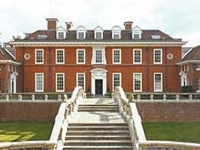
Pyrford Court, Surrey (Image: Savills)

One of the most interesting is grade-II listed Pyrford Court, Surrey.  Originally built in 1910 for the 2nd Lord Iveagh, of the Guinness brewing family, it was one of a group of houses built around that time on the profits of beer (along with Polesden Lacey, Elveden Hall, and Bailliffscourt). The land was sold to Lord Iveagh by his father-in-law, Lord Onslow, whose family had owned the area since the 17th-century.  The house was designed by Clyde Young who had also worked at Elveden, another seat of the Guinness family, though the sensitively designed wings were added in 1927-29 by J.A. Hale of Woking to designs by Lord Iveagh.  The stylish neo-Georgian house is an elegant red-brick composition which originally sat in a 1,000-acre estate – though sadly now reduced to just 21-acres.  Lord Iveagh died in 1967 and the house sat empty until sold in 1977 – apart from a brief burst of fame as a location in the 1976 film ‘The Omen’.  The house then became an old people’s home with all the attendant damage until the current owners started their seven-figure restoration.

Pyrford Court was originally launched on the market in January 2010 for an ambitious £20m, a staggering rise in valuation from the £3.25m paid in 2000 and from the £8m asking price when it was offered for sale in 2002 (reduced, a year later, to £6.5m).  Yet this proved too much for the market to take; even for a ‘super-prime’ house within 25 miles of central London, and despite the high-quality restoration of the impressive interiors.  It subsequently languished and has now been promoted with a double-page advert – though the price is ‘on application’ meaning we won’t yet know quite how far the price has dropped.  However, looking at the other houses Savills have for sale in the area this is by far the most interesting and attractive house.
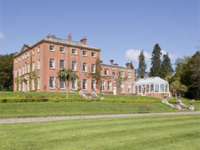
Brockhampton Park, Herefordshire (Image: Jackson-Stops & Staffs)

Another impressive house is the classically elegant, red-brick Brockhampton Park, Herefordshire.  Although the architect hasn’t been confirmed, the fact that it is virtually identical to Hatton Grange in Shropshire by Thomas Farnolls Pritchard, means it can probably be attributed to him.  The house was built in the late 1750s for Bartholomew Richard Barneby, probably using the £3,000 brought to him through his marriage in 1756 to one Betty Freeman. The Barneby family had owned the estate since the 15th-century and were to own it until 1946 when John Talbot Lutley (who was a descendent of the  Barneby family) left the house and 1,200-acre estate to the National Trust. Col. Lutley was a no-nonsense man who, on hearing of the NT country houses scheme, wrote them a short letter in 1938 saying that as he was a bachelor whose heirs were rather distant, would they be interested?

James Lees-Milne was duly dispatched – and almost rejected it on sight as it wasn’t pure Georgian due to some relatively small Victorian alterations.  However, after a tour of the estate and on seeing the beautiful Lower Brockhampton Manor, he felt that the latter two would be fine additions for the Trust – even if the big house would be a drain. It was duly left to the NT in 1946 following the Colonel’s death. Neither the house nor the contents were of sufficient quality to justify retaining or opening to the public so they sought to let it.  Unfortunately no private tenant wished to take it on, usually citing its remoteness, however in 1985 an insurance company let the house as offices and undertook a comprehensive restoration programme.  After they moved out in 1996 it was again restored as a private home and is now available with just 8-acres but surrounded by the rest of the NT-owned estate.  Interestingly the house is listed under the ‘Sales’ section of the Jackson-Stops & Staff website but I suspect this is due to it being leasehold – again ‘price on application’ so the price of the privilege is unknown, but the house has been advertised since last summer so it may be cheaper than before.

Ebberly House, Devon (Image: Savills)

Perhaps the most surprising house to still be available is the grand Ebberly House, Devon.  Rather than the expected provincial house, this is a house which displays remarkable architectural sophistication. Described by Pevsner as ‘unusual and attractive’, whose distinctive rounded ends ‘hint at the variety of room shapes inside; a provisional echo of the interest of contemporary architects such as Nash and Soane’.  Designed by Thomas Lee of Barnstaple, a pupil of Sir John Soane, the grade-II* house compensates for it’s remoteness with a fantastic house set in a fine 250-acre estate.  Offers in excess of £4m on the back of a postcard to Savills in Exeter.

Perhaps there are some clever marketing plans being hatched at the estate agents which means that rather than pushing their best properties in the first big property edition of Country Life of 2011 they’re saving them for…when?  Bonuses have just been announced and those looking to buy are probably active so perhaps there is just a general scarcity of significant country houses coming to the market.  Does this indicate 2011 will be rather thin for the agents as uncertainty limits buyers to the super-rich looking for somewhere in London or will the market pick up and a slew of new houses soon be released to whet our appetites?

How tourism split a house from the estate: Warwick Castle, Warwickshire

Warwick Castle, Warwickshire (Image: Gernot Keller/Wikipedia)

A small advert tucked away in a recent Country Life marks the final split of a house from it’s estate. With the sale of the parkland associated with Warwick Castle in Warwickshire, another house loses control over an important asset – though this separation is very much tied up with the history of the opening of country houses to tourists, and this castle in particular.

Country house visiting is perhaps thought of as a more modern phenomenon but Warwick Castle was one of the first houses to be truly exploited as a tourist attraction with visitors coming in significant numbers from 1815 onwards. The growth of the industrial Midlands in the Victorian era and consequently a growing middle class seeking excursions, shifted the pattern of ‘show-houses’ (that is, ones regularly open to the public when the family were absent or on specific days) northwards, away from the more aristocratic 18th-century London-Bath axis.  The Midlands were particularly well provided for with many houses open to the public from the 1850s including Eaton Hall, Chatsworth House, Haddon Hall, Newstead Abbey, and Belvoir Castle amongst perhaps a hundred.  This reached a peak in the 1880s when the most popular houses would receive tens of thousands of visitors a year, reflecting a popular interest in the houses of ‘Olden Time‘ as popularised by writers such as Joseph Nash and Sir Walter Scott.

Warwick Castle, with it’s prized medieval origins, was particularly popular – to the extent that not opening it was considered unthinkable.  That the public expected to be allowed to see inside these houses could be shown in a comment in the Daily Telegraph in 1871 which said:

An Earl of Warwick who would make his whole castle his own in the spirit of an inhospitable curmudgeon, who would shut out all eyes but his own from the feast within those walls, is a being so opposed to every English tradition that it is difficult to realise him.

For the aristocratic owners, economics certainly played a stronger role than any sense of public generosity.  For some, having a popular house in the country was no inconvenience as, such as at Dunster Castle in Somerset, it was remarked in 1845; ‘The owner, an inveterate Bachelor, lives in London and hardly ever comes here‘.

Especially convenient for trippers from Birmingham and the nearby resort of Leamington Spa, Warwick Castle was hosting as many as 6,000 visitors per year in 1825-26 and when the Earl of Warwick’s housekeeper died in 1834 she was said to have left £30,000 earned from tips.  Yet it was the devastating fire of December 1871 which firmly moved the castle from being simply a home to a business. The fire destroyed the family apartments but luckily left the oldest parts of the castle untouched.  The Earl of Warwick’s financial situation meant that he simply could not afford to restore the house to its former glory, a prospect which scared the local tradespeople, fearing the loss of the tourist trade and so a restoration fund was created.  However, to ensure the Earl’s pride was not dented it was presented as recognition of the burden he bore as owner of a national treasure.

However, a furious response from no lesser figure than John Ruskin marked the start of a backlash, saying ‘If a noble family cannot rebuild their own castle, in God’s name let them live in the nearest ditch till they can‘.  Behind this was the growing social democratic movement which moved from support of national treasures privately-owned towards a more socialist belief that national assets ought to be owned by the ‘people’.  The purchase of Aston Hall by Birmingham Council in 1864 as a public museum and park was no doubt playing on the minds of both certain radical sections of society and Lord Warwick – though for different reasons.  The appeal eventually raised £9,000 which paid for restoration by Anthony Salvin but the importance of opening the house as an attraction was highlighted as a way of not only funding costs but also as a way of keeping the public happy that they had ‘access’ to what they now felt of as ‘theirs’.

From this point, the house was never really a private home again.  The Earl and his son embraced the tourist industry but in 1885 closed the castle for a year to re-organise the showing on a more commercial basis.  Gone were the old servants acting as guides; in came professionals paid for by the one shilling admission tickets.  The new system was a success, with 20,000 visitors in the first full year of the new regime.  The new domestic arrangements were confirmed by the 5th Earl who inherited in 1893 and preferred to live at his wife’s estate Easton Lodge in Essex.  In the same year, the castle staged its first historical pageant, which was repeated on a grander scale in 1906.  The 6th Earl, who took over in 1924, further promoted the tourist business, pushing visitors to a peak in 1930 of over 80,000.  Even during the war years, there were over 10,000 visitors in 1943-44, and numbers had recovered to their pre-war peak by 1949-50.

All this increasingly showed that the wider estate, for all its charms – landscaped by Capability Brown in 1747 and much admired by Horace Walpole, it was considered secondary to the primary purpose of the enterprise; to get people into the castle. When the 8th Earl decided to abandon Warwick Castle once and for all in 1978, selling it to the Madame Tussauds group which underlined just how much a tourist attraction it had become, the estate was included but farmed by tenant farmers leaving the grounds as a mere sideshow.  The 679-acres now under offer (guide price: £3m) is the bulk of the estate bar a few acres around the castle.  Land and house have been separated as assets and are unlikely to be reunited. This leaves a house without control of the setting which, although sidelined, has been an important part of what made it into such a popular tourist attraction, and leaving fans of our country houses sad that another has been split up in this way.

Property details: ‘Warwick Castle Park, Warwickshire‘ [John Shepherd]

For more history on country house tourism I can strongly recommend ‘The Fall and Rise of the Stately Home’ by Peter Mandler which proved very useful in relation to this article.

As predicted; Cherkley Court, Surrey now for sale

Cherkley Court, Surrey

When the doors to Cherkley Court in Surrey closed to visitors in December 2009, it was thought that low visitor numbers had proved it uneconomic to keep the house and gardens open.  However, as predicted by a commenter to my original blog post [thanks Andrew], Cherkley Court is now for sale and has been launched with a double-page centre spread in the Sunday Times Home section today [19 Sept 2010].

If one was to try an define what might constitute a perfect trophy estate in Surrey, Cherkley Court might well tick most of the estate agents’ criteria.  The grade-II listed house, built c1870 (and rebuilt after a fire in 1893), is a four-storey, chateau-style mansion extending to over 24,000 sq ft with home cinema and five grand reception rooms, with nearly 400-acres of gardens and parkland.

The house is now for sale following a 7-year, £10m restoration of the house and grounds orchestrated by the architect Christopher Smallwood and David Mlinaric, the interior designer.  The house became a famous venue for parties under the ownership of Max Aitken (later Lord Beaverbrook) and his wife Gladys who lived there until her death in 1994.  It was her death which sparked a bitter legal dispute between beneficiaries of the will which has forced the sale.

So if you have £20m and don’t mind the restriction on not landing your helicopter in the grounds, have a word with Savills.

Property details: ‘Cherkley Court, Surrey‘ [Savills]

Listed building description: ‘Cherkley Court, Surrey

Developer shows sense; Ruperra Castle for sale

Ruperra Castle, Newport, Wales (Image: Savills)

Run-down or derelict country houses are often an enticing prospect for a developer, especially where the house still retains some land, on which they can propose ‘enabling development’.  In theory this is the correct use of this exemption but frequently the developer will suggest too many houses or ignore the fact that the house has too little land to avoid any development compromising the setting of the house.  When this happens, it is often the house which suffers as the developers wait for appeals or a change in policy whilst allowing the house to deteriorate further.  So in the case of Ruperra Castle in Wales it’s encouraging that the owner has decided to bow out giving someone else the chance to restore this architecturally interesting house.

Ruperra is an early example of the ‘mock’ castles which became fashionable in the Elizabethan and Stuart eras and were an example of life imitating art as the idea of these houses drew from the ‘pageant castles’ as featured in court entertainment of the time.  These stage castles formed the centrepiece to the royal ‘masques’ and were laden with allegorical symbolism as they might be populated by damsels (signifying virtue) but successfully defended against attacking knights (signifying baser desires).  Works such as Edmund Spenser’s The Faerie Queen (published in 1590 and 1596) also fed a fashion for chivalry and heraldic forms. Importantly, the long period of domestic peace during Elizabeth’s reign meant that the design of houses moved from being primarily military and defensive to more simply domestic with the look of a house increasingly dictated by aesthetics.

Ruperra wasn’t quite the first of it’s type; that distinction could be said to be held by houses such as Michaelgrove in Sussex built for the Shelley family in 1536 (dem. 1830s), and Mount Edgcumbe in Devon, built between 1547 – 1554, which also were not fortresses and featured a square or rectangular central block with drum or square towers on each corner.  This was followed by the fabulous Wollaton Hall in Nottinghamshire, begun in 1580, which was an altogether more grandiose statement of power but broadly followed the same layout – as did Hardwick Hall, although in an adapted form. However, the Renaissance ornamentation of Robert Smythson‘s design at Wollaton contrasted dramatically with more austere designs of the true ‘mock’ castles which harked back to the earlier simplicity of decorated castles such as Herstmonceaux Castle in Sussex, begun in 1440, with its many windows and regularised defensive elements (such as the arrow loops) making them almost decorative.

Lulworth Castle, Dorset (Image: Matthew Beckett)

The design for Ruperra Castle was clearly based on that for Lulworth Castle, just 100 miles away in Dorset, and built between 1603-05.  Always called a ‘castle’ but built with the instruction from Lord Howard of Bindon that it ‘prove pretty’, it was never military.  Indeed, Thomas Gerard writing in 1630 described it as ‘well seated for prospect and pleasure; but of little other use’. Bought by the Weld family from Lord Howard it remained their family seat until a devastating fire in 1929 completely gutted the interior – as it remains today, although the building itself has been restored.  Another house thought to have been built around 1612 is Compton Bassett House in Wiltshire (dem. c1929) which clearly shared a similar layout although the corner turrents were square.

The builder of Ruperra Castle was Thomas Morgan (b.1564 – d.1632), who made his fortune as the Steward for the Earls of Pembroke at Wilton House, Wiltshire.  Morgan would have been regularly exposed to court life and would have been very aware of the latest architectural fashions.  Hence when he came to build his own house, which was finished in 1626, he deliberately drew on the latest architectural fashions and created one of the first of the ‘modern’ country houses.  The layout was a significant departure as the rooms were orientated to the outside to make the most of views – hence Ruperra’s elevated site chosen for its beauty rather than defensibility.  Interestingly the ‘castle’ design seemed to fall quite quickly from favour and so there are few other examples of this type – though one late example was Beaurepaire Park in Hampshire built in 1777 (sadly burnt down in 1942).

Ruperra Castle remained as part of the Morgan’s vast Tredegar estate and was traditionally used to house the eldest son before he inherited Tredegar House, the family’s principal seat.  The castle originally had dormers but these were removed during the rebuilding after a fire in 1785 and replaced with the crenellations there today.  It was last inhabited during World War II when a searchlight battery requisitioned it and they were there when the terrible fire caused by faulty wiring broke out in 1941.  Despite best efforts, the house was completely gutted and was eventually sold, along with the rest of the 52,000-acre Tredegar estate in 1952.

Since then, constant promises of restoration have come to nothing and it has steadily deteriorated, most dramatically when, in 1982, the south east tower largely collapsed.  Sold to the current vendor, Mr Ashraf Barakat, in 1998 he had hoped to convert the house into 11 flats and build 18 more houses in the 14-acre grounds that remained with the house.  After a final rejection at a public enquiry in 2009, Mr Barakat has now, wisely, put the still grade-II* listed Ruperra Castle on the market for £1.5m, rather than holding on and letting the house deteriorate further.  This should not be considered a development opportunity, so hopefully now someone with deep pockets will come forward to restore, as a single family house, this architecturally important building.  Its rescue would once again connect the modern history of country house design in Wales, bringing life back to a house which, when it was built, was the most sophisticated in the country.

Property details: ‘Ruperra Castle, Lower Machen, Gwent, Wales‘ [Savills]

More on this story:

More information:

Credit: I’m indebted to the prior work of Mark Girouard (‘Elizabethan Architecture‘ 2009) and the late Andor Gomme for their knowledge of Elizabethan architecture.

For the polo enthusiast; for sale – Cowdray Park House, Sussex

Cowdray Park House, West Sussex (Image: Knight Frank)

Despite a house having been in the family for over a hundred years, sometimes it can seem the most rational choice to sell.  For the current Lord Cowdray, the idea that he might saddle his heir with what he considers a burden has led to his decision to put the impressive Cowdray Park House up for sale.

If you mention Cowdray often the first house which springs to mind are the atmospheric ruins which are all that are left of one of the grandest Tudor houses in the country.  The fire in September 1793 destroyed not only a large part of the house but also many priceless and historically important artefacts including William the Conqueror’s sword and also the roll-call of those present at the Battle of Hastings.   Just two weeks after the fire the 8th Viscount Montague drowned whilst swimming in the Rhine, forcing the title to a distant descendent of the the 2nd Viscount, who died childless, extinguishing the Viscountancy.

The tragedies continued – the 8th Viscount’s sister inherited but both her sons died whilst swimming off Bognor in 1815.  The three daughters who then inherited in 1840 eventually decided to sell and it was bought by the 6th Earl of Egmont for £300,000.  The current Cowdray Park House dates from 1878 when the 7th Earl, who had inherited the estate in 1874, massively enlarged the Keeper’s Lodge to create the house we see today.  A large rambling, but very picturesque creation, it obviously has taken its cues from houses such a Knole and Penhurst with their varied rooflines and many courtyards.  The grounds had been previously landscaped by Lancelot ‘Capability’ Brown between 1768 and 1774 with the ornamental gardens laid out in the early 18th-century.

The house was bought in 1908 by Sir Weetman Pearson who was created Viscount Cowdray in 1917.  Sir Weetman was a brilliant engineer who not only built the Blackwall Tunnel under the Thames but also had extensive oil interests in Mexico.  The house then passed through the Pearson family with few changes until the 3rd Viscount, in pursuit of his passion for polo, created one of the premier polo grounds in the country within the 16,500-acre estate.

Yet being a titled aristocrat living in a 16-bedroomed, 44,000 sq ft house in the middle of a fine estate proved to not be what the current Viscount hoped for after he inherited in 1995.  In May 2009 it was announced that he and his wife and son were to move out of the main house and into a smaller house on the estate, Fernhurst, where they had lived before inheriting.  The 2009 plan involved finding someone to take a long lease and create a hotel and spa in the house but the wider economic circumstances have forced this plan to be abandoned.    Unwilling to continue managing such a large house, with all the attendant issues with staffing and maintenance, the Viscount has decided to sell, putting it on the market, with 110-acres, for £25m, whilst retaining the rest of the estate including the world-famous polo grounds.  Renting the house out, he says, would just be delaying the decision.

Speaking to the Sunday Times in 2009 when he announced his plans, Viscount Cowdray admitted that “I’m not the sort of person who feels hugely attached to things, and it’s a big house.” and later speaking to the Observer that same year he said “I have worried whether I will be leaving Perry a wonderful asset or a noose around his neck. I fear it is likely to be the latter,”.

Whilst the arguments put by the Viscount seem rational it does seem a shame to divorce the house from the estate.  The Cowdray estate has long adapted to changing circumstances but to dismember it seems to be a short-term solution which his son may, with hindsight, regret when he comes to take over, as it leaves one of the most significant estates in Sussex without a principal house.

*Update* Remarkably, Cowdray Park House is unlisted so any buyer has the opportunity to make any changes they wish – and I’m willing to bet they won’t be good.  Knight Frank are touting this as a benefit but perhaps representations ought to be made to Chichester District Council to nominate it for listing using this form.

More details: ‘Cowdray Park House on sale for £25m‘ [Chichester Observer]

Property details: ‘Cowdray Park House, West Sussex‘ [Knight Frank]

The Cowdray Estate