The history of the country house is sadly often a cycle of rise and fall with the main variable being the speed of each respectively. The old phrase was ‘one generation made the wealth, the second enjoyed it, and the third lost it’. Over recent decades the trend has changed slightly in that, with longer life expectancies prolonging the older generations, the houses have had fewer chances for the rejuvenation which inheritance often brought. As an alternative, Ruth Watson uses Country House Rescue as a catalyst for the type of entrepreneurial change which is the only way for these houses to survive – if only the owners would listen!
The first episode in Series 3, to be broadcast at on Channel 4 at 21:00 on 6 March 2011, takes us to Wyresdale Park in Lancashire to meet a father and son who don’t agree on the best way to maximise the obvious potential of the beautiful estate.
Wyresdale Hall was built between 1856-65 for Bolton cotton-magnate-turned-banker, Peter Ormrod, who bought 6,000-acres from the Duke of Hamilton to create his estate. The house, which cost £50,000 (about £4m at today’s value) at the time, was designed by noted local architect Edward Graham Paley (b.1823 – d.1895) who had an extensive practice, partnering first with his mentor Edmund Sharpe, then, following Sharpe’s retirement, Hubert Austin, before being joined by his son, Henry Paley. The work of Paley & Austin in particular was well-regarded with Pevsner saying they “did more outstanding work than any other in the county” and was “outstanding in the national as well as the regional context”.
Paley worked on relatively few country houses, being much better known for his ecclesiastical output, with included the design of Lancaster Cathedral. Paley was brought up in deeply religious home and, working with Edmund Sharpe, who was heavily influenced by Pugin, it was unsurprising that Paley adopted the strict ecclesiastical style with the ‘correct’ use of Gothic elements. Perhaps looking a little too much like a convent rather than a home, the house is, nonetheless, still a good example of the type of regional interpretations of Pugin’s architectural theories which gained ground in the 19th-century.
The grade-II listed house and estate passed through the Ormrod family before the land was bought by the Whewell family in the 1920s who then bought the house in 1967. Now the family are facing the usual struggles of a listed house, an extensive list of improvements, and the need to make the changes which sometimes sit uncomfortably with the more traditional older generation.
———————————
Country House Rescue – Series 3
My usual powers have slightly failed me and I haven’t a verified list of all the houses in Series 3 but here are the ones I have identified so far:
One rather unscientific barometer of the health of the country house market is the thickness of Country Life magazine as it comes through the letterbox each week. After the thinning of the issue in the run-up to Christmas it’s always pleasing to feel the first weighty edition of the new year. Yet, though this week’s issue (2 March) boasts ’70 pages of property for sale’ it’s remarkable that the estate agents have so few significant country houses to offer and of those that are there, it seems, along with last week’s issue, the largest houses are relaunches.
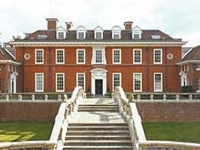
Pyrford Court, Surrey (Image: Savills)
One of the most interesting is grade-II listed Pyrford Court, Surrey. Originally built in 1910 for the 2nd Lord Iveagh, of the Guinness brewing family, it was one of a group of houses built around that time on the profits of beer (along with Polesden Lacey, Elveden Hall, and Bailliffscourt). The land was sold to Lord Iveagh by his father-in-law, Lord Onslow, whose family had owned the area since the 17th-century. The house was designed by Clyde Young who had also worked at Elveden, another seat of the Guinness family, though the sensitively designed wings were added in 1927-29 by J.A. Hale of Woking to designs by Lord Iveagh. The stylish neo-Georgian house is an elegant red-brick composition which originally sat in a 1,000-acre estate – though sadly now reduced to just 21-acres. Lord Iveagh died in 1967 and the house sat empty until sold in 1977 – apart from a brief burst of fame as a location in the 1976 film ‘The Omen’. The house then became an old people’s home with all the attendant damage until the current owners started their seven-figure restoration.
Pyrford Court was originally launched on the market in January 2010 for an ambitious £20m, a staggering rise in valuation from the £3.25m paid in 2000 and from the £8m asking price when it was offered for sale in 2002 (reduced, a year later, to £6.5m). Yet this proved too much for the market to take; even for a ‘super-prime’ house within 25 miles of central London, and despite the high-quality restoration of the impressive interiors. It subsequently languished and has now been promoted with a double-page advert – though the price is ‘on application’ meaning we won’t yet know quite how far the price has dropped. However, looking at the other houses Savills have for sale in the area this is by far the most interesting and attractive house.
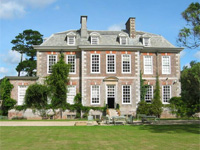
Brockhampton Park, Herefordshire (Image: Jackson-Stops & Staffs)
Another impressive house is the classically elegant, red-brick Brockhampton Park, Herefordshire. Although the architect hasn’t been confirmed, the fact that it is virtually identical to Hatton Grange in Shropshire by Thomas Farnolls Pritchard, means it can probably be attributed to him. The house was built in the late 1750s for Bartholomew Richard Barneby, probably using the £3,000 brought to him through his marriage in 1756 to one Betty Freeman. The Barneby family had owned the estate since the 15th-century and were to own it until 1946 when John Talbot Lutley (who was a descendent of the Barneby family) left the house and 1,200-acre estate to the National Trust. Col. Lutley was a no-nonsense man who, on hearing of the NT country houses scheme, wrote them a short letter in 1938 saying that as he was a bachelor whose heirs were rather distant, would they be interested?
James Lees-Milne was duly dispatched – and almost rejected it on sight as it wasn’t pure Georgian due to some relatively small Victorian alterations. However, after a tour of the estate and on seeing the beautiful Lower Brockhampton Manor, he felt that the latter two would be fine additions for the Trust – even if the big house would be a drain. It was duly left to the NT in 1946 following the Colonel’s death. Neither the house nor the contents were of sufficient quality to justify retaining or opening to the public so they sought to let it. Unfortunately no private tenant wished to take it on, usually citing its remoteness, however in 1985 an insurance company let the house as offices and undertook a comprehensive restoration programme. After they moved out in 1996 it was again restored as a private home and is now available with just 8-acres but surrounded by the rest of the NT-owned estate. Interestingly the house is listed under the ‘Sales’ section of the Jackson-Stops & Staff website but I suspect this is due to it being leasehold – again ‘price on application’ so the price of the privilege is unknown, but the house has been advertised since last summer so it may be cheaper than before.
Ebberly House, Devon (Image: Savills)
Perhaps the most surprising house to still be available is the grand Ebberly House, Devon. Rather than the expected provincial house, this is a house which displays remarkable architectural sophistication. Described by Pevsner as ‘unusual and attractive’, whose distinctive rounded ends ‘hint at the variety of room shapes inside; a provisional echo of the interest of contemporary architects such as Nash and Soane’. Designed by Thomas Lee of Barnstaple, a pupil of Sir John Soane, the grade-II* house compensates for it’s remoteness with a fantastic house set in a fine 250-acre estate. Offers in excess of £4m on the back of a postcard to Savills in Exeter.
Perhaps there are some clever marketing plans being hatched at the estate agents which means that rather than pushing their best properties in the first big property edition of Country Life of 2011 they’re saving them for…when? Bonuses have just been announced and those looking to buy are probably active so perhaps there is just a general scarcity of significant country houses coming to the market. Does this indicate 2011 will be rather thin for the agents as uncertainty limits buyers to the super-rich looking for somewhere in London or will the market pick up and a slew of new houses soon be released to whet our appetites?
The size of a country house was traditionally the physical embodiment of the wealth (or aspirations) of the owner. Yet as the role of the country house changed and the emblems of power altered, new, smaller forms of houses to emerge for both the aristocracy and minor gentry. The acceptability of a smaller house was to prove valuable in the financial crises of the 20th-century – though this is not to say that the later houses lacked anything in terms of quality of interiors or the richness of the architectural language used outside.
Wealth was obviously the most important consideration when deciding on the size of the house. However, the learned sophistication of many of the lesser aristocracy meant that although their funds may not be able to provide a palace, they were well-versed in the aesthetics of good (often Classical) architecture. This meant they were able to commission or design for themselves coherent and elegant smaller houses, giving us the much-coveted Queen Anne or Georgian smaller houses we see today up and down the country, such as Puslinch House in Devon.
The considerations in the 20th-century were also financial but driven by a different set of demands. The financial pressures of the early part of the century, particularly the agricultural slump and the Wall Street crash, naturally limited the size of the houses built (though not all e.g. Gledstone Hall by Sir Edwin Lutyens built in 1926). Yet, the changing social climate also meant that not only was it considered somewhat insensitive to build such large palaces, it was also unnecessary as the houses no longer required so many bedrooms to accommodate the now vanished armies of staff and house guests who used to turn up for the large weekend parties.
Hurtwood Edge, Surrey
Yet smaller didn’t have to mean less interesting as architects faced up to the new challenges with intelligent interpretations of Georgian, whilst others sought to experiment with different styles, such as at the now grade-II listed Hurtwood Edge in Surrey, where the builder/architect Arthur Bolton created an Italian villa in the English countryside.
In the immediate period following World War II, many larger houses, having been requisitioned and mistreated, were demolished, but the families often retained the ancestral estate but now required a new seat. The tight restrictions on materials, particularly for ‘luxury building’ under the Socialist Attlee government, naturally limited the ambitions of the owners. Yet the election of Conservatives in 1951 ushered in the gradual lifting of the restrictions until their abolition in 1954 which allowed a new wave of construction. The war seemed to have had a lasting effect – or maybe fear of a future Socialist government enacting a tax based on house size – as many of the houses were significantly smaller than those in previous eras.
Eaton Hall by John Dennys for Duke of Westminster (Image: Kathryn Gammon)
An example of this is Eaton Hall, seat of the Dukes of Westminster, where, following the demolition between 1961-63 of Sir Alfred Waterhouse’s high Gothic-Revival masterpiece, it was decided that a new house should be built. The commission went to John Dennys, who happened to be the Duke’s brother-in-law, for a starkly modern house which sat cross-wise on the main axis of the old house. Unfortunately in this case the new house was overwhelmed by the grandeur of the setting, appearing too small against the remaining buildings and the as the focus for the grand gardens. Worse, the house was unsuccessfully remodelled again in the late 1980s in an almost French chateau-style to create a larger house.
In recent years, planning restrictions have usually limited the size of new houses (though not always; see my recent post on large houses). The lack of architecturally educated clients has naturally led to a growth in crass, ugly smaller country houses, but all is not lost as determined clients are still able to demand and produce good designs, such as the one proposed for Harewood Park in Herefordshire, now mooted as the potential marital home for Prince William and Kate Middleton.
Harewood Park (proposed), Herefordshire (Image: Craig Hamilton Architects)
Ever since the Harewood Park estate was bought by the Duchy of Cornwall in 2000 as part of a larger purchase of 12,000 acres, rumours had been circulating that it would be for one of the Princes. The original house had been demolished in 1959 so the expectation was that another would have to be built if it was to have such a role. Considering the views of the Prince of Wales on modern architecture there was little surprise when a planning application was submitted in 2006 for a strongly Classical small country house by Craig Hamilton Architects.
Craig Hamilton originally prepared three designs but the final design (shown above) complements the existing stables and is perhaps the most interesting and the one successfully submitted for approval.
The house is based around the motif of the triumphal arch but, apparently drawing on the influence of Sir John Soane, it presents a simplified version rather than the more decorated versions often seen. Soane was schooled in the Classical style but re-invented the language to create a new direction for Neo-Classicalism; a much simpler version with an emphasis on the effective use of space and most importantly, light. Soane spent several years in Italy and was well-versed in Roman architecture and incorporated the three-arch motif into his designs, notably the entrance front to his own house at Pitzhanger Manor, Ealing, west London, and in one of his most impressive commissions for the old Bank of England (scandalously demolished in the the 1920s) as seen in the internal Lothbury Court.
The new Harewood Park is an inventive extension of this Soanian language and it’s encouraging that the planners had the courage to approve what will surely be one of the most interesting smaller country houses built in the UK. Sadly, I suspect that for security reasons, we won’t see the house featured in Country Life but I keep my fingers crossed.
Competition: nominate your choice for ‘England’s Favourite House’
Competition: 'England's Favourite House'
This seems a good moment to mention the competition to find the best smaller country house (i.e. with less than seven bedrooms). Most people have a favourite and usually it’s not so much the grand palaces of Chatsworth or Blenheim but the smaller houses of our local areas which form part of our local heritage. The competition is being run by Country Life magazine and Savills the estate agents and the house should be in private ownership and not currently for sale. The deadline is Wednesday 24 November 2010 so submit your suggestions as soon as possible.
Country houses are often launched on the market to catch either bonus money early in the year or those looking to move before the summer. However, circumstances or owner preference can lead to some interesting houses being given a promotional push in the autumn (usually through Country Life magazine) to catch those who fancy Christmas in front a different log fire. So, here’s a quick round-up of some of the better country houses currently for sale.
Upton Pynes, Devon (Image: Upton Pynes website)
Easily one of the most impressive houses is one that has always been a sign for me that I’m nearly home when travelling back to Devon on the train. Just outside Exeter is the beautiful grade-II* listed Upton Pynes, which, despite the very English sounding name, bears a striking resemblance to a French chateau. Built c.1700 by Hugh Stafford with very sympathetic later additions, this large but elegant house sits in a commanding position in the Exe Valley, perfectly positioned to catch the sun throughout the day, giving the red-brick façades a warm glow. Described by Pevsner as “…an excellent example of the stately double-pile house that became popular after the Restoration but is relatively rare in Devon.”, the interior features a particularly grand entrance hall created as part of alterations in 1852 by the architect Ambrose Poynter for Sir Stafford Henry Northcote (later the Earl of Iddesleigh). The main interiors of the house, including an enfilade of rooms on the south front and a notable library, largely dates from 1700. The house also has the claim that it was the one Jane Austen had in mind when describing ‘Barton House’ in ‘Sense & Sensibility’. The house still requires some restoration but will definitely reward whoever completes this grand project.
Sometimes a grand house designed by an interesting architect can remarkably remain unlisted, as is the case with the Edwardian Crendle Court in Dorset which was designed by Walter H. Brierley (b.1862 – d.1926) who has been described as ‘the Yorkshire Lutyens’. A prolific architect, he designed over 300 buildings including schools, churches and several country houses including the elegant neo-Georgian Sion Hill Hall in Yorkshire. Brierley was a versatile architect able to work successfully in various styles though with a preference for ‘Wrenaissance’ – a modern re-working of the architectural language of Sir Christopher Wren. Crendle Court was built in 1909 and features elaborate ornamental plasterwork in the main reception rooms by George Bankart, and sits, well, more luxuriates, in 270-acres of grounds. Considering the architect and the quality English Heritage ought to send someone round to evaluate and spot list it before it gets ruined by someone with more money than taste.
Other significant houses available were launched earlier but are now being promoted following price cuts. One such house is the grade-II* listed Rudby Hall in Yorkshire, which was originally given a guide price of £3.5m but now is offered at £2.75m. Designed by Anthony Salvin in 1838 for the 10th Viscount Falkland, who originally called it Leven Grove, but by the late 19th-century it was known as Skutterskelfe Hall before being given its present name by the company which owned it in the 1990s. The house was restored in the 1980s and comprises the main house but with the ancillary buildings converted into let accommodation bringing in a handy £50,000 p/a – so long as you don’t mind sharing your gardens, grounds and woodlands with them.
For those who fancy something more baronial, then Blairquhan Castle in Ayrshire, Scotland may be perfect. The core of the property is a tower house built in 1346 but was later given a new front by William Burn in 1820-24 to provide the imposing if slightly stern façade we see today. The estate was noted for it beauty with Lord Cockburn writing in 1844: “I rose early…and surveyed the beauties of Blairquhan. It deserves its usual praises. A most gentleman-like place rich in all sorts of attractions – of wood, lawn, river, gardens, hill, agriculture and pasture.”. What more could a squire desire?
Most of these houses seem to be with Savills so to even things up, and to include a house I’m surprised hasn’t sold already, is Beaurepaire in Hampshire. The house was featured on the blog in more detail (‘Phoenix for sale: Beaurepaire House, Hampshire‘) when it was first launched in June this year. The house is what remains after a devastating fire in 1942 destroyed the main block of the house, leaving the current service wing which was extensively refurbished and remodelled after WWII to give the elegant house which is for sale today. Approached down a long drive, what guest couldn’t fail to be impressed by the wonderful gates designed by Sir John Soane which guard the entrance over the moat? Sitting in a 250-acre estate, the £8m price tag is probably justified for the area – and the owner is apparently in no rush to sell so don’t expect any big price cut soon.
Knightshayes Court, Devon (Image: Matthew Beckett)
For all the wonderful work the National Trust has done over the last hundred years saving numerous country houses from demolition, one criticism that has been levelled at it is the almost artificial atmosphere it has created inside. A recent visit to Knightshayes Court in Devon has also highlighted an interesting series of judgements as to how far an interior should be restored, even to the point of creating a room which was planned but never executed.
Knightshayes Court sits in an elevated and enviable position above the market town of Tiverton where the Heathcoat Amory family had the factory which generated their wealth. The family fortune was created by the Loughborough-based John Heathcoat (b.1783 – d.1861) inventor of a revolutionary industrial lace-making machine who moved to Tiverton in 1816 after all 55 machines were smashed by drunken Luddites. A caring man, he ensured the workers were well-housed and the children educated, and the factory became the largest lace-making factory in the world, employing 1,100 workers.
Knightshayes Court, however, was built by his grandson, John Heathcoat Amory (b.1829 – d.1914), whose father had married the only daughter of John Heathcoat, and had added his father-in-laws surname on inheriting. Although politically active, being knighted in 1874, he had sufficient time to indulge the usual pastimes of the wealthy Victorian aristocrat, particularly hunting. So why would a provincial hunting gent commission a house from an eccentric medievalist, such as William Burges?
Burges (b.1827 – d.1881) has been described by Mark Girouard as ‘one of the most Gothic of the Gothicists‘. His spectacular remodelling of Cardiff Castle, and the creation of the fantastical Castell Coch, both for the immensely wealthy 3rd Marquess of Bute, allowed him free reign to indulge his bold and imaginative decorative schemes. Burges worked to a relatively simple philosophy that “No rule can be deduced except the golden one; whatever looks best is best‘ which combined with his other aphorism ‘Money is only a secondary concern in the production of first rate works…There are no bargains in art‘, meant that his work was never going to be cheap. Yet Heathcoat Amory chose him – but the suspicion is that it was his wife Henrietta who made the choice, perhaps on the back of family connections which included the 2nd Lord Carrington for whom Burges had remodelled Gayhurst in Buckinghamshire (now flats), in the late 1850s-early 1860s.
Perhaps John Heathcoat Amory had only given broad instructions as to what he wanted and had left his wife to chose the aesthetics – either way, as paymaster, Sir John would later regret not taking perhaps a closer interest in the choice of architect. Construction of the house started in 1869 and the exterior of the house was built almost exactly to Burges’ original design, with the exception of the reduced height of the great tower and a re-orientation of the billiard room. With the shell completed in July 1870, at a cost of £14,080 (approx. £1m today), the Architect magazine observed that for completion ‘…the actual cost will be something more.‘ – a classic in the canon of architectural understatements as Burges had reserved his most incredible work for the interior.
In 1873, Burges presented the family with a 57-page album of detailed drawings which depicted everything from floor to ceiling. Faced with such a grand and lavish scheme the Heathcoat Amorys abandoned Burges’ scheme, apart from the stone and wood carving, and, in 1874, brought in the cheaper but very talented John Diblee Crace. Crace was the fifth generation of architectural decorators and between 1875 and 1882 he completed the interior of the house in his own more restrained but still colourful designs. The last additions to the house were an extra floor to the service wing in 1885 and a Smoking Room in 1902.
However, in the 1930s and 1950s, when appreciation for Victorian exuberance was at its lowest, the Heathcoat Amorys retreated from the bold colour schemes, removing fireplaces, screen and bookcases and covering or repainting ceilings and walls. So when the National Trust took over in 1973 the house was very different, and less architecturally interesting, than the one of a century earlier. The guide book, to its credit, does an admirable job of spelling out what is original, what was originally planned, what Burges executed, what Crace did, and what the National Trust has restored – and, perhaps more controversially, has recreated.
The obvious question when deciding on restoration is what particular period you pick as the ‘authentic’ period. The National Trust took over Kedleston Hall in Derbyshire in 1987, easily one of the finest Adam houses in the country, but by 1994 the then Lord Scarsdale was complaining that the NT had decided that anything post-1760 had to go. This led to the emptying of rooms, the repainting of others to how they thought Adam had painted them, and the removal in the grounds of anything not thought to have been put there by the first Lord Scarsdale and Robert Adam.
This is in contrast to the principles of the Society for the Protection of Ancient Buildings (SPAB) who state: “In the architectural context “restoration” means work intended to return an old building to a perfect state. It can be the unnecessary renewal of worn features or the hypothetical reconstruction of whole or missing elements; in either case tidy reproduction is achieved at the expense of genuine but imperfect work.“[source].
The Burges Room - Knightshayes Court, Devon (Image: Britain's Finest)
So was the National Trust wrong to strip back the layers of changes? In view of the fascinating end result and the relative rarity of Burges country houses it can be argued that this work rescued what remained and cleverly exposed the earlier work. But whose earlier work? The guidebook explains that most of the interior is by Crace, and it’s his work which has been restored. Yet upstairs in ‘The Burges Room’, the National Trust took it a step further and took Burges unexecuted plan for that room and created it as it imagined it would have looked.
So is this mere architectural theme park-ism? Perhaps as it has be made clear what has been created from scratch there is less risk of confusion, but considering how few read the guidebook in detail (or at all), the National Trust has the unenviable choice between respecting all the changes or presenting a more visually interesting house but with necessary compromises in architectural integrity. On balance, there has to be a very strong case to take such a course of action otherwise we risk seeing recreations of idealised or imagined versions of houses rather than the rich and varied buildings which have honestly adapted and changed as family homes over time.








 The Country Seat