The growing silence: how many UK country houses were lost?

Slowly, then suddenly, many estates grew silent. Carriages no longer clattered down the drives. Entrance halls no longer echoed to voices. Kitchens went cold. Staff quarters were emptied. Then, the contents were sent to the auctioneers. Finally, the house was broken apart; hammers and pickaxes the new sounds as hundreds of years of history were reduced to rubble.

One key questions which architectural historians have been trying to answer for a number of years is just how many UK country houses have been lost? The answer, for now, is over three thousand. Each was a world on its own, but also part of the complex jigsaw of our national heritage.

The genesis for this area of research was ‘The Destruction of the Country House‘ exhibition, which ran from 9 October – 1 December 1974 at the Victoria & Albert Museum in London. I have written about it on a number of occasions so if you would like more insights into it, you can read my article on the 40th anniversary or my reflections on the 50th anniversary.

The position of the landed elites was considered the bedrock of society. The families provided political leadership, social aspiration, and were the centre of the local economy through their employment and expenditure. Land ownership was the passport to this elite status; the open market a safety valve which enabled ‘new money’ to mix with the old, to want to emulate them rather than remove them. This allowed new families to fluidly move up from merely wealthy to established gentry or nobility. After a few generations, the land functioned as an older form of ‘green-washing’, the verdant parkland obscuring where the family had started. Within a few short centuries (though sometimes it was just decades), they had become the elite.
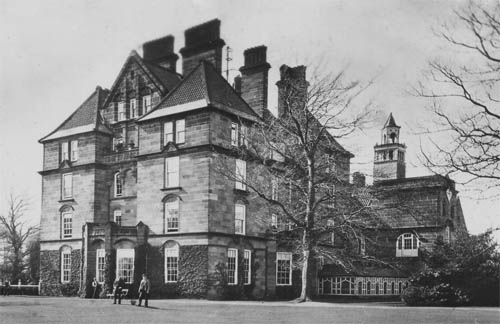
Rounton Grange, Yorkshire – seat of the Bell baronets, of Rounton Grange and Washington Hall (1885). House demolished 1954.

However, the first half of the twentieth century was, for the owner of these large houses, often financially, socially, and politically challenging. The repeal of the Corn Laws in 1846, which opened our markets to cheaper overseas produce, combined with the agricultural depressions of the latter-half of the nineteenth century, had undermined many of the assumptions about the financing of the country house. As debts grew, so the stark financial reality of the situation they were in began to dawn. For many, the path to recovery seemed to be to sell non-core assets such as artworks or outlying estates and hope that this would tide them over until their incomes, usually agricultural, recovered. For those who sold their land early and invested in the stock market, the crash of 1929, was another blow to their planning. As is so often the case, the markets remained against them longer than they could remain solvent.

When Aldous Huxley published his first novel, ‘Crome Yellow‘, in 1921, the challenge to the country house was already significant enough to feature as the fate of the imaginary Gobley Great Park;

‘A stately Georgian pile, with a façade sixteen windows wide; parterres in the foreground; huge, smooth lawns receding out of the picture to right and left. Ten more years of the hard times and Gobley, and all its peers, will be deserted and decaying. Fifty years, and the countryside will know the old landmarks no more. They will have vanished as the monasteries vanished before them.’.

Thankfully, Huxley’s apocalyptic vision wasn’t fully to come to pass. However, from the relatively low levels of losses in the nineteenth-century, the twentieth-century would bring decade after decade of destruction. It’s worth remembering that this was largely a crisis of the country house, not the wider estate. The land was considered more valuable as an income-generating asset and for the social prestige it conferred. Without the expense of the house – the maintenance, the staff, the general running costs – so the income was better able to meet their expenditures. Mr Micawber would be beaming with pride.

So, when seeking to bring their expenditure within the available income, the house was considered a necessary sacrifice. And with so many other families also facing a similar situation, the loss of any one house would be obscured by the loss of so many others. The problem with simple data is that it belies the dramatic local impact the loss of a house would have been. The country house and its estate embodied the idea of stability. The idea of a family owning the house and land and passing it down through the generations was – and arguably still is – embedded firmly in our national psyche, even if the family did change every few hundred years. The key difference in the twentieth-century was that there was often no other family to take their place.

In this dark era, houses languished on the market. This was often evidenced by adverts for the same properties appearing with sad regularity in magazines such as Country Life. It brought reminders of the increasing threats to the established order of the countryside into the drawing rooms and libraries of those most at risk.

Typical advert in Country Life magazine. Key aspects to note: the house is unnamed (though I think it is the infamous Burwell Hall, demolished in 1958), the language emphasises cheapness: ‘moderate price’, ‘modern conveniences’, ‘inexpensive gardens’. (Advert from Country Life, 10 November 1923, pg. XIII)

Each week, beyond the adverts in Country Life, ‘The Estate Market’ page offered a running commentary on the changes. For example, the headline for that page on May 5th 1922, was stark: ‘Demand for small properties’, with the opening paragraph stating, ‘The brightest section of the market is that in which the smaller properties are dealt with…’. Coverage includes the sale of Sudbourne Hall, Suffolk, saying it had sold with 500 acres, having first been offered as a whole but failing to find a buyer, it had been split up. The house was later demolished in 1953.

Another paragraph is headed ‘Mansions as sanatoria’ and writes approvingly of how Lords Londonderry and Boyne have both ‘generously offered’ Seaham Hall and Brancepeth Castle respectively for ‘hospital purposes’. Specifically, it states that Seaham Hall ‘…has had to be closed in consequence of taxation and the heavy cost of upkeep.’ (it survived and is now a hotel). It also mentions that Rendlesham Hall, Suffolk, has been sold for use as a ‘…retreat for drug-addicts and inebriates…’. It was also later demolished in 1949.

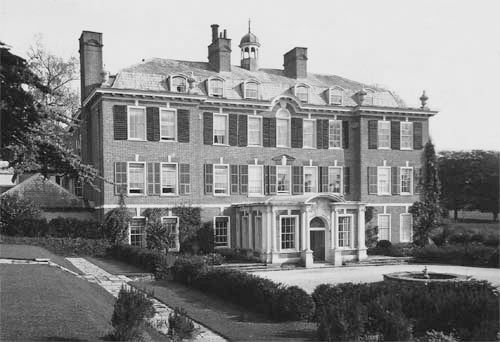
Sudbourne Hall, Suffolk, demolished in 1953 (Source: www.lostheritage.org.uk | More images)

During the nineteenth-century, the available data shows that there were fewer losses; approximately one a year. However, when considering the data, there are a few caveats to remember. Critically, the data for the nineteenth-century is thinner than the twentieth-century. Fewer books had been produced, research was sparse, and even confirming if a property was of sufficient stature to be classed as a country house is sometimes challenging. Fire and replacement by a new house were two of the most common reasons.

So how many have been lost?

Quoted in The Daily Telegraph magazine in 2007, the leading country house historian of the lost houses, the late John Harris, said that:

‘At the time [before the V&A exhibition], we reckoned that about 750 houses [in the UK] had been pulled down between 1880 and 1970. Now we know it’s about 1,800.’1

Sadly, John’s estimate was still too low – 1,800 doesn’t even cover England alone.

The gazetteer at the back of ‘The Destruction of the Country House‘ exhibition catalogue listed a total of 1,099 houses (740 for England, 313 Scotland, 46 Wales, with NI not included). This list had been compiled by John, Marcus Binney, and another researcher, Peter Reid, and explicitly stated it was not exhaustive. The total for England was updated with the publication in 2002 of ‘England’s Lost Houses‘ by Giles Worsley which added 445, to total 1,185 for England. However, Ian Gow’s ‘Scotland’s Lost Houses‘ in 2006 listed only 308 (5 fewer than before) but also included examples of houses in cities (which I have excluded from that total).

The task of taking the ground-breaking earlier research forward and to resurrect the memory of these otherwise obscured houses, has now been taken up by amateur enthusiasts, supported by the invaluable work of historians who have focused on specific areas. I started researching the English lost houses in 2006, compiling what I hoped would become the most comprehensive record. All the details, including detailed histories and thousands of images, are shared on the Lost Heritage website.

Using the same model, this was followed over the years by Dr Alastair Disley for Scotland, Dr Mark Baker for Wales, and Andrew Triggs for Northern Ireland (he also took on the much larger task of the Republic of Ireland).

Distribution of English lost country houses since 1800. Source: Matthew Beckett / www.lostheritage.org.uk

The scorecard of architectural losses

Each of these personal efforts has significantly increased the totals of lost houses with Scotland now standing at 545 (Disley), 390 for Wales (Baker), and 100 for Northern Ireland (Triggs – a particular achievement as they hadn’t been tallied previously).

The total number of lost houses for England alone has now exceeded John Harris’ original estimate for the whole of UK, having reached 2,019 (as at November 2024).

Overall, we can be confident that the number of UK country houses lost since 1800 now totals a remarkable 3,054.

Why does this matter? These houses and their particularly grand and hierarchical era and way of living has gone. It died, not in our leafy lanes, but in the battles and social change of the World Wars. The changes forced an evolution – and in that process, there are winners and losers. The tragedy was that the losers were often not inherently weaker houses, and in so many cases, they were some of the most interesting and significant. Beyond the random losses from fire and environmental causes, often what determined whether a house survived was their owners and their circumstances. For some, they were determined to ensure that the houses were reborn, albeit in a new way of living. For others, they were equally determined that that they would not pass what they saw as a burden to another generation.

In the specific losses to a family, and a locality, and to our architectural heritage, they were to be lamented. But in all of them, they possessed something of our shared heritage, and their loss, and the losses of the future, are pieces of the national jigsaw of our identity. As Simon Jenkins said, ‘Through them we hear the echo of our collective selves – and remember who we are.’2. We remember these parts of our history through the memory of these houses, and the roles they played in the life of our nation, both locally and nationally.

Request for help

If anyone has any further information on the lost country houses of England – either history, dates for losses, or family photos or recollections – please do contact me.


References:

1 – Campbell, Sophie, ‘Brideshead Detonated’ Telegraph Magazine, 20/01/2007
2 – Jenkins, Simon, ‘England’s Thousand Best Houses‘ (Penguin, 2004), vii

New Series: The Country House Revealed – South Wraxall Manor, Wiltshire

South Wraxall Manor, Wiltshire (Image: Traumahawk / flickr)

In contrast to the weekly dramas of Country House Rescue, a new series starting on the BBC, presented by the excitable Dan Cruickshank, looks at some of the finest homes in ‘The Country House Revealed – A Secret History of the British Ancestral Home‘.  The series promises a look behind the estate wall at some homes which have never been open to the public, giving us a rare chance to glimpse houses which enjoy secure, well-funded ownership and demonstrating that the fears of those who thought these houses would never be sustainable have been thankfully proved wrong.

The first in the series (broadcast 10 May on BBC2 at 21:00) visits South Wraxall Manor in Wiltshire; a house which matches a beautiful exterior with impressive interiors dominated by some of the finest chimneypieces and period rooms in the country.  The house was originally built for Robert Long who made a fortune in cloth in the early 15th-century before becoming an MP in 1433, around which time it is thought the core of the house was started.  As was befitting a rich MP, he was keen to show his status and as was often the case with the gentry, his home was the main platform with which to show off his wealth and erudition, creating one of the finest houses in the country today.

England, at the time work started at South Wraxall Manor, was feeling the influence of the Italian Renaissance and elements of the new fashions were often incorporated into the best homes, though often adapted for our native traditions and styles.  This use of wider influences was also a symptom of the gradual shift in power as major building projects were increasingly commissioned by wealthy gentry rather than the Church or Royal Court.  Maurice Howard also highlights that although the Court was highly competitive which might have led to a single architectural style being favoured, in fact, the houses we still have show how tenacious local styles were.

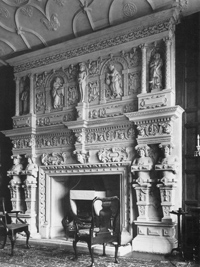
Chimneypiece c.1600, South Wraxall Manor (Image: (c) Nicholas Cooper)

This continuation of the vernacular can be seen in the architectural vocabulary used by those commissioning the houses, drawing still strongly on ecclesiastical traditions.  Reading the full listing description for South Wraxall one might almost believe it to be a local church or monastery – windows with Perpendicular tracery, buttresses, even gargoyles.  The house was significantly remodelled around 1600, creating what John Julius Norwich calls ‘one of the major Jacobean rooms in all England‘.  A vast west window floods the room with light and is matched by one at the other end of the room, providing the illumination to highlight a most impressive fireplaces – a colossal, florid statement of importance.

Each generation of the Long family added to the house, with additional wings and chimneypieces, and extending the estate.  As with other such early houses which have survived subsequent centuries without ‘modernisation’, this was due to a small element of luck in that it was inherited by a branch of the Long family in 1814 who were already well established at Rood Ashton House, Wiltshire (largely demolished c.1950) meaning the house was often rented out.  The house let between 1820-26 and served time as a boys school, before the 1st Viscount Long took over c.1880 following his election as a local MP.  Viscount Long undid much of the damage caused during its time as a school when the linenfold panelling had been painted over and the ornate ceilings plastered over, however he never really took up residence there.  The house was let for the rest of the 19th-century and the early 20th, before the 2nd Viscount Long moved in in 1935.  Used to house refugees in WWII, the family again lived there before finally selling up in 1966, ending over 500-years of family ownership.

South Wraxall then entered a rather uncertain period, until it was bought by a businessman with plans to turn it into a country house hotel but who had some issues with the local planning authority over unauthorised changes (for example, I think he glassed in the loggia without permission).  The house was up for sale again in 2003 for £6.5m after the businessman abandoned his plans.  After languishing on the market for a couple of years – probably due to the extent of the restoration required – it was bought by the current owners: John Taylor (bass player with the band Duran Duran) and his wife Gela Nash (founder of the fashion house Juicy Couture) who apparently have done an excellent and sympathetic job of the repairs, thus rescuing a house that is a quintessential example of an English manor house.

Full listing description: ‘South Wraxall Manor‘ [British Listed Buildings]

Further information: ‘South Wraxall Manor‘ [Wikipedia]

Book of the series: ‘The Country House Revealed‘ [Waterstones]

Rest of the series

This looks to be a fascinating set of programmes – for reference the other houses featured are:

How to get depressed quickly: the English Heritage Buildings at Risk Register 2010

Winstanley Hall, Lancashire (Image: English Heritage)

This blog has highlighted several country houses which are at risk but the true scale of the issue is unfortunately much larger, as the publication of the 2010 English Heritage Buildings at Risk Register shows.

Country houses all too easily can move from being secure, watertight buildings to having minor problems to becoming seriously at risk due to their size and the high standards required to repair them necessarily making even simple tasks much more expensive.  For the owners this can mean that the burden of looking after their ancestral family home becomes a daily challenge which, rather than facing, can be easier to ignore – especially if they are able to simply shut the door to a wing and forget the damp and leaks.

One of the greatest enemies of the country house is obscurity – particularly when combined with negligent or incapable owners. For some the house is merely an obstacle to redevelopment and so it is in their interest to forgo maintenance and hope that the house quickly and quietly deteriorates to the point where they can apply for permission to demolish.  Unfortunately under-resourced councils are rarely able to regularly survey all the listed buildings in the area meaning that houses can slip through the cracks.  The current economic climate means that it is even more unlikely that councils will be able to fully fund the heritage teams to ensure that they are able to ensure owners meet their obligations.

Melton Constable Hall, Norfolk (Image: English Heritage)

Although English Heritage have had some limited successes (e.g. Sockburn Hall, County Durham) there are still far too many houses at risk – I counted nearly 100 in a couple of searches.  It should be noted that houses are included even where works are planned or under way such as at Clarendon House, Wiltshire which was recently sold (with estate) for a reputed £30m and where restoration is expected to be completed by the end of 2010).  However, other examples include:

Others on the list include:

The head of English Heritage, Simon Thurley, said at the launch:

“Neglect is a slow, insidious process whose costly damage takes time to become clearly visible. Cuts in both private and public spending are currently inevitable but armed with our Heritage at Risk Register, English Heritage is well-equipped to guard against the loss of the nation’s greatest treasures and to suggest effective and economical strategies to protect our national heritage.”

One can only hope that this proves to be the case and that EH are able to fully fulfil their role particularly in relation to country houses and ensure that these beautiful buildings aren’t allowed to quietly slip into dereliction, depriving future generations of wonder of these grand houses.

More details: English Heritage Buildings at Risk 2010 or you can search the 2010 Register

Anyone with deep pockets? Country houses at risk today

It seems remarkable that between the popularity of country houses as tourist attractions or business or simply as homes that any would be at risk.  Yet as the 2010 SAVE Britain’s Heritage Building’s at Risk Register shows there are still a broad selection of fine houses which, for various reasons, are in need of someone with a desire to restore part of our heritage, lots of dedication, and pretty deep pockets.

Nocton Hall, Lincolnshire (photo copyright: Tom Vaughan)

One of the saddest is the case of Nocton Hall in Lincolnshire – a county which has lost so many of it’s fine old country houses already.  Fire is still one of the main reasons a house can quickly go from being a secure home to an ‘at risk’ shell.  Grade-II listed Nocton Hall is a warm honey-coloured stone house built for the 1st Earl of Ripon in 1841 to replace the original Jacobean house which burnt down in 1834.  After a stint as an RAF hospital in WWII it became a residential home before being bought by a property developer.  Unfortunately no development took place and the house was allowed to slowly deteriorate before a serious fire severely damaged what had been a perfectly good house.  Still sitting in its own gardens and parkland and near the village Nocton Hall cries out to be restored either as a h,otel or ideally as a grand family home.

Barmoor Castle, Northumberland (Photo: SAVE Britain's Heritage)

To look at the photo, Barmoor Castle in Northumberland looks in pretty good shape – but a picture can hide as much as it shows.  The first issue with Barmoor is that it actually is unused and sits in the middle of a caravan park which has been established in the grounds. Inside, there is some water damage as the roof has been leaking – although recent work, part funded by English Heritage, has alleviated this for the moment. Barmoor was built in 1801 around an older tower by the architect John Patterson of Edinburgh in a castellated Gothic Revival style for Francis Sitwell, in whose family it remained until 1979 when it was sold along with 200-acres.  The current owners have operated the caravan park since then but didn’t live in the house or use it leading to it’s current neglected state.  This is a classic example of where a house could be rescued from an inappropriate use, restored and enjoyed as a fine country house as was intended.

St Botolph's Mansion, Wales (Image: SAVE Britain's Heritage)

St Botolphs Mansion in Pembrokeshire was built in the early 1800’s for General Richard Le Hunt is a house in need of a use rather than repair.  The Doric porch and neat window architraves create an interesting facade which would normally ensure that such a house would be jealously fought over if it came to market.  However it is now owned by the nearby oil refinery (the proximity probably ruling out residential use) but they are exploring options as to how to make use of this elegant Georgian house – perhaps as a conference facility might be more appropriate.  Either way, this is a house which shouldn’t be forgotten.

Other country houses of note in the report include the Grade-II* listed Plas Machen nr Newport, the surviving portion of the 15th-century house of the Morgans who moved up in the world to Tredegar House, which is for sale. Also for sale, since 2007, is Benwell Towers in Newcastle which was a country house when built but is now suburban, achieving fame in later life as the set for the kid’s TV series ‘Byker Grove’.

Even if your pockets can’t stretch to a country house there are many other buildings seeking a saviour so do order your copy of ‘Live or Let Die‘ and certainly consider joining SAVE Britain’s Heritage to help to preserve our architectural legacy for future generations.

National Trust to allow life back into properties

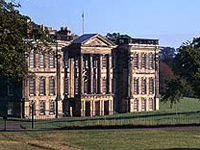
Calke Abbey, Derbyshire (Image: National Trust / Rupert Truman)

In an important change of policy, the National Trust has decided to lift some of the many restrictions which had led to criticisms that it was being too museum-like in it’s approach to its wonderful country houses.  The new strategy is designed to give visitors more of flavour of how a house might have been used when it was a home. 

This vision was inspired, at least in part, by the experience of the NT chairman Simon Jenkins, when visiting Chatsworth House in Derbyshire which is still the family home of the Duke and Duchess of Devonshire as well as one of the finest homes in private ownership in Europe.  Visitors often find that the Duchess has joined them and rooms show the momentoes and items found in any home.

The NT accepts that this will increase the wear-and-tear on the properties and inevitably some mistakes will be made. The expertise and experience of the Trust should ensure that the correct controls are still in place where appropriate as no-one wants to see damage to delicate fabrics, books or paintings. The new atmosphere of exploration and freedom will hopefully enhance the visitors experience and allow them to appreciate the house as it was intended to be; as a home.

Full story: ‘Welcome to Britain’s stately home from homes‘ [The Times]