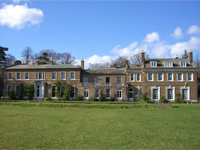
A restoration or a recreation: Knightshayes Court, Devon

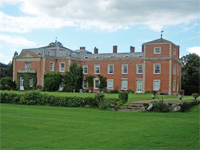
Knightshayes Court, Devon (Image: Matthew Beckett)

For all the wonderful work the National Trust has done over the last hundred years saving numerous country houses from demolition, one criticism that has been levelled at it is the almost artificial atmosphere it has created inside.  A recent visit to Knightshayes Court in Devon has also highlighted an interesting series of judgements as to how far an interior should be restored, even to the point of creating a room which was planned but never executed.

Knightshayes Court sits in an elevated and enviable position above the market town of Tiverton where the Heathcoat Amory family had the factory which generated their wealth.  The family fortune was created by the Loughborough-based John Heathcoat (b.1783 – d.1861) inventor of a revolutionary industrial lace-making machine who moved to Tiverton in 1816 after all 55 machines were smashed by drunken Luddites.  A caring man, he ensured the workers were well-housed and the children educated, and the factory became the largest lace-making factory in the world, employing 1,100 workers.

Knightshayes Court, however, was built by his grandson, John Heathcoat Amory (b.1829 – d.1914), whose father had married the only daughter of John Heathcoat, and had added his father-in-laws surname on inheriting. Although politically active, being knighted in 1874, he had sufficient time to indulge the usual pastimes of the wealthy Victorian aristocrat, particularly hunting.   So why would a provincial hunting gent commission a house from an eccentric medievalist, such as William Burges?

Burges (b.1827 – d.1881) has been described by Mark Girouard as ‘one of the most Gothic of the Gothicists‘.  His spectacular remodelling of Cardiff Castle, and the creation of the fantastical Castell Coch, both for the immensely wealthy 3rd Marquess of Bute, allowed him free reign to indulge his bold and imaginative decorative schemes.  Burges worked to a relatively simple philosophy that “No rule can be deduced except the golden one; whatever looks best is best‘ which combined with his other aphorism ‘Money is only a secondary concern in the production of first rate works…There are no bargains in art‘, meant that his work was never going to be cheap.  Yet Heathcoat Amory chose him – but the suspicion is that it was his wife Henrietta who made the choice, perhaps on the back of family connections which included the 2nd Lord Carrington for whom Burges had remodelled Gayhurst in Buckinghamshire (now flats), in the late 1850s-early 1860s.

Perhaps John Heathcoat Amory had only given broad instructions as to what he wanted and had left his wife to chose the aesthetics – either way, as paymaster, Sir John would later regret not taking perhaps a closer interest in the choice of architect.   Construction of the house started in 1869 and the exterior of the house was built almost exactly to Burges’ original design, with the exception of the reduced height of the great tower and a re-orientation of the billiard room.  With the shell completed in July 1870, at a cost of £14,080 (approx. £1m today), the Architect magazine observed that for completion ‘…the actual cost will be something more.‘ – a classic in the canon of architectural understatements as Burges had reserved his most incredible work for the interior.

In 1873, Burges presented the family with a 57-page album of detailed drawings which depicted everything from floor to ceiling.  Faced with such a grand and lavish scheme the Heathcoat Amorys abandoned Burges’ scheme, apart from the stone and wood carving, and, in 1874, brought in the cheaper but very talented John Diblee Crace.  Crace was the fifth generation of architectural decorators and between 1875 and 1882 he completed the interior of the house in his own more restrained but still colourful designs. The last additions to the house were an extra floor to the service wing in 1885 and a Smoking Room in 1902.

However, in the 1930s and 1950s, when appreciation for Victorian exuberance was at its lowest, the Heathcoat Amorys retreated from the bold colour schemes, removing fireplaces, screen and bookcases and covering or repainting ceilings and walls.  So when the National Trust took over in 1973 the house was very different, and less architecturally interesting, than the one of a century earlier.  The guide book, to its credit, does an admirable job of spelling out what is original, what was originally planned, what Burges executed, what Crace did, and what the National Trust has restored – and, perhaps more controversially, has recreated.

The obvious question when deciding on restoration is what particular period you pick as the ‘authentic’ period.  The National Trust took over Kedleston Hall in Derbyshire in 1987, easily one of the finest Adam houses in the country, but by 1994 the then Lord Scarsdale was complaining that the NT had decided that anything post-1760 had to go.  This led to the emptying of rooms, the repainting of others to how they thought Adam had painted them, and the removal in the grounds of anything not thought to have been put there by the first Lord Scarsdale and Robert Adam.

This is in contrast to the principles of the Society for the Protection of Ancient Buildings (SPAB) who state: “In the architectural context “restoration” means work intended to return an old building to a perfect state. It can be the unnecessary renewal of worn features or the hypothetical reconstruction of whole or missing elements; in either case tidy reproduction is achieved at the expense of genuine but imperfect work.“[source].

The Burges Room - Knightshayes Court, Devon (Image: Britain's Finest)

So was the National Trust wrong to strip back the layers of changes?  In view of the fascinating end result and the relative rarity of Burges country houses it can be argued that this work rescued what remained and cleverly exposed the earlier work.  But whose earlier work?  The guidebook explains that most of the interior is by Crace, and it’s his work which has been restored.  Yet upstairs in ‘The Burges Room’, the National Trust took it a step further and took Burges unexecuted plan for that room and created it as it imagined it would have looked.

So is this mere architectural theme park-ism?  Perhaps as it has be made clear what has been created from scratch there is less risk of confusion, but considering how few read the guidebook in detail (or at all), the National Trust has the unenviable choice between respecting all the changes or presenting a more visually interesting house but with necessary compromises in architectural integrity. On balance, there has to be a very strong case to take such a course of action otherwise we risk seeing recreations of idealised or imagined versions of houses rather than the rich and varied buildings which have honestly adapted and changed as family homes over time.

Visitor information: ‘Knightshayes Court, Devon‘ [National Trust]

Rent a doll’s house: Gunby Hall, Lincolnshire

Gunby Hall, Lincolnshire (Image: Gardens-Guide)

Sitting on a small rise, just off the A158 on the road to Skegness in Lincolnshire sits one of the prettiest of the National Trust’s many country houses; Gunby Hall. However, unlike the others, where we can only ever dream of moving in, Gunby is currently available to rent for the bargain rate of £10,000 per year – but do remember to add an estimated £100,000 for the annual running costs.

Gunby Hall was built in 1700 (commemorated with the date on the rainwater heads) for Sir William Massingberd by an unknown architect but one who was obviously familiar with the work of Sir Christopher Wren.  Built of warm plum-red bricks the sophisticated 3-storey exterior shows the elegant use of stone dressings which elevates this grade-I listed house to being one of the finest of the smaller country houses.  Although showing stylistic links with Wren it was almost certainly by a skilled provincial imitator or local builder.  Wren designed very few country houses – Tring Park in Hertfordshire, Winslow Hall and, according to John Harris, contributed designs for Wimpole Hall in Cambridgeshire, and Houghton Hall in Norfolk – all for patrons who were somehow connected to Wren.  So unless someone discovers a link between Sir William and Sir Christopher it is likely that the local ‘architect’ had only been shown Wren’s designs.

Newby Hall, Yorkshire (Image: johnet/flickr)

When Gunby Hall was built it would have been regarded as very fashionable as Baroque style houses had only become popular in the 1680s.  Newby Hall in Yorkshire is one of the best examples and was rated as the finest house in Yorkshire when it was completed c.1690 (remember the houses we regard as the finest today in Yorkshire such as Castle Howard, Wentworth Castle, and Wentworth Woodhouse amongst others hadn’t yet been built).  In many ways, Gunby Hall and Newby Hall are architectural ‘cousins’ – closely stylistically related but distinct, particularly in size; reflecting the relative wealth of the owners .  Similarities can also be seen with other Yorkshire houses such as the earlier Ribston Hall, built in 1674, and the wonderful but now sadly demolished Wheatley Hall built in 1680, and the later Bolton Hall.

Gunby Hall was later altered c.1730 and extended in 1873 and 1900 to very successfully add a Dining Room, Servants’ Hall and Service Wing.  The later additions blend very neatly with the existing building creating the harmonious look which is so attractive today.  Gunby has long been admired with the famous poet Lord Alfred Tennyson reputedly using it as his inspiration when he wrote during one visit:

. . . an English home – gray twilight

On dewy pastures, dewy trees

Softer than sleep – all things in order stored,

A haunt of ancient peace.

The house was also admired by James Lees-Milne who described it as ‘an Augustan squire’s domain, robust, unostentatious, dignified and a little prim.’.  Lees-Milne was a regular visitor and was instrumental in not only bringing the house to the National Trust, as he did many other houses, but also saving it from outright demolition during WWII.  This terrible prospect came about in 1943 when the Air Ministry wished to extend the airfield they had built at Great Steeping only later discovering that Gunby Hall inconveniently blocked the proposed path of the longer runway.  Luckily the combined forces of James Lees-Milne and the impressively named owner, Field Marshal Sir Archibald Montgomery-Massingberd, persuaded them to re-route the runway thus saving the house.  In thanks, the family immediately made over the house to the National Trust becoming one of the few houses to be taken on during the war.

So if you fancy living in one of the prettiest stately homes in the country and don’t mind a few tourists having a look round occasionally, get in contact with the Savills Lincoln office.

More details: ‘Stately home can be yours for just £10k a year… plus another £100k for the staff‘ [This is Lincolnshire]

Property details: ‘Gunby Hall‘ [Savills]

Houses as hospitals: the country houses in medical service

Hatfield House, Hertfordshire (Image: Amy Lloyd/flickr)

Our country houses have always been adaptable as changing fashions or functions required they accommodate new ways of living or roles.  One role which quite a few houses have taken on is that of hospital – either privately or as a fully-fledged part of the NHS – though this use has not always been sympathetic.  However, as the modern health service centralises to larger sites it seems some country houses are re-emerging to become homes again.

Hospitals were traditionally monastic, centred on the abbeys and convents but these were obviously scarce.  The ill were treated in large dormitories although some established houses in the country away from the main abbey to care for the mentally ill.  However the dismantling of the religious orders during the Reformation from 1536, meant that increasingly the burden for care of the pauper sick fell to secular civic bodies, with towns creating their own hospitals.  This model persisted until the 17th-century when private benefactors became increasingly prominent, donating funds and buildings for the care of the ill.

One of the earliest country houses to be converted was the partially completed Greenwich Palace. Originally a Tudor royal house, it had become derelict during the English Civil War, so in 1664 Charles II commissioned John Webb to design a replacement but which was only partially completed.  It was this building which Queen Mary II, who had been affected by the sight of the wounded sailors returning from the Battle of La Hogue in 1692, ordered to be converted to a navel hospital in 1694, to the designs of Sir Christopher Wren and Nicholas Hawksmoor and later Sir John Vanbrugh.

Possibly inspired by the royal example, other country houses were donated or converted for use as hospitals.  However, it quickly became apparent that they weren’t particularly suitable with one Irish physician, Edward Foster, complaining in 1768 that ‘In general, Houses have been rented for Hospitals, which are as fit for the Purposes, as Newgate for a Palace‘.  By the 1850s hospital design was beginning to emerge as a distinct branch of architecture -Florence Nightingale wrote to an officer of the Swansea Infirmary in 1864 saying that a hospital was a difficult to construct as a watch; no building ‘requires more special knowledge‘.  From this time, the country houses themselves became less important than the space they offered with the house itself being used as accommodation or offices. However, for the treatment of respiratory illness the clear country air was considered part of the cure with houses being acquired as tuberculosis sanatoria such as at Moggerhanger Park in Bedfordshire originally designed by Sir John Soane for the Thornton family.

The First World War necessarily required country houses to come back into medical use due to the terrible consequences of the strategy of attrition through trench warfare in WWI which created large numbers of wounded.  Without a national health service there were fewer hospitals able to cope with the seriously disabled or even those simply convalescing.  Many country houses were pressed into service, their clean country air and fine grounds considered most helpful to rest and recuperation. During WWII, fewer houses were used as military hospitals as changes in military tactics led to many fewer casualties than expected.  However, a significant number were used either by the military or as civilian replacements for urban hospitals which it was feared would be bombed.

Hatfield House, Herts - King James Drawing Room as a hospital ward in WWII

For country house owners, given the possible options of who might take over their house, the bed-ridden were infinitely preferable to the bored squaddies who wreaked such havoc at other houses (apparently housing art treasures was first preference, evacuated schools second, hospitals third).  This reality plus a genuine sense of wanting to help led to many owners voluntarily turning over their houses as hospitals including the Earl of Harewood offering Harewood House, Lord Howard of Glossop Carlton Towers, Lady Baillie lent Leeds Castle and the 4th Marquess of Salisbury offering Hatfield House as he had done during WWI.  On the civilian side, Brocket Hall in Hertfordshire became a maternity hospital as was Battlesden Abbey in Bedfordshire, Stockeld Park and Farnley Hall, both in Yorkshire. Cholmondeley Castle in Cheshire became a Royal Navy Auxiliary Hospital, treating ‘cases of good morale, who are suffering from nervous breakdown usually as the result of operational stresses’.

After the war many houses were returned to their owners in such terrible disrepair that unfortunately hundreds were demolished.  Others continued in their wartime roles with some such a Poltimore House in Devon becoming hospitals after the war when two local GPs recognised the need for more bedspaces and so took over the old seat of the Bampfyldes until it was nationalised after the creation of the NHS in 1948.  There were also many War Memorial hospitals, founded by public subscription after WWI, which often made use of a country house. The nationalisation of these hospitals gave the NHS many of the country houses it has today – although it is relatively few overall as less than 5% of all their buildings are grade II* or grade I listed.  Of the historic ‘therapeutic’ landscapes it manages, seven are included on the English Heritage Register of Parks and Gardens of Special Historic Interest in England.

However, sometimes these country houses and their settings can escape and revert to being homes, either through conversion or, if the houses has been lost, replacement.   Bretby Hall in Derbyshire, built between 1813-15 by Sir Jeffry Wyatville for the Earl of Chesterfield, was an orthopaedic hospital until the 1990s when the main house was converted into flats, as was the High Victorian Wyfold Court in Berkshire.  Harewood Park in Hertfordshire was demolished in 1959 after use as hospital in WWII but the estate has been bought by the Duchy of Cornwall with proposals for an elegant and very impressive new Classical house by Craig Hamilton Architects.  A similar plan has been put forward for the 57-acre site of the former Middleton Hospital in Yorkshire with the permission requiring the demolition of various redundant buildings from its former use to restore the site.

Sadly though, sometimes the NHS fails to adequately look after the houses it has in its care.  As the trend has moved towards large, new hospitals so the historic elements have been overlooked or abandoned as new hospitals are built elsewhere. As funding for new hospitals is not dependent on the sale of the old site and the house, sadly they can be neglected or subject to inappropriate development as has been the case with the grade-II listed Stallington Hall in Staffordshire, which became a home for the mentally ill in 1928, but after it closed has been vandalised and neglected with a housing development built inappropriately close to the house across the lawn, forever ruining it as a country house –  a poor payback for years of public service.

Related story: ‘Developers draw up plan for country house‘ [Ilkley Gazette]

Background information: ‘Reusing historic hospitals‘ [Institute of Historic Building Conservation]

As predicted; Cherkley Court, Surrey now for sale

Cherkley Court, Surrey

When the doors to Cherkley Court in Surrey closed to visitors in December 2009, it was thought that low visitor numbers had proved it uneconomic to keep the house and gardens open.  However, as predicted by a commenter to my original blog post [thanks Andrew], Cherkley Court is now for sale and has been launched with a double-page centre spread in the Sunday Times Home section today [19 Sept 2010].

If one was to try an define what might constitute a perfect trophy estate in Surrey, Cherkley Court might well tick most of the estate agents’ criteria.  The grade-II listed house, built c1870 (and rebuilt after a fire in 1893), is a four-storey, chateau-style mansion extending to over 24,000 sq ft with home cinema and five grand reception rooms, with nearly 400-acres of gardens and parkland.

The house is now for sale following a 7-year, £10m restoration of the house and grounds orchestrated by the architect Christopher Smallwood and David Mlinaric, the interior designer.  The house became a famous venue for parties under the ownership of Max Aitken (later Lord Beaverbrook) and his wife Gladys who lived there until her death in 1994.  It was her death which sparked a bitter legal dispute between beneficiaries of the will which has forced the sale.

So if you have £20m and don’t mind the restriction on not landing your helicopter in the grounds, have a word with Savills.

Property details: ‘Cherkley Court, Surrey‘ [Savills]

Listed building description: ‘Cherkley Court, Surrey

For the polo enthusiast; for sale – Cowdray Park House, Sussex

Cowdray Park House, West Sussex (Image: Knight Frank)

Despite a house having been in the family for over a hundred years, sometimes it can seem the most rational choice to sell.  For the current Lord Cowdray, the idea that he might saddle his heir with what he considers a burden has led to his decision to put the impressive Cowdray Park House up for sale.

If you mention Cowdray often the first house which springs to mind are the atmospheric ruins which are all that are left of one of the grandest Tudor houses in the country.  The fire in September 1793 destroyed not only a large part of the house but also many priceless and historically important artefacts including William the Conqueror’s sword and also the roll-call of those present at the Battle of Hastings.   Just two weeks after the fire the 8th Viscount Montague drowned whilst swimming in the Rhine, forcing the title to a distant descendent of the the 2nd Viscount, who died childless, extinguishing the Viscountancy.

The tragedies continued – the 8th Viscount’s sister inherited but both her sons died whilst swimming off Bognor in 1815.  The three daughters who then inherited in 1840 eventually decided to sell and it was bought by the 6th Earl of Egmont for £300,000.  The current Cowdray Park House dates from 1878 when the 7th Earl, who had inherited the estate in 1874, massively enlarged the Keeper’s Lodge to create the house we see today.  A large rambling, but very picturesque creation, it obviously has taken its cues from houses such a Knole and Penhurst with their varied rooflines and many courtyards.  The grounds had been previously landscaped by Lancelot ‘Capability’ Brown between 1768 and 1774 with the ornamental gardens laid out in the early 18th-century.

The house was bought in 1908 by Sir Weetman Pearson who was created Viscount Cowdray in 1917.  Sir Weetman was a brilliant engineer who not only built the Blackwall Tunnel under the Thames but also had extensive oil interests in Mexico.  The house then passed through the Pearson family with few changes until the 3rd Viscount, in pursuit of his passion for polo, created one of the premier polo grounds in the country within the 16,500-acre estate.

Yet being a titled aristocrat living in a 16-bedroomed, 44,000 sq ft house in the middle of a fine estate proved to not be what the current Viscount hoped for after he inherited in 1995.  In May 2009 it was announced that he and his wife and son were to move out of the main house and into a smaller house on the estate, Fernhurst, where they had lived before inheriting.  The 2009 plan involved finding someone to take a long lease and create a hotel and spa in the house but the wider economic circumstances have forced this plan to be abandoned.    Unwilling to continue managing such a large house, with all the attendant issues with staffing and maintenance, the Viscount has decided to sell, putting it on the market, with 110-acres, for £25m, whilst retaining the rest of the estate including the world-famous polo grounds.  Renting the house out, he says, would just be delaying the decision.

Speaking to the Sunday Times in 2009 when he announced his plans, Viscount Cowdray admitted that “I’m not the sort of person who feels hugely attached to things, and it’s a big house.” and later speaking to the Observer that same year he said “I have worried whether I will be leaving Perry a wonderful asset or a noose around his neck. I fear it is likely to be the latter,”.

Whilst the arguments put by the Viscount seem rational it does seem a shame to divorce the house from the estate.  The Cowdray estate has long adapted to changing circumstances but to dismember it seems to be a short-term solution which his son may, with hindsight, regret when he comes to take over, as it leaves one of the most significant estates in Sussex without a principal house.

*Update* Remarkably, Cowdray Park House is unlisted so any buyer has the opportunity to make any changes they wish – and I’m willing to bet they won’t be good.  Knight Frank are touting this as a benefit but perhaps representations ought to be made to Chichester District Council to nominate it for listing using this form.

More details: ‘Cowdray Park House on sale for £25m‘ [Chichester Observer]

Property details: ‘Cowdray Park House, West Sussex‘ [Knight Frank]

The Cowdray Estate

The greatest threat: fire strikes at Tidmington House, Warwickshire

Tidmington House, Warwickshire (Image: Philip Halling/Geograph)

With sad co-incidence, having recently posted about how owners respond to fires in country houses, news comes through that Tidmington House in Warwickshire was badly damaged whilst undergoing renovations.

Tidmington was built in the early 17th-century but was re-fronted in the 18th-century giving it a pleasing and elegant facade, which is visible from the road. Distinctive gables top a neat front which successfully mixes Elizabethan elements with the classical.  The recessed central section runs from a smaller middle gable featuring a Diocletian (or thermal) window, above a first floor tripartite Venetian window, sometimes known as Palladian or Serlian after the two architects most associated with popularising it, with finally the two wings being joined by a Tuscan colonnade.  Two 1-bay pavilions extend to the left and right, providing a clever balance to the height of the main house.

The grade-II* listed house was once the home of Thomas Beecham, 2nd son of the famous conductor, before being put up for sale in 2009 for £3.95m by the owners who had moved there in 1988.  The house was then given a glowing write-up in The Times by Marcus Binney who relished the bold use of colour; the sky-blue library, the jade green dining room – but I wonder if the bold colours in the house contributed to the situation as it was during renovations by the new owners that the fire started.

The blaze is reported to have badly damaged the first floor where the fire started and also part of the ground floor but hopefully a majority of the 8,500 sq ft house will have been spared from the flames – though the inevitable smoke and water damage will have spread beyond the immediate blaze.  Again, it shows that insurance companies are right to demand to be told when works are taking place as it is so often during renovations when these fires seem to break out – please don’t let this be another workman being careless with a blow-torch.

More details: ‘Country house is hit by fire‘ [Cotswold Journal]

In need of resuscitation: Firbeck Hall, Yorkshire

Firbeck Hall, Yorkshire (Image: Paul Eggleston/English Heritage)

Some houses languish for years slowly deteriorating, much to the annoyance of interested locals who care about their architectural heritage.  For some houses, the obstacle in the way can sometimes be a difficult owner, for others it’s just the sheer scale of the job. Certainly falling into the latter category is Firbeck Hall near Rotherham in South Yorkshire; once palatial home, then a country club, a hospital, and now a cause for serious concern.

Firbeck Hall was originally built in 1594 for William West, a wealthy lawyer who was also connected between 1580 to 1594 to Gilbert Talbot, 7th Earl of Shrewsbury.  After his death in 1598 it passed through various branches of the family via inheritance until bought by Henry Gally in the late 18th-century.  It was his son, Henry Gally-Knight, who, in 1820, substantially remodelled and extended Firbeck in the Elizabethan style we see today. Sold in the mid-19th-century it passed through the Ecclesiastical Commissioners who sold it to Mrs Miles of Bristol who left it to the Jebb family who remained there until 1909 when it was put up for sale.  The early 20th-century was a particularly hard time for country house owners with falling rental and agricultural income affecting all landowners but particularly those caring for the architectural extravagances of previous owners.

Firbeck Hall was badly damaged by fire in 1924 but it’s fortunes improved when it was eventually sold in 1934 to businessman Cyril Nicholson who invested £80,000 (approx £4m – 2008 values) who created the premier country club in the nation, visited by royalty and celebrities.  World War II put an end to the gilded lifestyle and it became a hospital in 1943, a role it was to fulfil until c.1990 when it eventually closed.

Firbeck Hall, Yorkshire (Image: Rookinella @ Pretty Vacant)

Since then the house has deteriorated significantly – despite it’s grade-II listing it has suffered from lead theft from the roofs, neglect, and a series of failed plans to rescue what is still one of the largest houses in the area with over 200 rooms.  It’s this last fact which is the root cause of the difficulties with any plans for conversion and restoration requiring significant financial resources which banks are unwilling to provide in these tough economic times.  Too large for private solutions, the house is also probably too large for our stretched national heritage organisations to take on (such as English Heritage did with Apethorpe Hall, Northamptonshire) – especially as the institutional use has degraded the interior.

The house was bought by a local construction firm in 1996 but little seemed to happen apart from further thefts and vandalism and with little reaction initially from Rotherham Council and active interest from a local conservation group, the ‘Friends of Firbeck Hall‘. However, a major theft in 2005 prompted a complete change of heart from the owner who forged links with a new conservation officer leading to new plans for conversion, active security and some remedial restoration works.  Although progress was slow, at least it was progress – until July 2009 when a fire broke out during works on the roof causing serious damage.  More bad news followed when the construction firm went into liquidation in May 2010 – joining the ranks of developers with grand plans who have been beaten by the scale of the task, as seen at Gwrych Castle in Wales.

There does seem to be a gap in the provision of solutions for larger houses where private initiatives are insufficient.  A more active local conservation department may have slowed the decay in the early stages but the longer houses of this size continue to be unused the greater the cost of restoration, reducing the chances that they can be saved.  Hopefully there is some hope for Firbeck Hall as the house was sold again in July 2010 – but as yet there’s no news as to future plans, or more importantly, how they will be financed.

Campaign group: ‘Friends of Firbeck Hall

Detailed architectural description: ‘Firbeck Hall, Yorkshire‘ [Heritage Gateway]

A justifiable replacement? Parkwood House, Surrey

Parkwood House, Surrey (Image: Peter Lind & Co)

There is a long tradition of replacing country houses going back hundreds of years ever since the first non-fortified mansions were built in the early Tudor period. Since 1974 when the V&A exhibition ‘The Destruction of the Country House’ did so much to highlight the hundreds which had already been lost across the UK and particularly in England the presumption has rightly been against the demolition of country houses – a position which this blog very firmly supports.  Yet to stop the replacement entirely could be seen as preventing the improvement of existing estates and seems to presume that no modern architect could match the skill of those who went before.  The case of Parkwood House in Surrey could be a useful case study in showing that replacement can be ‘creative destruction’.

Since 1800, of the nearly 1,800 English country houses which have been lost, over 150 have been replaced by a new house.  In the austere times of the post-WWII era, the new house was often smaller and easier to manage.  However, before 1930, houses which were demolished were often replaced by much larger houses to reflect the newly established status of the modern captains of industry and finance or to mark an inheritance.

Fonthill Splendens, Wiltshire (Image: RIBA)

This process of renewal could strike again and again – I think the record is held by the Fonthill estate in Wiltshire which has had seven principal houses of varying sizes including the infamous Fonthill Abbey which replaced the superb Fonthill Splendens. James Wyatt’s Fonthill Abbey is widely regarded as one of the most interesting (if ultimately unsuccessful) houses ever built in the UK – yet its creation led to the destruction of the old house.  Do we deny country house architects the ability to develop and improve just to preserve every older country house regardless of its merits?  Is it worse to stagnate estates with unsuitable (or unsightly) houses or must new houses only be built where a house has already been lost or on greenfield sites?

Parkwood House in Surrey is unlisted – and probably rightly so.  Built in the late nineteenth-century, it is, in the words of the architects of the new house “…an unremarkable and diluted essay in the ‘Old English’ or ‘Arts and Crafts’ style of the time” – but of course they would say that.  However, looking at it architecturally, there does seem little to recommend it – a rambling house, pebble-dashed, with an unexciting entrance front with an only slightly more interesting garden front.  The house is not connected with any noted architect, nor any particularly notable family (the only one of interest is the Australian 1st Baron Ballieu who was living there in the 1950s). The house then became the Rank Hovis conference and training centre with all that damage that entails during institutional conversion.

Proposed Parkwood House, Surrey (Image: Candy & Candy)

Planning permission was originally submitted in September 2007 and approved in November 2007 – a remarkably quick approval which might indicate that the planners had few qualms about the loss of the house.  In fact it might be said that Parkwood is simply a big house a countryside setting – and ‘big’ does not automatically mean it is of merit.  However, if the new house designed by the eminent Robert Adam Architects was not of such a high quality would the presumption fall on the side of retaining the old house?  The new house is an elegant essay in the use of the Palladian vocabulary to create a design which obviously provides the space and comfort that someone who would live in such a house would demand but is also architecturally interesting.  This is no mere cobbling together of a few weak ideas – this is a house which would rightly enter the list of good country houses in Surrey.  Robert Adam Architects are one of the leading practices in the country working in the Classical style and have completed other similar projects such as this house in Surrey which also replaced an earlier country house or this house in Sussex.

So if we can be confident that the new house would be high quality replacement is it justified to demolish the existing house?  In this case, as the earlier property is so unremarkable it would seem that the 91-acre estate would be better served through the keeping alive of the tradition of country house replacement – but this can only be justified where the original house is unlisted and of a poor design and the new house would be of the highest quality.  Demanding the destruction of one house to provide another has a long tradition but is a very risky path and any such application must be open closely scrutinised to ensure that we are not simply throwing away architecturally interesting houses just to build hideous ‘McMansions‘ where bigger is automatically assumed to be better.

Credit: thanks to Andrew for flagging this up.

More details and images: ‘Parkwood Estate, Surrey‘ [Candy & Candy]

More work by Robert Adam Architects: Residential portfolio

Bargains from difficult circumstances: country house reposessions

Sheriff Hutton Hall, Yorkshire (Image: Savills)

An article in the Sunday Times Home section (11 June 2010) includes two houses featured on this blog; one recently and one back in November 2009.  The story this week exposes that both are for sale as some of the grandest repossessions in the country with lenders forcing the sale.

Each of these houses when bought was probably the realisation of an aspiration many have to own a grand country house.  Yet, what goes up can come down and each owner has now been forced out of their dream.  The first house, Sheriff Hutton Hall in Yorkshire is a grade-I listed gem surrounded by 170-acres and indeed featured on this blog entitled ‘If I won the lottery…‘.  Originally built in the early 1600s as a hunting lodge before being remodelled in a lighter brick in 1732.  The outbuildings were constructed using quantities of stone and panelling from nearby Sheriff Hutton Castle, it also features richly decorated ceilings with plasterwork by John Burridge and Francis Gunby, who is also thought to have worked on the Dining Room at Temple Newsam in Leeds.

Sheriff Hutton Hall was sold in 1998 and became the northern branch of the East 15 acting school.  Today however, despite strenuous efforts by the owner, a secondary lender has called in their loan forcing the sale.  Originally for sale, through Savills, at offers over £5m (nearer £6m was apparently hoped for) the price has now dropped to £4.5m.

Sale details: ‘Sheriff Hutton Hall‘ [Savills]

Detailed architectural description: ‘Sheriff Hutton Hall‘ [British Listed Buildings]

Wardour Castle, Wiltshire (Image: Strutt & Parker)

The second property, Apartment One in Wardour Castle, Wiltshire, was only launched in Country Life magazine a few weeks ago and was featured here with the idea that it might be used as a starting point for the conversion of the house back to a single home (‘Conversion reversion: Wardour Castle‘).  Yet it now appears that it was the original project to convert this Georgian gem that has caused the current vendor’s difficulties.  The house, designed by James Paine, was built in the 1770s for the eighth Baron Arundell and was (and in some ways still is) the grandest and largest house of it’s era in Wiltshire.

After use as a school for thirty years until 1990 it had an uncertain future.  Nigel Tuersley then bought the grade-I listed house for £1m in 1992 and decided to convert the house into ten large apartments with Nigel retaining the largest in the centre of the house for himself.  However with property boom turning to bust the bank was unwilling to continue funding the project.  This first manifested itself when the same apartment, all 23,000 sq ft of it, was put on the market for £7m in 2008 – possibly a bit ambitious even at the time.  With the contents now removed (not that you can really tell as the interior was designed by the famous Minimalist architect John Pawson) the apartment now waits for someone with a more reasonable £2.75m through Strutt & Parker.

The house is another in a small but sadly growing list of ‘posh repossessions’ (those valued at over £1m) which show that dreams, however big, can still be brought down and that perhaps the hardest part of reaching the top is staying there.

Sale details: ‘Apartment One – Wardour Castle‘ [Strutt & Parker]


Credit: original story in the Sunday Times Home section – 11 July 2010.  Story only available online to subscribers.

For those who like their houses with pedigree: Plumpton Place, Sussex

Plumpton Place, Sussex (Image: Knight Frank)

One of the greatest of the UK’s country house architects was Sir Edwin Lutyens – a man with undoubted talent who was also able to use thoroughly modern techniques of collaboration and media exposure to boost his career and win business.  His main media connection was the tireless promotion of his work by Country Life magazine which was, in no small part, due to his close friendship with the founder and editor Edward Hudson.  So when Hudson needed to restore and modernise a manor house he’d bought it was inevitable who he would call on.   Plumpton Place in Sussex is now considered to be one of Lutyens’ best country houses and it’s for sale.

Lutyens (b. 1869 – d. 1944) was a master at the creation of houses which evoked what many would have in their minds as the ‘ideal’ country house.  He was able to marry the romanticism of the Arts & Crafts movement to his own clear ideas as to how a house should look both inside and out.  A strong proponent of using local materials he, more importantly, was able to use them in innovative ways which made his houses distinctive.

Marsh Court, Hampshire (Image: Clicks_1000 @ flickr)

A classic example of this was his use of chalk at Marsh Court in Hampshire which gave this house a brilliant white appearance, and which contrasted with small tiles of knapped flint set into the walls and the red-brick chimneys.  Marsh Court (finished in 1904 and for sale in 2007 for around £13m) was the last of Lutyens’ ‘Tudor’ style houses but it would never be considered an old house – again showing his genius of matching local materials with an assured architectural design.

Much of Lutyens’ fame can be attributed to the unstinting support he received from Edward Hudson who had cleverly exploited the growing urban middle-classes interest in a nostalgic view of ‘olde’ England and the country lifestyle.  Founded in 1897 it chronicled not only the best of the grand old country seats but also sought to keep the tradition alive at a time when the lifestyle was beginning to come under threat. One of his writers was the renowned garden designer Gertrude Jekyll who had met Lutyens in 1889 and had collaborated with him to create some of the best regarded house-and-garden compositions in the country.  Jeykll introduced Lutyens to Edward Hudson in 1899 thus creating a life-long friendship between the two.  To Hudson, Lutyens’ ability to create these idealistic visions of country life were the perfect material for his magazine.  Coupled with the extensive use of their distinctive, high-quality black & white photos it provided an unrivalled opportunity for Lutyens to built fame with the middle-classes but also advertise his talents to the aspirational wealthy or the existing gentry.

Hudson was a man to put his money where his magazine was and commissioned Lutyens to work on three houses; Deanery Gardens, Lindisfarne Castle and Plumpton Place – all now considered to be Lutyens’ best work.  Hudson had bought Plumpton, a derelict, moated manor house, in 1928 for £3,300, to be used as a weekend retreat and a place to entertain.  In some ways Lutyens’ work there was a surprising contrast to the grand Classical-style banks and corporate work he was engaged with in London and elsewhere.  Lutyens created a new route to the house which used a theatrical sense of surprise to hide the house except for glimpses through arches and trees.  Inside the most notable addition was that of a music room with huge, almost mullioned, windows with small panes of glasses set into wooden frames rather than the then fashionable steel, flooding the room with light.

The house was bought in 1983 for £800,000 by an American venture capitalist called Tom Perkins who has since lavished ‘millions’ on careful restoration.   So if you have £8m, this is a rare opportunity to live in a genuine Lutyens masterpiece which has played its own part in shaping our national impression as to what a country house should look like.

Property details: ‘Plumpton Place, Sussex‘ [Knight Frank]