Country House Rescue: Tapeley Park, Devon

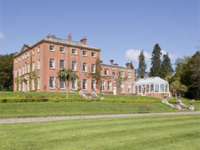
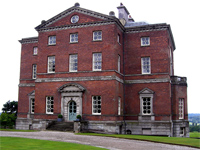
Tapeley Park, Devon (Image: chatoul / flickr)

The subject of the 13 March episode of Country House Rescue, Tapeley Park in Devon, carries on the wonderful tradition for country house eccentricities – and eccentrics.  From how the site was chosen to the manner of the inheritance, this beautiful house has a fascinating history – though more recently it’s been a little neglected.

According to Simon Jenkins, “Few Devon houses have so spectacular an outlook” – and few would disagree.  Situated above the pretty seaside town of Bideford, the site of the house was apparently chosen by the builder, Captain William Clevland, who apparently spotted the location through his telescope as he sailed up the Torridge in 1702.  He made good on his wish, rebuilding the existing manor house in an austere and somewhat uninspiring style but which took full advantage of the fine views from its elevated position – though this was later largely negated by an enthusiastic blocking up of windows to avoid the window tax.
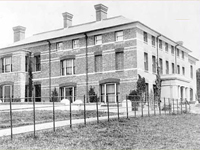
Tapeley Park, Devon - before Belcher alterations (Image: tapeleygardens.com)

The house eventually passed to the Christie family through marriage when Agnes Clevland married William Langham Christie in 1855.  The Christie fortune was made when one Daniel Christie joined the East India Company and was later given a fortune in gems by a Sultan in thanks for having prevented troops from pillaging a harem.  On his return he married the daughter of Sir Purbeck Langham of Glyndebourne in East Sussex and Saunton Court in Devon.  His grandson, Augustus Langham Christie, inherited both estates and now being a very eligible and wealthy man was able, in 1882, to marry the daughter of the Earl of Portsmouth, Lady Rosamund, whose family seat was the nearby Eggesford House (demolished in 1917).  Coming from such a grand house she was fairly unimpressed with Tapeley, writing in her diary:

“When I first saw Tapeley it was in the winter of 1881 before my marriage to Augustus Langham Christie. It was a Georgian stucco house, very plain and rather dreary in appearance, for many of the front windows had been blocked and the sunk apertures painted black with halfdrawn paint blinds, cords and tassells, looked very dull. The terrace walk and garden did not exist and the drive approached between iron railings.”

The marriage was not a particularly happy one with Lady Rosamund eventually banishing Augustus to the other Christie estate, the nearby Saughton Court, for his ‘eccentricities’ which apparently included ‘childish behaviour’ such as kicking the furniture repeatedly to annoy her.  In his absence, Lady Rosamund poured her energies into rebuilding Tapeley and engaged one of the leading neo-baroque architects, John Belcher (b.1841 – d.1913).  Due to limited finance, the work was to last from 1896 until 1916 but the professional relationship between client and architect was a happy one – so much so that on his death she had a plaque added to a wall in his memory.

Belcher is not as widely known as perhaps he should be, though his work is well regarded. He worked mainly on commercial buildings and institutions including the Whiteleys department store in London, and the brilliant Mappin & Webb building in the City of London which was scandalously demolished in 1994 to build No.1 Poultry (the only good view is looking out from the top of it!). More prominently, Belcher also designed in 1907  the imposing Ashton Memorial in Lancaster for Baron Ashton.

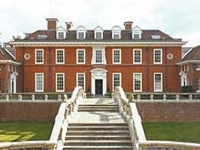
Belcher transformed the ‘dreary’ house to create an imposing but elegant ‘Queen Anne’ style Georgian villa of brick with stone pilasters, parapet and a pediment, sitting above the impressive terraced gardens. The interiors are also of note, featuring a grand staircase hall and also several good fireplaces and plaster ceilings from the original house.  Lady Rosamund had to fight to keep hold of her creation as, in an act of revenge, Augustus left the house in his will on his death in 1930 to a distant cousin in Canada, forcing her to have to go to court to argue, successfully, that Augustus was obviously insane.

The house and estate were inherited by her son, John Christie, who founded the famous opera at Glyndebourne, where he spent the other half of his time when he wasn’t at Tapeley.  Tapeley was then inherited by his daughter, another Rosamund, who frugally ran the house until her death in 1988 and was known for conducting the tours with a parrot on her head.

The current owner is one Hector Christie, Rosamund’s nephew, who apparently decided with his brother which was to inherit Glyndebourne and Tapeley by flipping a coin whilst in a Brighton nightclub.  Hector, though Eton-educated, is something of a rebel, once sneaking into a Labour party conference to heckle Tony Blair about the Iraq war, and also extending a fairly broad invitation to various hippies to create something of an eco-commune at Tapeley.

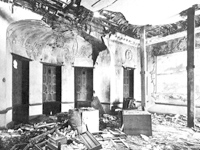
Though almost all the hippies have now left, Hector has now decided that he should focus on managing the house and estate on a more commercial basis, and not a moment too soon judging by the deteriorating condition of the grade-II* listed house, where part of the dining room ceiling fell in shortly before Ruth Watson’s first visit.  Fingers crossed her advice can provide a means for the family to stay in their ancestral seat without compromising either the architecture or setting or his principles.

Official site: Tapeley Park, Devon

Country House Rescue: Tapeley Park

Country House Rescue returns for Series 3: Wyresdale Park, Lancashire

Wyresdale Park, Lancashire (Image: Channel 4)

The history of the country house is sadly often a cycle of rise and fall with the main variable being the speed of each respectively.  The old phrase was ‘one generation made the wealth, the second enjoyed it, and the third lost it’. Over recent decades the trend has changed slightly in that, with longer life expectancies prolonging the older generations, the houses have had fewer chances for the rejuvenation which inheritance often brought.  As an alternative, Ruth Watson uses Country House Rescue as a catalyst for the type of entrepreneurial change which is the only way for these houses to survive – if only the owners would listen!

The first episode in Series 3, to be broadcast at on Channel 4 at 21:00 on 6 March 2011, takes us to Wyresdale Park in Lancashire to meet a father and son who don’t agree on the best way to maximise the obvious potential of the beautiful estate.

Wyresdale Hall was built between 1856-65 for Bolton cotton-magnate-turned-banker, Peter Ormrod, who bought 6,000-acres from the Duke of Hamilton to create his estate.  The house, which cost £50,000 (about £4m at today’s value) at the time, was designed by noted local architect Edward Graham Paley (b.1823 – d.1895) who had an extensive practice, partnering first with his mentor Edmund Sharpe, then, following Sharpe’s retirement, Hubert Austin, before being joined by his son, Henry Paley. The work of Paley & Austin in particular was well-regarded with Pevsner  saying they “did more outstanding work than any other in the county” and was “outstanding in the national as well as the regional context”.

Paley worked on relatively few country houses, being much better known for his ecclesiastical output, with included the design of Lancaster Cathedral.  Paley was brought up in deeply religious home and, working with Edmund Sharpe, who was heavily influenced by Pugin, it was unsurprising that Paley adopted the strict ecclesiastical style with the ‘correct’ use of Gothic elements.  Perhaps looking a little too much like a convent rather than a home, the house is, nonetheless, still a good example of the type of regional interpretations of Pugin’s architectural theories which gained ground in the 19th-century.

The grade-II listed house and estate passed through the Ormrod family before the land was bought by the Whewell family in the 1920s who then bought the house in 1967.  Now the family are facing the usual struggles of a listed house, an extensive list of improvements, and the need to make the changes which sometimes sit uncomfortably with the more traditional older generation.

———————————

Country House Rescue – Series 3

My usual powers have slightly failed me and I haven’t a verified list of all the houses in Series 3 but here are the ones I have identified so far:

See also:

A bad omen: the spring country house relaunch

One rather unscientific barometer of the health of the country house market is the thickness of Country Life magazine as it comes through the letterbox each week.  After the thinning of the issue in the run-up to Christmas it’s always pleasing to feel the first weighty edition of the new year.  Yet, though this week’s issue (2 March) boasts ’70 pages of property for sale’ it’s remarkable that the estate agents have so few significant country houses to offer and of those that are there, it seems, along with last week’s issue, the largest houses are relaunches.

Pyrford Court, Surrey (Image: Savills)

One of the most interesting is grade-II listed Pyrford Court, Surrey.  Originally built in 1910 for the 2nd Lord Iveagh, of the Guinness brewing family, it was one of a group of houses built around that time on the profits of beer (along with Polesden Lacey, Elveden Hall, and Bailliffscourt). The land was sold to Lord Iveagh by his father-in-law, Lord Onslow, whose family had owned the area since the 17th-century.  The house was designed by Clyde Young who had also worked at Elveden, another seat of the Guinness family, though the sensitively designed wings were added in 1927-29 by J.A. Hale of Woking to designs by Lord Iveagh.  The stylish neo-Georgian house is an elegant red-brick composition which originally sat in a 1,000-acre estate – though sadly now reduced to just 21-acres.  Lord Iveagh died in 1967 and the house sat empty until sold in 1977 – apart from a brief burst of fame as a location in the 1976 film ‘The Omen’.  The house then became an old people’s home with all the attendant damage until the current owners started their seven-figure restoration.

Pyrford Court was originally launched on the market in January 2010 for an ambitious £20m, a staggering rise in valuation from the £3.25m paid in 2000 and from the £8m asking price when it was offered for sale in 2002 (reduced, a year later, to £6.5m).  Yet this proved too much for the market to take; even for a ‘super-prime’ house within 25 miles of central London, and despite the high-quality restoration of the impressive interiors.  It subsequently languished and has now been promoted with a double-page advert – though the price is ‘on application’ meaning we won’t yet know quite how far the price has dropped.  However, looking at the other houses Savills have for sale in the area this is by far the most interesting and attractive house.

Brockhampton Park, Herefordshire (Image: Jackson-Stops & Staffs)

Another impressive house is the classically elegant, red-brick Brockhampton Park, Herefordshire.  Although the architect hasn’t been confirmed, the fact that it is virtually identical to Hatton Grange in Shropshire by Thomas Farnolls Pritchard, means it can probably be attributed to him.  The house was built in the late 1750s for Bartholomew Richard Barneby, probably using the £3,000 brought to him through his marriage in 1756 to one Betty Freeman. The Barneby family had owned the estate since the 15th-century and were to own it until 1946 when John Talbot Lutley (who was a descendent of the  Barneby family) left the house and 1,200-acre estate to the National Trust. Col. Lutley was a no-nonsense man who, on hearing of the NT country houses scheme, wrote them a short letter in 1938 saying that as he was a bachelor whose heirs were rather distant, would they be interested?

James Lees-Milne was duly dispatched – and almost rejected it on sight as it wasn’t pure Georgian due to some relatively small Victorian alterations.  However, after a tour of the estate and on seeing the beautiful Lower Brockhampton Manor, he felt that the latter two would be fine additions for the Trust – even if the big house would be a drain. It was duly left to the NT in 1946 following the Colonel’s death. Neither the house nor the contents were of sufficient quality to justify retaining or opening to the public so they sought to let it.  Unfortunately no private tenant wished to take it on, usually citing its remoteness, however in 1985 an insurance company let the house as offices and undertook a comprehensive restoration programme.  After they moved out in 1996 it was again restored as a private home and is now available with just 8-acres but surrounded by the rest of the NT-owned estate.  Interestingly the house is listed under the ‘Sales’ section of the Jackson-Stops & Staff website but I suspect this is due to it being leasehold – again ‘price on application’ so the price of the privilege is unknown, but the house has been advertised since last summer so it may be cheaper than before.

Ebberly House, Devon (Image: Savills)

Perhaps the most surprising house to still be available is the grand Ebberly House, Devon.  Rather than the expected provincial house, this is a house which displays remarkable architectural sophistication. Described by Pevsner as ‘unusual and attractive’, whose distinctive rounded ends ‘hint at the variety of room shapes inside; a provisional echo of the interest of contemporary architects such as Nash and Soane’.  Designed by Thomas Lee of Barnstaple, a pupil of Sir John Soane, the grade-II* house compensates for it’s remoteness with a fantastic house set in a fine 250-acre estate.  Offers in excess of £4m on the back of a postcard to Savills in Exeter.

Perhaps there are some clever marketing plans being hatched at the estate agents which means that rather than pushing their best properties in the first big property edition of Country Life of 2011 they’re saving them for…when?  Bonuses have just been announced and those looking to buy are probably active so perhaps there is just a general scarcity of significant country houses coming to the market.  Does this indicate 2011 will be rather thin for the agents as uncertainty limits buyers to the super-rich looking for somewhere in London or will the market pick up and a slew of new houses soon be released to whet our appetites?

The future of the country house? Alderbrook Park, Surrey

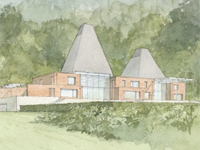
Proposed Alderbrook Park, Surrey (Image: PRS Architects)

Within any established pattern there is always the shock of the new. Most people when asked to imagine an English country house will usually think of red-brick Jacobean or light-stone Georgian but the design of new country houses is always in flux and what has gone before is no guarantee of what will come. Following World War II, the aftermath of which led to the demise of many large houses, the fashion changed to have a smaller but more modern house – one which required fewer staff and perhaps used more contemporary architectural language; however much it was derided by others.

Queen's House, Greenwich (Image: Bill Bertram / wikipedia)

The nature of architectural innovation has usually been one of gradual change – subtle at first and then growing bolder.  For example, Palladianism is widely seen to have arrived rather dramatically with the building of the Queen’s House in Greenwich in 1616 to a design by Inigo Jones.  Jones had recently studied Palladian architecture in Rome for three years and this commission was his chance to put this into practice.  One can imagine the surprise of Londoners, long used to timber, gables, and red-brick, to the square, stuccoed, and very white, Queen’s House.  Yet Sir John Summerson argues that there is evidence of Palladianism in the plan of Hardwick Hall in Derbyshire, built in the 1590s by Robert Smythson.  Here, the placing of the hall on the central axis of the main entrance and the colonnades between towers front and back, echo the layout of Palladio’s Villa Valmarana featured in his Second Book of Architecture, making Hardwick the first known use of Palladio by an English architect.  This quiet use would have meant that visitors would have become accustomed to a symmetrical, regularised interior, paving the way for the same style to appear externally.

As much as the role of ‘architect’ took time to develop, so to did the responses to their work.  In 1624, Sir Henry Wotton, writing in his ‘Elements of Architecture‘, bemoaned the lack of ‘artificiale tearmes’ – that is, language with which to describe architecture.  Yet William Webb, writing in 1622, managed to praise the then new Crewe Hall in Cheshire, saying that the owner, Sir Randolph Crew;

“…hath brought into these remote parts a modell of that most excellent for of building which is now grown to a degree beyond the building of old times for loftiness, sightlines and pleasant habitation…”

So, ever since we’ve had architects, we’ve had critics (who were also sometimes architects); Jones, Wren, Ruskin, Pugin, Morris, Lutyens, Pevsner, etc have all made their opinions known.  Overseas visitors were also apt to compare what they had seen.  Jean Barnard le Blanc, visiting in 1737-8, was well educated and travelled and critical of the emerging use of Italian designs in England saying;

“These models have not made the English architects more expert; for whenever they attempt to do anything more than barely to copy, they erect nothing but heavy masses of stone, like of Blenheim Palace…”

As the language developed and architecture became more academic it became more rigorous and perhaps dry, with light relief afforded by more waspish commentators such Sacheverell Sitwell.

So why are some houses criticised more than others?  It seems that houses which appear without the ground being prepared before them suffer most.  The shock of the new is unmitigated and particularly where there is a strong local vernacular, the language of the new house will be a greater change.  More broadly, where a house is seen to be breaking with old traditions and what is seen as the ‘appropriate’ style for a family or an area, criticism can be swift and strong.

Eaton Hall by John Dennys for the Duke of Westminster (Image: Kathryn Gammon)

One example of this is Eaton Hall in Cheshire following the unfortunate demolition between 1961-63 of the vast Victorian masterpiece designed by Alfred Waterhouse.  The loss of the house left a gaping hole at the centre of the estate with large gardens and long tree-lined avenues leading to nowhere.  The 5th Duke decided to rebuild and commissioned his brother-in-law, the architect John Dennys, to design a very modern replacement.  The resulting house, although striking, was regarded as unsuccessful, with John Martin Robinson saying,

“The sad fact is that, while from a distance the new Eaton has some of the classic Modern impact of the Corbusier dream…close up it is rather disappointing…”

Yet rather than criticising the house for not being in the traditional language of the English country house, Robinson is saying that it’s not Modern enough.  Others disagreed, with perhaps the most amusing response coming from the Duke of Bedford before it was even built.  Writing in 1970 after the unveiling of the design, he wrote;

“I was interested to see…a sketch model of Eaton Hall.  It seems to me one of the virtues of the Grosvenor family is that they frequently demolish their stately home [Waterhouse’s being the third on the site]. I trust future generations will continue this tradition if this present edifice, that would make a fine office block for a factory on a by-pass, is constructed.”

Proposed Grafton New Hall, Cheshire (Image: Ushida Finlay Architects)

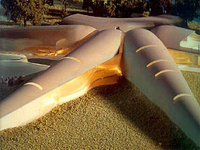
In more recent times, one design which met with critical acclaim but was perhaps a step too far was the Ushida Findlay design for Grafton New Hall, Cheshire.  Their house was a response to a 2001 RIBA competition to ‘design a country house for the 21st century’.  In creating their radical ‘star-fish’ layout they were rejecting the established patterns and trying to create a new response to the same requirements for the functions of a country house.  Yet the house never found a patron and, tellingly, the house now being constructed is a classic of modern Palladianism, designed by the pre-eminent Classical architect, Robert Adam.

There are, of course, many other examples of intelligent but unpopular designs for modern country houses – for example, Wadhurst Park in Sussex for TetraPak billionaire Hans Rausing.  And it’s in this constant stylistic flux into which Lakshmi Mittal has pitched the very radical designs for his new house on the 340-acre Alderbrook Park estate which he bought four years ago for £5.25m.  The original house by Richard Norman Shaw for the Ralli family was demolished in 1956 as too large, with a poor, inadequate substitute built in the 1960s.  The estate was sold with the express intention of demolishing this house and in its place Mittal is proposing a £25m, carbon neutral ‘eco-home’.  To help achieve this, the design of the house is driven by the functional requirements to minimise heat loss, to be cooled by natural ventilation, and have hot water provided by pyramid chimneys which incorporate solar thermal collectors which will help also vent heat in summer.  This house is a rejection of the idea of the house as an aesthetic construct in a particular architectural style but is more Corbusier-like; a ‘machine for living’ – a somewhat depressing prospect.

Grafton New Hall, Cheshire (Image: Robert Adam Architects)

So what does the future hold?  The natural course of the development of the country house has been its adaptation to the whims and preferences of the owners.  As younger generations have taken the reins they’ve chosen different and perhaps more fashionable styles – and without change we wouldn’t have the Georgian mansions or Lutyens to love. However, each of the previous styles could be seen as natural evolution which reused a broad architectural vocabulary which was instantly recognisable as distinctively rural.  What seems to jar with the very modern designs is that they seem to use a more urban, industrial language to interpret the form of the country house.  This seems to sit somewhat uneasily with our preconceived notions as to what a country house should look like – but who knows, perhaps in 50 years maybe it’ll be accepted and appreciated and we’ll be concerned about the next stylistic evolution.  I still prefer Georgian Palladian.

Back from the brink: country houses rescued from dereliction

Finedon Hall, Northamptonshire (Image: Stephens Pictures / flickr)

One often forgotten aspect of local newspapers is their ability to draw on their archives and provide reminders of local history. The local paper frequently played an important part in publicising the goings on at the ‘big house’, reporting the successes and scandals with usually equal vigour.  A recent article in the Northamptonshire ‘Evening Telegraph‘ reflects not only on the collapse of the Volta tower, built by the owner of Finedon Hall as a memorial to his drowned son, but also the later dereliction and near loss of the house itself as it slipped from dereliction ever closer to demolition.  Yet, unlike so many hundreds of other country houses which were lost, Finedon Hall was one of the many which have been saved.

c1980 - Finedon Hall, Northamptonshire (Image: Evening Telegraph)

Finedon Hall has 17th-century origins but its current style is the result of what Mark Girouard called “eccentric chunky” alterations by E.F. Law for the owner, William Mackworth-Dolben, in the 1850s.  Built in a Tudor-Gothic style in the local ironstone (which was quarried on their land) the house passed through the family until the last of the family, the spinster Ellen Mackworth-Dolben died in 1912.  With no heirs, the estate was sold off in parcels with the house passing through a number of owners before being bought by developers in 1971.  For over a decade they allowed the house to deteriorate until just ten years later parts of the roof had gone and the exterior was in serious danger of collapse.  Luckily, more enlightened developers stepped in and during the 1990s the house (and estate buildings) were converted into apartments.

One of the largest houses to be converted in this way was Thorndon Hall in Essex.  One of James Paine‘s largest commissions, this Palladian mansion was originally built for the 9th Lord Petre in 1764-7 but was gutted by fire in 1876, leaving only the eastern end of the main block and the eastern pavilion intact.  The Petre family lived in the reduced house until 1919 when they leased it and the estate to a golf club and they moved back to the original family home, Ingatestone Hall.  The house remained a largely ruined shell until it was sold for development in 1976 but was then bought in 1978 by a local builder who created a total of 84 apartments in the house, pavilions and estate buildings.

Ecton Hall, Northamptonshire (Image: Conway Collections / Courtauld Institute of Art)

One of the most accomplished and intelligent of the developers to convert country houses is Kit Martin who has saved several houses and including Ecton Hall in Northamptonshire.  The house was largely remodelled by Ambrose Isted in 1755 in the then relatively new ‘Gothic-Revival‘ style (Horace Walpole had only started his work at Strawberry Hill in the early 1750s and it’s considered one of the earliest houses in the new style).  The house was filled with fine art, books and furniture and passed through the Isteds and then, by marriage, to the Sothebys who owned it until the last died, childless, in 1952. At this point the rot set in; builders called in to remove a large kitchen extension also, apparently, stole the valuable lead from the roof leading to dry and wet rot. Alexander Creswell, visiting in the 1980s, described the scene:

“The rich ochre stone of the garden front is engulfed in Virginia creeper, and sparkles of broken glass litter the terrace.  Inside the house, the drawing room fireplace rises above a heap of plaster that the roof has brought down…At one end of the house the winter storms have toppled a gable, which in falling has crushed the fragile camellia-house below; one surviving camellia blooms among the rubble of ironstone – the only flourishing vestige of Ecton’s former glory” – ‘The Silent Houses of Britain

However, by 1989 Kit Martin had finished his work and the new apartments were advertised for sale in Country Life; a remarkable rescue for this almost lost house.

Gunton Park, Norfolk (Image: Broads Marshman / flickr)

Perhaps Kit’s finest work is Gunton Park in Norfolk.  The house was originally the work of Matthew Brettingham, a competent, if sometimes unimaginative, Palladian who had first achieved recognition with his work executing William Kent and Lord Burlington‘s designs for Holkham Hall.  This work brought him to the attention of other aristocratic clients, particularly in Norfolk, including Sir William Harbord who commissioned him in 1745 to design a replacement at Gunton for an earlier house which had burnt down three years earlier.  Brettingham’s house was to be significantly enlarged c.1785 to designs by James Wyatt.

Sadly, fire struck again; in 1882 the Brettingham portion of the house, including the fine rooms, was almost completely gutted and remained a forlorn shell for the next 100 years.  Kit Martin bought the house in 1981 and sensitively created well-proportioned apartments in the remaining wings. The front of the Brettingham wing (pictured above) become one large house separated from the main block by a large void created by the fire but still linked by the retained façades.  It’s not just the house which has been rejuvenated; the parkland – nearly 1,000 acres – has also been bought or, through agreements, reunited (and in the process winning an award from Country Life magazine) to restore the setting of this elegant house.

Barlaston Hall, Staffordshire (Image: Peter I. Vardy / Wikipedia)

It’s rare for a house, once in a state of dereliction, to be restored as a single family home, yet thankfully it does happen. Barlaston Hall is one example of this – and it’s rescue was down to some bold decisions by the campaigning charity SAVE Britain’s Heritage and their President, the architectural writer Marcus Binney, who was offered this elegant house for £1!  Barlaston Hall is, according to Binney, almost certainly the work of the architect Sir Robert Taylor (b.1714 – d.1788).   The house is a relatively unadorned but sophisticated house, enlivened with unusual octagonal and diamond glazing bars in the sash windows; Taylor’s response to the popularity of Chinese Chippendale furniture and a general fashion for the Rococo.

Dining Room - Barlaston Hall, Staffordshire (Image: Christopher Dalton)

However, the house had been built on several coal seams which threatened the house when they were mined in the 20th-century.  Structurally unsound, it had been abandoned and vandalised but SAVE stepped in to challenge Wedgewood’s application to demolish.  At the subsequent public inquiry, the National Coal Board threw down the challenge that SAVE could buy the house for £1 provided it completed restoration and repairs within six years.  SAVE swung into action, raising money through grants and by forcing the NCB to meet its obligations (which it did after some shameful attempts to avoid doing so), and the house was stabilised, restored, and subsequently sold to a couple who completed the interior and it remains a family home.

Piercefield House, Monmouthshire (Image: darkcell / flickr)
Piercefield House, Monmouthshire (Image: darkcell / flickr) - click to see large version

Sadly there are many country houses still at risk today – though the rescues also continue. Pell Well Hall in Shropshire, a wonderful house by Sir John Soane built in 1822-28, has been restored as a shell after decades of neglect, vandalism and fire, and now requires someone with vision to complete the process.  Bank Hall in Lancashire was featured in the original ‘Restoration’ TV series but has continued to deteriorate with sections collapsing.  However, planning permission is being sought to convert the house into apartments which will enable restoration of the house. One house however has, inexplicably (well, to me), remained unrestored; Piercefield House in Monmouthshire.  This beautiful house, again by Sir John Soane, became uninhabited and was mistreated during WWII by the American troops stationed nearby who used the façade for target practice.  The house, set in 129 acres, has been for sale for several years but despite the architectural provenance and the wonderful setting it remains unsold.

The story of the country house has always been one of changing fortunes, which sadly led to many being demolished. The difference now we have heritage legislation is that whereas before houses were often simply demolished, now their plight is likely to drag on for many years.  Restoration is often the best course of action, preserving as much of the original fabric as possible, and ideally as a single family home, though the less palatable options of conversion are always to be preferred to the complete loss of another of our historic houses.

News story: ‘Fascinating history of Hall‘ [Evening Telegraph]