Tidmington House, Warwickshire (Image: Philip Halling/Geograph)
With sad co-incidence, having recently posted about how owners respond to fires in country houses, news comes through that Tidmington House in Warwickshire was badly damaged whilst undergoing renovations.
Tidmington was built in the early 17th-century but was re-fronted in the 18th-century giving it a pleasing and elegant facade, which is visible from the road. Distinctive gables top a neat front which successfully mixes Elizabethan elements with the classical. The recessed central section runs from a smaller middle gable featuring a Diocletian (or thermal) window, above a first floor tripartite Venetian window, sometimes known as Palladian or Serlian after the two architects most associated with popularising it, with finally the two wings being joined by a Tuscan colonnade. Two 1-bay pavilions extend to the left and right, providing a clever balance to the height of the main house.
The grade-II* listed house was once the home of Thomas Beecham, 2nd son of the famous conductor, before being put up for sale in 2009 for £3.95m by the owners who had moved there in 1988. The house was then given a glowing write-up in The Times by Marcus Binney who relished the bold use of colour; the sky-blue library, the jade green dining room – but I wonder if the bold colours in the house contributed to the situation as it was during renovations by the new owners that the fire started.
The blaze is reported to have badly damaged the first floor where the fire started and also part of the ground floor but hopefully a majority of the 8,500 sq ft house will have been spared from the flames – though the inevitable smoke and water damage will have spread beyond the immediate blaze. Again, it shows that insurance companies are right to demand to be told when works are taking place as it is so often during renovations when these fires seem to break out – please don’t let this be another workman being careless with a blow-torch.
When Raasay House on the Isle of Skye Raasay was largely destroyed by a huge fire in January 2009 just days before it was due to reopen following a £4m refurbishment, the locals and owners vowed to quickly rebuild the house as it was. Fire has always been one of the major threats to our country houses and when it strikes the responses to the destruction can vary greatly – particularly in the modern era.
For many country house owners in the 16th-19th-centuries immediate rebuilding was the favoured response if funds allowed – either to re-create the original house or sometimes to build an entirely new one. Raasay House was built in 1746 for the clan Macleod after the previous house, built in the 1500s, was deliberately burnt down in 1745 in the wave of retribution which followed the Battle of Culloden. The house, extended in the 1870s, was run as an outdoor pursuits centre and was an important part of the economy on the Isle of Skye Raasay. This meant the response was largely on the basis of local economics which required the house to be rebuild to support the business, apparently not for its intrinsic architectural value. However, the Scottish grade-A listing (equivalent to the English grade-I) means that the ‘new’ Raasay will be a faithful recreation of the original house as it was before the fire.
Although country house owners have long rebuilt, the principle that the house will be strictly rebuilt exactly as it was is, in some ways, a modern response as heritage legislation requires full salvage of any architectural fragments with the presumption of restoration. Insurance companies also pay out for recreation of the old building, not the construction of a new one. So responses now are sometimes based on the architectural or heritage value, and sometimes due to the constraints placed on the owners. The wishes of the owners also play an important part with some looking to recreate whilst others follow the principles of the Society for the Protection of Ancient Buildings who state:
Although no building can withstand decay, neglect and depredation entirely, neither can aesthetic judgement nor archaeological proof justify the reproduction of worn or missing parts. Only as a practical expedient on a small scale can a case for restoration be argued.
The 1992 fire at Windsor Castle destroyed large sections of the State Apartments including the Crimson and Green Drawing Rooms, the Queen’s Private Chapel and St George’s Hall. It was quickly decided by the Restoration Committee (headed by Prince Philip) that many of the rooms would be restored to as close as possible their original state with only a few modern rooms and the Queen’s Private Chapel to be restored in a modern style.
However, no lesser organisation than the National Trust also has firmly followed the faithful re-creation approach, particularly following the devastating 1989 fire at Uppark, Sussex. Although the dramatic pictures of the fire would suggest total loss, brave efforts by staff saved the majority of the contents of the house and the fire was found to have only destroyed the attic and first floors whilst severely damaging the ground floor. It was then announced by Martin Sekers, the National Trust’s Regional Director for the Southern Region, that “We feel that enough survives to justify total restoration.”. So how much has to survive to warrant re-creation? A spirited public debate at the time brought forward opposing views such as that expressed by the respected architecture critic Deyan Sudjic who argued in an article in the Sunday Correspondent (17 Sept 1989) that:
“…it won’t actually be Uppark no matter how skilful the work of the 20th Century craftsman who seek to recreate it. What tourists come to see will, in fact, be a replica, one which could be said to diminish those fragments which actually are authentic…”
However, other eminent architectural historians such as Dan Cruikshank came out strongly in favour of recreation principally from the point that it provided the opportunity to re-learn old techniques and provide a model in their use. Andor Gomme argued that a recreated Uppark would be the only appropriate way to show the rescued contents in an appropriate setting. Gomme also highlighted that in previous cases where a house owned by the National Trust had burnt down (the incomparable Coleshill, Berkshire in 1953 and Dunsland House, Devon in 1967) the decision at the time to demolish what remained was later deeply regretted.
So for public organisations the clear preference is strongly in favour of re-creation despite the claims of the modernist and the SPAB that such an approach is to miss an opportunity or is simply fake. Yet, for private country house owners, their long-held preference has been to simply restore as much as possible – even if just the walls were left standing.
When Knepp Castle, Sussex was gutted by fire in 1904, work started in 1905 to recreate John Nash’s original design. Similarly after fires at Bramham Park in 1828, Duncombe Park in 1879, Stourhead in 1902, Monzie Castle in 1903 and Sledmere in 1911, the owners all worked to faithfully recreate the houses to the state as they had been. For houses such as Lees Court in Kent which was almost completely destroyed in 1911 (scroll to last image) the house was just rebuilt using what remained of the outer walls.
So is restoration the best approach? Although there is danger that the new work might be a poor pastiche of the earlier work, to just discard what has been salvaged and what remains and to only allow modern work would seem to be overly dogmatic. However, it will only work if any restoration is of the highest quality to avoid any chance that what is produced is merely a lifeless reproduction. Owners over the last 400-years when faced with a greater or lesser degree of loss have often sought to restore and to continue that tradition today is to draw on a much longer history than to rely only on the intellectual restrictions of the later purists.
Firbeck Hall, Yorkshire (Image: Paul Eggleston/English Heritage)
Some houses languish for years slowly deteriorating, much to the annoyance of interested locals who care about their architectural heritage. For some houses, the obstacle in the way can sometimes be a difficult owner, for others it’s just the sheer scale of the job. Certainly falling into the latter category is Firbeck Hall near Rotherham in South Yorkshire; once palatial home, then a country club, a hospital, and now a cause for serious concern.
Firbeck Hall was originally built in 1594 for William West, a wealthy lawyer who was also connected between 1580 to 1594 to Gilbert Talbot, 7th Earl of Shrewsbury. After his death in 1598 it passed through various branches of the family via inheritance until bought by Henry Gally in the late 18th-century. It was his son, Henry Gally-Knight, who, in 1820, substantially remodelled and extended Firbeck in the Elizabethan style we see today. Sold in the mid-19th-century it passed through the Ecclesiastical Commissioners who sold it to Mrs Miles of Bristol who left it to the Jebb family who remained there until 1909 when it was put up for sale. The early 20th-century was a particularly hard time for country house owners with falling rental and agricultural income affecting all landowners but particularly those caring for the architectural extravagances of previous owners.
Firbeck Hall was badly damaged by fire in 1924 but it’s fortunes improved when it was eventually sold in 1934 to businessman Cyril Nicholson who invested £80,000 (approx £4m – 2008 values) who created the premier country club in the nation, visited by royalty and celebrities. World War II put an end to the gilded lifestyle and it became a hospital in 1943, a role it was to fulfil until c.1990 when it eventually closed.
Since then the house has deteriorated significantly – despite it’s grade-II listing it has suffered from lead theft from the roofs, neglect, and a series of failed plans to rescue what is still one of the largest houses in the area with over 200 rooms. It’s this last fact which is the root cause of the difficulties with any plans for conversion and restoration requiring significant financial resources which banks are unwilling to provide in these tough economic times. Too large for private solutions, the house is also probably too large for our stretched national heritage organisations to take on (such as English Heritage did with Apethorpe Hall, Northamptonshire) – especially as the institutional use has degraded the interior.
The house was bought by a local construction firm in 1996 but little seemed to happen apart from further thefts and vandalism and with little reaction initially from Rotherham Council and active interest from a local conservation group, the ‘Friends of Firbeck Hall‘. However, a major theft in 2005 prompted a complete change of heart from the owner who forged links with a new conservation officer leading to new plans for conversion, active security and some remedial restoration works. Although progress was slow, at least it was progress – until July 2009 when a fire broke out during works on the roof causing serious damage. More bad news followed when the construction firm went into liquidation in May 2010 – joining the ranks of developers with grand plans who have been beaten by the scale of the task, as seen at Gwrych Castle in Wales.
There does seem to be a gap in the provision of solutions for larger houses where private initiatives are insufficient. A more active local conservation department may have slowed the decay in the early stages but the longer houses of this size continue to be unused the greater the cost of restoration, reducing the chances that they can be saved. Hopefully there is some hope for Firbeck Hall as the house was sold again in July 2010 – but as yet there’s no news as to future plans, or more importantly, how they will be financed.
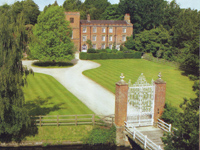
Launched this week ( 23 June 2010) in Country Life magazine is a fine, grade-II* listed, moated manor house set in nearly 250 acres of Hampshire. Open the first set of impressive wrought iron gates and follow the drive down to the ancient moat and through the second, equally impressive, set of white painted gates over the wooden bridge. Before you stands a beautiful red-brick manor house – but why is the house set in one small corner of the island? Why does the drive lead over the moat but unusually not to the middle of the house? And why does that tower look a bit new?
The answer to all these questions is that Beaurepaire House, as it now stands, is what remains of an important and beautiful manor house which burnt down in 1942 after a chimney fire. What happened subsequently is an interesting example of how disaster need not lead to the loss of the whole house or the estate.
Beaurepaire House, Hampshire before the fire (Image: Lost Heritage: England's Lost Country Houses)
Beaurepaire House has royal connections having been visited twice, once by Henry VIII in 1531 and then by his daughter Elizabeth I during her visit to The Vyne. The moat itself dates from 1369 but the original house was built in the 16th-century but was badly damaged during the Civil War and was only rebuilt in 1777. The design of the new Georgian ‘Gothick’ house followed the rare structure of having a square core with castellated corner turrets. There are relatively few examples of these houses – and the ones we have today are all ruined to some degree (Ruperra Castle, Wales / Lulworth Castle, Dorset) or lost entirely (Compton Bassett House, Wiltshire).
At the time of the fire the house was owned by one of the richest men in the country, Sir Strati Ralli, but wartime building restrictions prevented restoration. After the war the estate was owned by Lady Sherfield and in 1965 she decided to restore the remaining servant’s wing as a house and commissioned the well-known architect Tom Bird, who had restored many other country houses, to make the house habitable. Bird decided to add a sympathetic tower, which continued the existing architectural style, to the fire-damaged southern flank of the remaining wing to not only provide structure but also to improve the proportions of what was left. The addition was less than 10% of what remained but successfully ensured that the house was able to rise again from the ashes of the fire to retain the role it had enjoyed for hundreds of years as the centrepiece to an impressive country estate.
_____________________
Property details: Knight Frank seem to have forgotten to put the details on their website. Nevermind, here’s a link to all the Hampshire houses they’re selling in the hope that they soon add it in: Knight Frank: Hampshire
Plas Gwynfryn, Wales (Image: SAVE Britain's Heritage)
It’s often been said that there are no problem buildings, just problem owners. However, an even more difficult situation is where the house is ‘orphaned’ because no legitimate owner can be found. This can make it doubly frustrating for those looking to buy and restore a property who are forced to sit by and watch a building deteriorate as the search goes on to find the owner. This also highlights something of a legislative loophole as having no known owner also prevents the council serving an ‘Urgent Works Notice’ to force repairs thus ensuring that the house will continue to deteriorate. Which brings us to Plas Gwynfryn; an orphan with good prospects if adoption takes place quickly.
The grade-II listed Plas Gwynfryn is another of the many Welsh country houses built to serve the minor gentry, with their increased wealth from the Victorian industrial boom. The estate had been inherited from a childless uncle by Owen Jones Ellis-Nanney in 1819, and he hugely increased the size of his lands by purchasing the neighbouring Plas Hen estate. On his death it passed to his son, Hugh John Ellis-Nanney. Having been educated at Eton and Oxford and, on his 21st birthday, now owner of a huge estate, Hugh was the epitome of the eligible bachelor and wanted a house to reflect his status.
The old house was demolished in 1866 and the new house was completed by 1876 at the then astronomical cost of £70,000 (approximately £3m in today’s money). The design, by architect George Williams, was regarded as very fashionable to the extent that the house was featured in ‘The Builder’ magazine in June 1877. Hugh was very active in local politics and in 1895 almost beat the local Liberal candidate, the future Prime Minister David Lloyd George, losing by only 194 votes. Almost by way of consolation Hugh was given a baronetcy and happily lived out his days at Plas Gwynfryn, dying in 1925, with his wife following in 1928. As their only son had died aged just eight, the house was inherited by their daughter who moved out to Plas Hen. The house was then let to the Church of Wales before being sold off in 1959 when the estate was broken up.
It then became a hospital and then a hotel before a mysterious fire entirely gutted it in 1982. Since then it has stood as an empty shell, slowly deteriorating, and is now in serious danger of collapse with the tower a particular risk. Almost no work has been done on the house except for a brief period when a conservation-minded squatter moved in and started work. This prompted the only known appearance by the apparently Canadian owner who appeared in a local court during eviction proceedings. Since then nothing has been heard of the owner and the local council, though aware of the situation, seem powerless to act unless the owner can be found. A local developer, Aaron Hill, who has completed other historic restorations, is keen to find the owner and buy Plas Gwynfryn with a view to fully restoring it as a family home – which would surely be the best outcome.
Although rare, this example shows that despite the combined efforts of the local Council and a potential buyer an owner can remain a mystery, thwarting well-intentioned efforts to rescue a house before it deteriorates beyond the point of repair. If there is a legislative loophole it must be closed to prevent any other houses languishing in such a way.
Perhaps councils could be given the legal power to compulsorily purchase when a house is at risk of complete loss, with the money held in escrow in case the owner should appear. Councils are often reluctant to use their powers of compulsory purchase as they become legally responsible for repairs but surely in cases like this with an owner desperate to take the house on, the risk to the public purse is very low. The power would have to only be used in extremis when all other avenues had been exhausted but at least it would give a tool of last resort to ensure that more of our heritage is not lost just because a problem owner can’t be located and forced to honour their responsibilities.
If you are the owner and you happen to read this, please do get in contact with either me or the Council or SAVE Britain’s Heritage who would be more than happy to help get the process of rescuing this house under way.




 The Country Seat