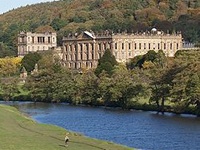
The front line: the campaigners for country houses

Apethorpe Hall, Northamptonshire (Image: English Heritage)

Despite the image of wealth and power a country house might create, in reality their existence is far more precarious – as can be seen with nearly 1,800 houses lost over the last two centuries.  A house facing the threats of being uninhabited without a concerned, well-funded owner with an inclination to keep it in good repair can quickly deteriorate leaving another gap in the tapestry of the countryside.  Sometimes it requires someone other than concerned locals and architectural historians to highlight and campaign on behalf of those ‘at risk’ so here’s a quick round-up of the main English organisations fighting on behalf of country houses and who are very worthy of support.

English Heritage inhabits a prime position in view of its role in defining and, in conjunction with local authorities, implementing the statutory protection of our built heritage.  Its role can be traced back to the Ancient Monuments Act of 1882 – though the legislation specifically excluded privately owned houses. The responsibilities were exercised through various government departments until it became a quango in 1984.  As well as being responsible for the listing system and the annual production of the various ‘at risk’ registers (focussing mainly on grade-I and -II* properties), EH is also directly responsible for various country houses including Brodsworth Hall (Yorkshire), Rufford Abbey (Nottinghamshire), Hill Hall and Audley End (Essex), Kirby Hall (Northamptonshire), Witley Court (Worcestershire), Stokesay Castle (Shropshire), and Apethorpe Hall (Northamptonshire).   It’s at the grade-I listed Apethorpe where EH has done some of it’s most interesting work; taking a direct role in the restoration of one of the finest Elizabethan/Jacobean houses in the country following a long period of neglect. Since 2008, the house has been for sale for around £5m – though there is a compulsory £4m list of renovations, and if you want complete privacy expect to pay another £8m to fully reimburse EH otherwise you have to open it for 28 days a year; so a nice round £20m to restore, furnish and keep as your own. However, this is a role that I fully support them in taking on – they should be there as owner and restorer of last resort for threatened grade-I houses.  Now perhaps we can interest them in the sadly deriorating Melton Constable Hall in Norfolk…?

Another important group of campaigners are recognised in the 1968 Town and Country Planning Act which formalised the role of what are known as ‘amenity societies‘; that is, well-established voluntary societies who are experts in their areas, who must, by law, be informed of any applications for listed building consent to demolish listed buildings in whole or in part in England and Wales.

One of the best known is the Georgian Group who cover a period broadly from 1700-1837.  The society was established in 1937 and has long campaigned for the sensitive restoration and retention of not only the buildings but the many important, and sometimes sadly overlooked, internal features which are a key part of the character of a building.  Current active campaigns and cases they are involved in include Bank Hall in Lancashire and Trewarthenick House in Cornwall and many others. They also produce a scholarly annual research journal which provides a much more in-depth view of aspects of Georgian architecture.  Access for the wonderful trips to houses not normally open to the public are worth joining for alone.
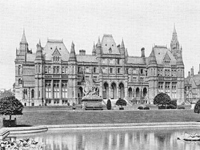
Eaton Hall, Cheshire (by Alfred Waterhouse - dem. 1961) (Image: Lost Heritage)

The Victorian Society (which also covers Edwardian buildings too) was formed in 1958 at a time when almost all things Victorian were disliked and an easy target for demolition.  Founded at the suggestion of Anne, Lady Rosse, along with her influential friends such as Sir John Betjeman and Sir Nicklaus Pevsner, the Society has fought some notable battles; losing some such as Euston Station but winning others, such as the soon-to-reopen St Pancras Midland Grand Hotel building.  Victorian country houses have suffered badly as, although designed by eminent architects such as Richard Norman Shaw and Alfred Waterhouse, they were often built on a much grander and therefore less economically sustainable scale and at the times of greatest threat (the 1930s and 1950s) had few friends to argue on their behalf.  Luckily though this has changed – but with the predominant ‘gothic-revival’ style being quite polarising, threats to houses from this period will always be present. Again, well worth joining.

Perhaps more controversially for this blog, it’s also worth bearing in mind the Twentieth Century Society.  Although the focus of the houses usually covered is before 1900, there has been a growing recognition that some of the country houses built in the 20th-century were well-planned and architecturally pleasing, even if they sometimes replaced a much more attractive Georgian or Victorian house.  It does seem to take about 50 years after a style has passed from being fashionable for it to be appreciated, so I suspect there will be a growing realisation that we need to protect the work of those such as Francis Johnson, Craig Hamilton, Quinlan Terry, and Robert Adam (amongst many others) in the future.

The Society for the Protection of Ancient Buildings (SPAB) is, as its name makes clear, not usually concerned with country houses as they are relatively ‘modern’ in terms of its remit.  However, they do immensely important work in promoting good repair practice to all buildings and their courses have taught generations of owners and craftsmen to respect the country houses and to approach any work required with a more ‘heritage’ mindset.

Although not ‘amenity societies’, two other organisations deserve a mention. The first is the Historic Houses Association which acts on behalf of the private owners of country houses and often lobby government to make them aware of the immense work done by the individual owners to maintain their slice of the national architectural heritage.  It may seem unfashionable in wider society to support the wealthy but they are the ones not only maintaining their homes to the exacting standards of English Heritage, but also restoring and rescuing houses and converting them back into homes again – and for that they deserve our thanks.

The Grange, Hampshire (Image: mpntod / Wikipedia)

The other organisation is one in which I have an interest having worked with them for several years: SAVE Britain’s Heritage.  Founded in 1974, SAVE have taken a very active stance on campaigning, willing to create media interest at short notice, but also to take time to produce some excellent research on houses at risk with thoughtful proposals for their re-use.  These campaigns have saved houses such as Calke Abbey in Derbyshire, The Grange in Hampshire, Barlaston Hall in Staffordshire (where SAVE bravely took on the house for £1!), and, working with Kit Martin, have acted as a catalyst for the saving of other houses through conversion into apartments.  Supporting SAVE’s work and becoming a Friend also gives access to their extensive ‘Buildings at Risk Register’ which features over 800 properties, including several country houses, which are in need of rescue – could it be you?

It is also worth keeping an eye out for local activists and campaigns which can also be remarkably successful at highlighting buildings at risk but can also sometimes take a more direct role; see the wonderful work at Poltimore, Devon, Bank Hall, Lancashire, and Copped Hall, Essex.  These are just three examples where concerned locals have organised themselves and presented a credible alternative and prevented the complete loss of the house.

All of these organisations are worth joining but economics being what they are it can be best to join a national organisation and then another to focus on the period which you prefer.  Joining up means that you are helping to support research but also active campaigns to ensure that as much of our built heritage is passed on to future generations.

———————————————————

I realise this selection is not comprehensive and is quite national in focus and deficient in regional organisations but this will be remedied in another post once I’ve had time to learn a bit more about who’s out there.

– Matthew

———————————————————

Going to the country: the country houses of UK Prime Ministers – Part 1

Houghton Hall, Norfolk (Image: Dennis Smith / Geograph)

Those in important political roles have often sought to escape the pressures of office by escaping to the calm and tranquillity of the countryside.  This has been particularly true of the holder of the most important role; that of Prime Minister.  With early PMs drawn from the aristocracy, their backgrounds provided them with a seat which became a natural refuge but was also an important part of their political identity.  However, as their origins changed, so too did the nature of the country retreat.  However, for all PMs the country retreat has been a fairly constant feature – though not all aspired to live in grandeur.

To make this broad survey more digestible I’ve split this into PMs by ruling monarch, starting from when the role of Prime Minister was first recognised in 1721 under King George I.

The first holder of the office, Robert Walpole, 1st Earl of Orford, was the epitome of the aristocratic leader.  Walpole was born at Houghton Hall in Norfolk – though the house was a more modest one before Sir Robert engaged Colen Campbell in 1722 to rebuild it, creating one of the finest Palladian houses in the country.  The second PM was Spencer Compton, 1st Earl of Wilmington, who also employed Colen Campbell in 1726 to create a more modest home; Compton Place in Sussex.

The seat of Henry Pelham, who became the 3rd PM in 1743, was (according to Howard Colvin) Esher Place in Surrey which he bough in 1729. In 1733, he commissioned William Kent, who was also to create some garden buildings for Claremont for the Duke of Newcastle (see below), to add wings to the original house, Wolsey’s Tower, in a Gothic style.  The wings and garden buildings at Esher have now been demolished but drawings survive in the Victoria & Albert Museum in London.

Pelham was succeeded as PM by his older brother, Thomas Pelham-Holles, the 1st Duke of Newcastle, whose main seat was Claremont in Esher, Surrey which he had bought from Sir John Vanbrugh who had built a ‘very small box’ as his own home.  The Duke then commissioned Vanbrugh to extend the house, adding two large wings.  This house was subsequently demolished as unfashionable by Clive of India who had bought the estate in 1768 following the Duke’s death, before being rebuilt in the Palladian style we see today.   The Duke also had other homes including in Halland, Sussex, an area the Pelham family had dominated since 1595 when they first bought land there.  Halland Place was also sold in 1768 and later demolished for materials.  [Originally I gave Welbeck Abbey as his seat but it was, in fact, inherited by the Holles Earls of Clare branch of the family creating a bitter feud.  A more detailed history of the feud is given by dennis in this comment below (thank you for the correction).]

One of the most fascinating houses in the country, particularly due to the extensive tunnelling work commissioned by the 5th Duke, but also one of the least known due to the reclusiveness of the Bentinck family and then later due to its role as the Army Sixth Form college which ensured military-level privacy. The house was largely the work of Sir Charles Cavendish who was given the house and estate by his mother, the remarkable Bess of Hardwick. [Corrected in response to comment below]

To complete the list of aristocratic PMs during the reign of George I (1714–1727) and George II (1727–1760), the last was William Cavendish, 4th Duke of Devonshire who lived in the peerless Chatsworth in Derbyshire – then, as now, one of the finest of our large country houses.  Interestingly, at the same time as he took on the role of PM in 1756, he also engaged in building at Chatsworth employing James Paine to add a new office wing and court (later replaced by Sir Jeffry Wyatville), a stable block, a bridge in the park, a bridge at Beeley, a water mill and also alterations to interiors of the house – though this work was not to be completed until 1767, long after his time as PM finished in 1757.

One notable feature of all the first PMs was they were all Whigs, a party nicknamed the ‘Country Party’ for their support was strongest in the shires and amongst the great landowners.  Unsurprisingly, these leaders were already managing vast estates which naturally came with sizeable houses which reflected their status – which then gave them the authority to aspire to be PM.  At this time, elections were rather crude affairs with the major landowners having MPs in their pockets due to ‘rotten boroughs‘ which gave the landowner a disproportionate, not to mention undemocratic, influence in the Houses of Commons.  Their country houses were therefore not a symptomatic trapping of power, something that they had aspired to and then acquired, but, in fact, were the foundation of the power which had secured them the position in the first place.

Chatsworth House, Derbyshire

Architecturally, the apparently only acceptable styles were either Palladian or Classical which reflected the political nature of the landowners – symmetry, structure, proportion and the use of the correct orders would have appealed to those who were against monarchical absolutism (which would have challenged their own power) but also reflected a societal structure which ensured their wealth and status.  The Whigs were also closely associated with the Church of England and, as such, would not have entertained the idea of building their houses in the ‘Catholic’ Gothic style, and anyway, with the neo-Gothic movement only really starting in the 1740s it would be several decades before it gained real influence.

So the early years of the role of PM was dominated by the existing ruling class; the great landowners who now shifted from trying to solely influence events through the levers of Royal favouritism (though their support of the Hanoverian succession and therefore King George wasn’t overlooked) to the use of Parliament – though on their terms.  The houses which had often been built to attract and impress a visiting monarch in the hope of securing influence now shifted to helping build alliances with other landowners – and what better way than creating a home they would feel comfortable in? Architecture had become a key part of the political landscape; a physical expression of certain values but also part of a supporting cast which would build the alliances which elevated men to be Prime Minister.

Next: a change of King, and a new PM.

List of UK Prime Ministers

Thanks to Andrew for the original suggestion for this survey

The price of progress: country houses and the High Speed 2 rail project

One of the sadly almost inevitable side-effects of urban and industrial growth is the loss of more of our countryside. Sometimes it can be on a smaller scale for residential developments and industrial units but occasionally society’s plans are much grander and require a greater sacrifice. This has been shown with the publication of the latest proposed route for the new High Speed 2 rail project to provide a fast link between London and Birmingham.  In previous generations, landowners could influence the path of developments such as roads or canals to their benefit but as their power has diminished so routes of these developments can now threaten the settings of our country houses.

The High Speed 2 railway is aiming to dramatically reduce the need for internal domestic flights in the UK by linking London to, first, the West Midlands, followed by Leeds and Manchester.  The plan has always been controversial, requiring the loss of hundreds of homes in the urban areas around the terminals and also a significant loss of farmland.  Following an initial proposal, the latest route was announced to the House of Commons on 20 December 2010 which reflected some concerns about the initial proposal.  However, 13 of the 30 sections (yes, I have been through all of them!) contain a number of country houses and manors which will still be significantly affected by the plans.

Edgcote House, Northamptonshire (Image: Bacab)

One bit of good news is that fears over the proximity of the link to the wonderfully elegant West Wycombe Park (raised in a blog post in Oct 2009) have been alleviated as the new route is further away.  However, another significant house will still be badly affected; the Georgian, grade-I listed, Edgcote House, Northamptonshire.  The proposed route now slices through the remarkably unlisted grounds with the line passing just to the east of the ornamental lake which forms one of the main axial views from the house.  Edgcote was built between 1747-1752 for London merchant Richard Chauncey by architect William Jones and featured as ‘Netherfield’ in the 1995 TV adaptation of ‘Pride and Prejudice’.  The house and grounds form the centrepiece to a 1,700-acre estate which was bought for £30m in 2005. Interestingly, this value has not deterred the planners (who moved the line from the original position cutting across the lake) so it will be interesting to see if the owner submits a claim a for ‘statutory blight‘ [.pdf]. This gives the Secretary of State the option to buy the property at the current market value if the owner can show that they have been unable to sell due to the Government proposals, or only at a substantially lower value.

Hartwell House, Buckinghamshire (Image: Giano via Wikipedia)

Amendments have also been made to protect another significant property; Hartwell House in Buckinghamshire.  A grade-I listed house, now run as a hotel, it was built in the early 17th-century for the Hampden family but was later let to the exiled King Louis XVIII of France who lived there between 1809-14.  Originally Jacobean, it was substantially enlarged and ‘Georgianised’ between 1759 and 1761 by the architect Henry Keene.  Again, following initial concerns, the route has now been moved further away from the house so that it would not be visible and will benefit from extra earth works and planting to reduce the noise.

Stoneleigh Abbey, Warwickshire (Image: PinkyVicki via Flickr)

Another grade-I house which would have been worse affected if it hadn’t been blighted already is Stoneleigh Abbey in Warwickshire.  This imposing house, now converted into apartments, is part medieval, part Georgian designed by the talented Francis Smith of Warwick, exists in a seriously compromised setting with the Stoneleigh Park exhibition and conference venue built in one half of the immediate parkland.  The proposed line will not only cut through the conference venue but also forever separate the house from the northern edge of the original park – though the massive scale of development already means this was never a house which was going to be returned to splendid isolation.

Another compromised house is Swinfen Hall in Staffordshire where the train will pass in front but quite some distance away.  The house itself, a beautiful Baroque-style Georgian mansion was built in 1757 to a design by Benjamin Wyatt and remained the home of the Swinfen family for nearly 200 years.  After the death of the last Swinfen in 1948 the land was sold and later a huge youth detention centre built to the immediate north-west with the house being left to deteriorate until it was converted into a hotel in the 1980s.  Having a railway line in the middle distance is the least of the concerns for the setting of this house.

Waddesdon Manor, Buckinghamshire (Image: National Trust)

Despite the vocal complaints of Lord Rothschild it seems that the route will be quite far from their old family seat of Waddesdon Manor.  However, Rothschild has become one of the leading opponents of the scheme – along with 16 other Conservative MPs whose constituencies will be affected.

With the rail route cutting across the countryside it was unavoidable that it would pass near to country houses, ironically which, of course, were often built to get away from the industrial blight.  Other houses which now lie close to the proposed route include:

  • The Vache (image), Buckinghamshire
  • Pollard Park House – a 1903 house built to a Lutyens design.
  • Classical Shardeloes, built between 1758-66 for William Drake MP by the architect Stiff Leadbetter would also suffer from the high speed line cutting across the main view from the house.
  • Grade-II* Doddershall House would be within a couple of hundred metres of the line on which up to 18 trains per hour are expected to rush past at speeds of up to 400kph.
  • Chetwode Manor
  • Oatley’s Hall
  • Berkswell Hall, Warwickshire – a grade-II* listed house now converted into apartments
  • Coleshill Manor, Birmingham – now offices and already suffering from being surround by motorways, the house will now have the line within metres, also necessitating the demolition of a new office complex next door.

The route also cuts across the old estate of the now demolished Hints Hall in Staffordshire – an elegant two-storey Georgian mansion with giant pilasters to enliven the facade.  It’s unlikely that if the house had survived it would have prevented the proposed route but again, without the house, an estate becomes even more vulnerable.

These are just the houses affected by the first 120 miles of the proposed 355 mile scheme.  If successful, we can expect more houses to be blighted as the route carves through the Midlands and up into Lancashire, shattering the peace and quiet that were the original reasons for the creation of these refuges from the industrial reality of the cities.  Although progress can often bring benefits, in this case the price is being paid by our country houses as their parklands and estates are judged the path of least resistance.


More information: High Speed 2 [wikipedia]

An ambition frustrated: country houses never completed

The delight of a country house is the beautiful meeting of house, setting and contents to create a complete picture.  Yet, for some houses, they never make that stage – finances or death of the instigator usually being the main obstacle to completion.  For some, these half-built aspirations are demolished, others left as a shell which can tantalise us today as to why they failed to achieve their purpose.

In previous generations, the simplicity of construction methods would necessarily mean that in some cases a decade could pass from plans being drawn up to actually moving in. As now, families can go from great wealth to poverty in a short time so to build a substantial country house was a commitment and a statement of the aspirations of the owners as to their future good fortune and health – though sometimes it was not to be.

Many a mansion has been started with grand ambitions which will forever remain unfulfilled (how impressive would Goodwood House in Sussex be if they’d completed the other five sides of the intended octogon?).  However this post is focussed on those which were started and ended only as frustrated shells.

Woodchester Mansion, Gloucestershire (Image: Matthew Lister via Wikipedia)

One of the most impressive of these is Woodchester Mansion in Gloucestershire.  Originally built for William Leigh, a wealthy trader, who, inspired by his conversion to Catholicism, sought to create a religious community in the Cotswolds on his estate.  As any good Catholic was inclined to do at the time, he consulted A.W. Pugin, a devout Catholic who believed that Gothic architecture was the only true Christian style.  He produced plans for a grand new house (after naturally condemning the existing house as “…a more hopeless case of repairs I never saw.“) and a church and monastery, and sent his new design for the house with his estimate of £7,118.  Anyone familiar with Pugin’s career will know that he never saw an estimate he couldn’t exceed so Leigh probably had a lucky escape when Pugin resigned the commission in 1846.  Leigh instead turned to another Catholic architect Charles Hansom (b.1817 – d.1888).  Leigh’s religious zeal took priority so the church was completed in 1849 and the monastery in 1853 after which work started on the new house.

However, progress was slow; the workers were occasionally given tasks elsewhere on the estate, funds were inadequate, and Leigh was also a perfectionist who took a close interest which can only have delayed things.  The architect had also changed, with the young and inexperienced Benjamin Bucknall taking over and revising the designs to a combination of Pugin and the French architect Viollet-le-Duc, giving the house a distinctly French influence.  However, Leigh’s declining health overtook the build and he died in 1873 with only the shell complete.  A profligate son, declining family fortunes, the World Wars, and its isolation meant that despite various plans, including completion for use as mental hospital offices, it simply sat in its parkland. Now grade-I listed, the house gives a unique insight into the construction methods of the time.

Worksop Manor, Nottinghamshire (Image: Heritage Images)

Perhaps the grandest house never to be completed was the Worksop Manor in Nottinghamshire for the Dukes of Norfolk.  Part of the ‘Dukeries‘, that area of the county formerly rich in ducal seats, the original 500-room Elizabethan Worksop Manor, designed by Robert Smythson, burnt down in 1761 during renovations, destroying £100,000 (approx. £143m) of works of art from the famous Arundel collection.  Although childless, the 9th Duke decided to rebuild for the benefit of his eventual heir.

The plans were colossal and would have been the largest house in the county and maybe the country – if it had been completed.  Even Horace Walpole, who had developed a discerning eye for country houses during his many tours, thought the Duke’s schemes “…so vast and expensive that it is scarcely possible they can be completed.“. Designed by James Paine (b.1717 – d.1789), the aim was to mark the status and learning of the Duke’s family, building only one side, however it alone was 23-bays, 318ft long and featured a fine Corinthian column supported by six columns, with a 37ft x 25ft entrance hall, decorated by Flemish artist Theodore de Bruyn, and a grand drawing room of 50ft x 30ft.

However, following the death of the heir, Edward Howard, the grief-stricken Norfolks abandoned the project and concentrated on their Sussex seat Arundel Castle.  The 10th and 11th Dukes never completed it so it was therefore unsurprising that the 12th Duke decided to sell the house and estate in 1838 to the neighbouring Duke of Newcastle-under-Lyme for £375,000.  With his own palatial house at the nearby Clumber House, the Duke was not interested in the house, just in adding the land to his own. Rather than pay for the upkeep, the Duke sold the fabric of the building before demolishing the rest in June 1841 leaving just the stables and part of the service wing.  It was these that were later restored to make a rather awkward looking new Worksop Manor.

Lyvden New Bield, Northamptonshire (Image: Ed Bramley via Wikipedia)
Lyveden New Bield, Northamptonshire (Image: Ed Bramley via Wikipedia)

Altogether more mysterious is Lyveden New Beild in Northamptonshire.  Built for the remarkable if oft persecuted Catholic Sir Thomas Tresham (b.? – d.1605), a well-educated and wealthy man who moved in the highest social circles.  Never intended as a main residence (Lyveden Old Bield), this was apparently a summer house, a retreat for the owner during the annual spring clean of his main house.  That said, this is a house with many meanings.  Designed by Robert Stickells (b.? – d.1620) to indulge Tresham’s interest in antiquity and religious symbolism, the house was built in the shape of a cross and other elements aligned or organised according to mystical numbers, often alluding to the Holy Trinity.  Tresham also used the same ideas in his construction of the famous Rushton Triangular Lodge, a small folly also on the estate.

However, the same ardent Catholicism which drove the design of the New Bield and the Lodge also meant that he was regularly persecuted for his faith, frequently being fined huge amounts.  With borrowing his only option, funds were scarce and his estate heavily indebted.  Perhaps surprisingly, this half-finished house, set in fine gardens and parkland, was never bought and completed and so remains an architectural enigma to this day.


Visiting

Woodchester Mansion holds regular open days more details available on their website. The surrounding Park is owned by the National Trust.

Worksop Manor is still very much a private residence and is not open to the public.

Lyveden New Beild is owned by the National Trust and is regularly open.

So you can’t afford a whole house: country house apartments

Charlton Park, Wiltshire (Image: Chesterton Humberts)

Country houses were always a community with not only the family but also a significant number of staff.  Yet as these houses became more uneconomical and houses emptied, large sections often lay dormant, until the family moved out and, in darker times, the house might be demolished.  However, conversion of the house into multiple individual homes offered a route to not only save the house but ensure that it was lived in rather than just used as a conference centre or hotel.  These apartments are now highly prized and offer the fascinating possibility of living in a grand stately home without many of the burdens – but only if it was converted sensitively and the setting preserved, which sadly isn’t always the case.

The idea of converting country houses into smaller, more manageable units is a fairly modern practice, largely since World War II, though some smaller conversions had taken place previously.  A pioneer was the now defunct Country Houses Association which was set up in 1955 to provide shared accommodation, with communal meals, for well-to-do retirees in good health in a style to which many residents had formerly been accustomed. The first house to be bought and converted, in 1956, was the red-brick Elizabethan Danny in Sussex. Next, in 1959, was the grade-I listed Aynhoe Park in Northamptonshire, a Soanian masterpiece with an elegant central block framed by two wings (though this has now been converted back into being a single home).  These set the pattern which was successfully repeated for seven other houses, some of which remain as retirement communities despite the collapse of the CHA scheme.

Around the same time, Christopher Buxton formed ‘Period and Country Houses Ltd’ which focused on creating independent units within the house and estate buildings.  Buxton had several notable successes such as the restoration of Kirtlington Park in Oxfordshire, keeping the splendid central portion as his own home, and also Charlton Park in Wiltshire, seat of the Earls of Suffolk, who currently still live in a portion of the house and own the 4,500-acre estate surrounding it.

In the 1950s and 60s, sale adverts for country houses often included the phrase “eminently suitable for conversion”.  Other developers could now see the potential and developed their own schemes – but with little heritage protection they often did more harm than good.  For them the key to getting the maximum profit was to cram in as many units as possible within the house and estate buildings before trying to built in the parkland.  This sadly meant that the grandest rooms in the houses – ballrooms, libraries etc, – would be crudely sub-divided, wreaking their proportions and destroying decorative details.  Sometimes developers simply developed the houses in the estate and then neglected to restore the main house, often citing the mounting costs of the work.

Northwick Park, Gloucestershire (Image: Cotswold District Council)

A sad example of where the house has been compromised through too many units is at Northwick Park in Gloucestershire, a grade-I listed house of 1686, with later work by Lord Burlington in 1728-30 for Sir John Rushout.  An architecturally interesting house with a Classical east front topped with a decorated pediment, which contrasts with Burlington’s work on the east front, which was later, oddly, given shaped gables sometime between 1788-1804.   Empty from 1976 with significant thefts of chimneys and doorcases and general deterioration, it was then bought including just 19-acres in 1986 by a local developer for £2m.  With repairs estimated at the time to come to at least £1.5m, the local authority permitted some enabling development totalling 68 new units – with just six in the main house itself.  However, the new properties had to be sited within the footprint of existing estate buildings leading to an overcrowded development with the house becoming almost an architectural ornament, lost in the rest of the residential development.

Many of the most successful and sensitive conversions have been undertaken by Kit Martin, a gifted architect who has saved some wonderful houses and been instrumental, with assiduous promotion by Marcus Binney of SAVE Britain’s Heritage, in demonstrating that it is possible to convert a house without compromising it.  His particular skill was in dividing the houses vertically, rather than horizontally, which gave each residence (as they always are in KM’s developments – never apartments) a range of rooms and usually included one of the fine rooms.  Starting with Dingley Hall, a beautiful but terribly derelict house at risk of complete loss, he has worked on a number of significant houses including The Hazells in Bedfordshire, Burley-on-the-Hill in Leicestershire, and Ecton Hall in Northamptonshire.  His finest work, however, has been at Gunton Park in Norfolk, grade-II* listed house of 1742 designed by Matthew Brettingham with later work c1785 by Samuel and William Wyatt.

Formerly seat of Lord Suffield it had suffered a serious fire in 1872 leaving a large section of the main house as a burnt out shell.   Fortunately for Mr Martin, extensive Georgian estate buildings had been constructed in anticipation of future work to enlarge the house which never happened, leaving him with a perfect opportunity to create a new community.  He then proceeded to vertically divide the main house into four large 5,000 sq ft houses, with other smaller houses created in the wings and outbuildings.  Having restored the house, he then sought to recreate the 1,500-acre parkland by William Gilpin and Humphrey Repton and has succeeded in re-acquiring over 1,000-acres and has been replanting over 6,000 trees – each one in the place originally marked out on Repton’s plan.

It’s not known in total how many country houses have been converted to multiple residences but it is probably at least between 40-50.  Many of these would otherwise likely have been demolished so conversion is preferable but only where it respects the existing architectural heritage and setting.  However, where successful, these fascinating properties allow the opportunity for those of lesser means to experience living in the grandeur of a stately home with the cost and responsibility of owning a whole one.


Examples of apartments currently for sale in country houses: