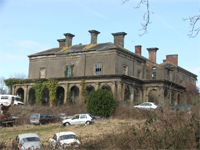
Blackborough House, Devon (Image: Trouserama / Derelict Places) - currently for sale with Winkworths
Heritage and the dedicated work of those who seek to rescue it can often be overlooked only to be occasionally thrust into the spotlight of TV – though this can be a useful promotion in these times of austerity. Sadly, the schedules seem to focus on heritage in bursts, giving us ‘The Restoration Man‘ and ‘Country House Rescue‘ at the same time but it’s good to know that their popularity encourages the programme makers to continue to commission this type of series. Of course these programmes need material so if you know anyone restoring a UK country house, please read on.
One of the most successful of the heritage programmes was the original ‘Restoration‘, a wonderful series presented by Griff Rhys Jones who has personal experience of restoring his own rural Welsh farmhouse. This series truly caught the attention of the public and raised awareness of the buildings at risk in their own areas. Keen to tap this interest again, Endemol, the production company behind ‘Restoration’, have a new series, ‘Restoration Home‘, ready for broadcast in Spring 2011 (and flagged up as a comment already on this blog) – though sadly without Griff as the presenter. The new series focuses on private owners and follows their restoration of ‘at risk’ houses as modern homes. Although the intention is that these will be sensitive restorations it will be interesting to see exactly what compromises and sacrifices are made in creating the home the owner wishes to achieve.
As a sign of the confidence that Endemol have in likely popularity of the series, they are already looking for houses to feature in a second series with, ideally, work starting in the next few months and reaching completion around March 2012. To quote Natasha Evans of Endemol Television:
“Each show will chart the restoration process by the owners of one house, as they restore their home to its former glory. Much as the original series, we’ll bring the property to life, setting it in its cultural and historic context. This is a major aspect of each show and will be interwoven with the restoration. At the same time, we’ll be looking at the different stages of its architectural styles.”
One of the key criteria is that the houses must be owned privately by those who are intending to live in them, that they are currently in need of a bit of love and attention, and that the owners are passionate about their house and specifically interested in the history of their house. So if you are undertaking your own project, or know someone who fits the criteria, please contact Natasha Evans on 0208 222 4326 or by email natasha.evans@endemoluk.com
——
If you are inspired by these programmes and would like to find your own building at risk then one of the best places to start is the ‘Buildings at Risk Register‘ managed by the architectural heritage charity SAVE Britain’s Heritage. To access the register you need to subscribe but this will give you full access to the register of hundreds of properties in need of a sensitive owner.
If Blackborough House (pictured above) takes your fancy, it’s currently (January 2011) for sale with Winkworths for between £1m – £1.5m, but will require at least that (and probably more) spent again on it to restore it as a home.
Houghton Hall, Norfolk (Image: Dennis Smith / Geograph)
Those in important political roles have often sought to escape the pressures of office by escaping to the calm and tranquillity of the countryside. This has been particularly true of the holder of the most important role; that of Prime Minister. With early PMs drawn from the aristocracy, their backgrounds provided them with a seat which became a natural refuge but was also an important part of their political identity. However, as their origins changed, so too did the nature of the country retreat. However, for all PMs the country retreat has been a fairly constant feature – though not all aspired to live in grandeur.
To make this broad survey more digestible I’ve split this into PMs by ruling monarch, starting from when the role of Prime Minister was first recognised in 1721 under King George I.
The seat of Henry Pelham, who became the 3rd PM in 1743, was (according to Howard Colvin) Esher Place in Surrey which he bough in 1729. In 1733, he commissioned William Kent, who was also to create some garden buildings for Claremont for the Duke of Newcastle (see below), to add wings to the original house, Wolsey’s Tower, in a Gothic style. The wings and garden buildings at Esher have now been demolished but drawings survive in the Victoria & Albert Museum in London.
Pelham was succeeded as PM by his older brother, Thomas Pelham-Holles, the 1st Duke of Newcastle, whose main seat was Claremont in Esher, Surrey which he had bought from Sir John Vanbrugh who had built a ‘very small box’ as his own home. The Duke then commissioned Vanbrugh to extend the house, adding two large wings. This house was subsequently demolished as unfashionable by Clive of India who had bought the estate in 1768 following the Duke’s death, before being rebuilt in the Palladian style we see today. The Duke also had other homes including in Halland, Sussex, an area the Pelham family had dominated since 1595 when they first bought land there. Halland Place was also sold in 1768 and later demolished for materials. [Originally I gave Welbeck Abbey as his seat but it was, in fact, inherited by the Holles Earls of Clare branch of the family creating a bitter feud. A more detailed history of the feud is given by dennis in this comment below (thank you for the correction).]
One of the most fascinating houses in the country, particularly due to the extensive tunnelling work commissioned by the 5th Duke, but also one of the least known due to the reclusiveness of the Bentinck family and then later due to its role as the Army Sixth Form college which ensured military-level privacy. The house was largely the work of Sir Charles Cavendish who was given the house and estate by his mother, the remarkable Bess of Hardwick. [Corrected in response to comment below]
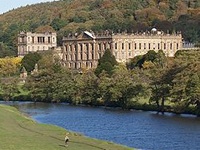
To complete the list of aristocratic PMs during the reign of George I (1714–1727) and George II (1727–1760), the last was William Cavendish, 4th Duke of Devonshire who lived in the peerless Chatsworth in Derbyshire – then, as now, one of the finest of our large country houses. Interestingly, at the same time as he took on the role of PM in 1756, he also engaged in building at Chatsworth employing James Paine to add a new office wing and court (later replaced by Sir Jeffry Wyatville), a stable block, a bridge in the park, a bridge at Beeley, a water mill and also alterations to interiors of the house – though this work was not to be completed until 1767, long after his time as PM finished in 1757.
One notable feature of all the first PMs was they were all Whigs, a party nicknamed the ‘Country Party’ for their support was strongest in the shires and amongst the great landowners. Unsurprisingly, these leaders were already managing vast estates which naturally came with sizeable houses which reflected their status – which then gave them the authority to aspire to be PM. At this time, elections were rather crude affairs with the major landowners having MPs in their pockets due to ‘rotten boroughs‘ which gave the landowner a disproportionate, not to mention undemocratic, influence in the Houses of Commons. Their country houses were therefore not a symptomatic trapping of power, something that they had aspired to and then acquired, but, in fact, were the foundation of the power which had secured them the position in the first place.
Chatsworth House, Derbyshire
Architecturally, the apparently only acceptable styles were either Palladian or Classical which reflected the political nature of the landowners – symmetry, structure, proportion and the use of the correct orders would have appealed to those who were against monarchical absolutism (which would have challenged their own power) but also reflected a societal structure which ensured their wealth and status. The Whigs were also closely associated with the Church of England and, as such, would not have entertained the idea of building their houses in the ‘Catholic’ Gothic style, and anyway, with the neo-Gothic movement only really starting in the 1740s it would be several decades before it gained real influence.
So the early years of the role of PM was dominated by the existing ruling class; the great landowners who now shifted from trying to solely influence events through the levers of Royal favouritism (though their support of the Hanoverian succession and therefore King George wasn’t overlooked) to the use of Parliament – though on their terms. The houses which had often been built to attract and impress a visiting monarch in the hope of securing influence now shifted to helping build alliances with other landowners – and what better way than creating a home they would feel comfortable in? Architecture had become a key part of the political landscape; a physical expression of certain values but also part of a supporting cast which would build the alliances which elevated men to be Prime Minister.
One of the sadly almost inevitable side-effects of urban and industrial growth is the loss of more of our countryside. Sometimes it can be on a smaller scale for residential developments and industrial units but occasionally society’s plans are much grander and require a greater sacrifice. This has been shown with the publication of the latest proposed route for the new High Speed 2 rail project to provide a fast link between London and Birmingham. In previous generations, landowners could influence the path of developments such as roads or canals to their benefit but as their power has diminished so routes of these developments can now threaten the settings of our country houses.
The High Speed 2 railway is aiming to dramatically reduce the need for internal domestic flights in the UK by linking London to, first, the West Midlands, followed by Leeds and Manchester. The plan has always been controversial, requiring the loss of hundreds of homes in the urban areas around the terminals and also a significant loss of farmland. Following an initial proposal, the latest route was announced to the House of Commons on 20 December 2010 which reflected some concerns about the initial proposal. However, 13 of the 30 sections (yes, I have been through all of them!) contain a number of country houses and manors which will still be significantly affected by the plans.
Edgcote House, Northamptonshire (Image: Bacab)
One bit of good news is that fears over the proximity of the link to the wonderfully elegant West Wycombe Park (raised in a blog post in Oct 2009) have been alleviated as the new route is further away. However, another significant house will still be badly affected; the Georgian, grade-I listed, Edgcote House, Northamptonshire. The proposed route now slices through the remarkably unlisted grounds with the line passing just to the east of the ornamental lake which forms one of the main axial views from the house. Edgcote was built between 1747-1752 for London merchant Richard Chauncey by architect William Jones and featured as ‘Netherfield’ in the 1995 TV adaptation of ‘Pride and Prejudice’. The house and grounds form the centrepiece to a 1,700-acre estate which was bought for £30m in 2005. Interestingly, this value has not deterred the planners (who moved the line from the original position cutting across the lake) so it will be interesting to see if the owner submits a claim a for ‘statutory blight‘ [.pdf]. This gives the Secretary of State the option to buy the property at the current market value if the owner can show that they have been unable to sell due to the Government proposals, or only at a substantially lower value.
Hartwell House, Buckinghamshire (Image: Giano via Wikipedia)
Amendments have also been made to protect another significant property; Hartwell House in Buckinghamshire. A grade-I listed house, now run as a hotel, it was built in the early 17th-century for the Hampden family but was later let to the exiled King Louis XVIII of France who lived there between 1809-14. Originally Jacobean, it was substantially enlarged and ‘Georgianised’ between 1759 and 1761 by the architect Henry Keene. Again, following initial concerns, the route has now been moved further away from the house so that it would not be visible and will benefit from extra earth works and planting to reduce the noise.
Stoneleigh Abbey, Warwickshire (Image: PinkyVicki via Flickr)
Another grade-I house which would have been worse affected if it hadn’t been blighted already is Stoneleigh Abbey in Warwickshire. This imposing house, now converted into apartments, is part medieval, part Georgian designed by the talented Francis Smith of Warwick, exists in a seriously compromised setting with the Stoneleigh Park exhibition and conference venue built in one half of the immediate parkland. The proposed line will not only cut through the conference venue but also forever separate the house from the northern edge of the original park – though the massive scale of development already means this was never a house which was going to be returned to splendid isolation.
Another compromised house is Swinfen Hall in Staffordshire where the train will pass in front but quite some distance away. The house itself, a beautiful Baroque-style Georgian mansion was built in 1757 to a design by Benjamin Wyatt and remained the home of the Swinfen family for nearly 200 years. After the death of the last Swinfen in 1948 the land was sold and later a huge youth detention centre built to the immediate north-west with the house being left to deteriorate until it was converted into a hotel in the 1980s. Having a railway line in the middle distance is the least of the concerns for the setting of this house.
Waddesdon Manor, Buckinghamshire (Image: National Trust)
Despite the vocal complaints of Lord Rothschild it seems that the route will be quite far from their old family seat of Waddesdon Manor. However, Rothschild has become one of the leading opponents of the scheme – along with 16 other Conservative MPs whose constituencies will be affected.
With the rail route cutting across the countryside it was unavoidable that it would pass near to country houses, ironically which, of course, were often built to get away from the industrial blight. Other houses which now lie close to the proposed route include:
Classical Shardeloes, built between 1758-66 for William Drake MP by the architect Stiff Leadbetter would also suffer from the high speed line cutting across the main view from the house.
Grade-II* Doddershall House would be within a couple of hundred metres of the line on which up to 18 trains per hour are expected to rush past at speeds of up to 400kph.
Berkswell Hall, Warwickshire – a grade-II* listed house now converted into apartments
Coleshill Manor, Birmingham – now offices and already suffering from being surround by motorways, the house will now have the line within metres, also necessitating the demolition of a new office complex next door.
The route also cuts across the old estate of the now demolished Hints Hall in Staffordshire – an elegant two-storey Georgian mansion with giant pilasters to enliven the facade. It’s unlikely that if the house had survived it would have prevented the proposed route but again, without the house, an estate becomes even more vulnerable.
These are just the houses affected by the first 120 miles of the proposed 355 mile scheme. If successful, we can expect more houses to be blighted as the route carves through the Midlands and up into Lancashire, shattering the peace and quiet that were the original reasons for the creation of these refuges from the industrial reality of the cities. Although progress can often bring benefits, in this case the price is being paid by our country houses as their parklands and estates are judged the path of least resistance.
The delight of a country house is the beautiful meeting of house, setting and contents to create a complete picture. Yet, for some houses, they never make that stage – finances or death of the instigator usually being the main obstacle to completion. For some, these half-built aspirations are demolished, others left as a shell which can tantalise us today as to why they failed to achieve their purpose.
In previous generations, the simplicity of construction methods would necessarily mean that in some cases a decade could pass from plans being drawn up to actually moving in. As now, families can go from great wealth to poverty in a short time so to build a substantial country house was a commitment and a statement of the aspirations of the owners as to their future good fortune and health – though sometimes it was not to be.
Many a mansion has been started with grand ambitions which will forever remain unfulfilled (how impressive would Goodwood House in Sussex be if they’d completed the other five sides of the intended octogon?). However this post is focussed on those which were started and ended only as frustrated shells.
Woodchester Mansion, Gloucestershire (Image: Matthew Lister via Wikipedia)
One of the most impressive of these is Woodchester Mansion in Gloucestershire. Originally built for William Leigh, a wealthy trader, who, inspired by his conversion to Catholicism, sought to create a religious community in the Cotswolds on his estate. As any good Catholic was inclined to do at the time, he consulted A.W. Pugin, a devout Catholic who believed that Gothic architecture was the only true Christian style. He produced plans for a grand new house (after naturally condemning the existing house as “…a more hopeless case of repairs I never saw.“) and a church and monastery, and sent his new design for the house with his estimate of £7,118. Anyone familiar with Pugin’s career will know that he never saw an estimate he couldn’t exceed so Leigh probably had a lucky escape when Pugin resigned the commission in 1846. Leigh instead turned to another Catholic architect Charles Hansom (b.1817 – d.1888). Leigh’s religious zeal took priority so the church was completed in 1849 and the monastery in 1853 after which work started on the new house.
However, progress was slow; the workers were occasionally given tasks elsewhere on the estate, funds were inadequate, and Leigh was also a perfectionist who took a close interest which can only have delayed things. The architect had also changed, with the young and inexperienced Benjamin Bucknall taking over and revising the designs to a combination of Pugin and the French architect Viollet-le-Duc, giving the house a distinctly French influence. However, Leigh’s declining health overtook the build and he died in 1873 with only the shell complete. A profligate son, declining family fortunes, the World Wars, and its isolation meant that despite various plans, including completion for use as mental hospital offices, it simply sat in its parkland. Now grade-I listed, the house gives a unique insight into the construction methods of the time.
Perhaps the grandest house never to be completed was the Worksop Manor in Nottinghamshire for the Dukes of Norfolk. Part of the ‘Dukeries‘, that area of the county formerly rich in ducal seats, the original 500-room Elizabethan Worksop Manor, designed by Robert Smythson, burnt down in 1761 during renovations, destroying £100,000 (approx. £143m) of works of art from the famous Arundel collection. Although childless, the 9th Duke decided to rebuild for the benefit of his eventual heir.
The plans were colossal and would have been the largest house in the county and maybe the country – if it had been completed. Even Horace Walpole, who had developed a discerning eye for country houses during his many tours, thought the Duke’s schemes “…so vast and expensive that it is scarcely possible they can be completed.“. Designed by James Paine (b.1717 – d.1789), the aim was to mark the status and learning of the Duke’s family, building only one side, however it alone was 23-bays, 318ft long and featured a fine Corinthian column supported by six columns, with a 37ft x 25ft entrance hall, decorated by Flemish artist Theodore de Bruyn, and a grand drawing room of 50ft x 30ft.
However, following the death of the heir, Edward Howard, the grief-stricken Norfolks abandoned the project and concentrated on their Sussex seat Arundel Castle. The 10th and 11th Dukes never completed it so it was therefore unsurprising that the 12th Duke decided to sell the house and estate in 1838 to the neighbouring Duke of Newcastle-under-Lyme for £375,000. With his own palatial house at the nearby Clumber House, the Duke was not interested in the house, just in adding the land to his own. Rather than pay for the upkeep, the Duke sold the fabric of the building before demolishing the rest in June 1841 leaving just the stables and part of the service wing. It was these that were later restored to make a rather awkward looking new Worksop Manor.
Lyveden New Bield, Northamptonshire (Image: Ed Bramley via Wikipedia)
Altogether more mysterious is Lyveden New Beild in Northamptonshire. Built for the remarkable if oft persecuted Catholic Sir Thomas Tresham (b.? – d.1605), a well-educated and wealthy man who moved in the highest social circles. Never intended as a main residence (Lyveden Old Bield), this was apparently a summer house, a retreat for the owner during the annual spring clean of his main house. That said, this is a house with many meanings. Designed by Robert Stickells (b.? – d.1620) to indulge Tresham’s interest in antiquity and religious symbolism, the house was built in the shape of a cross and other elements aligned or organised according to mystical numbers, often alluding to the Holy Trinity. Tresham also used the same ideas in his construction of the famous Rushton Triangular Lodge, a small folly also on the estate.
However, the same ardent Catholicism which drove the design of the New Bield and the Lodge also meant that he was regularly persecuted for his faith, frequently being fined huge amounts. With borrowing his only option, funds were scarce and his estate heavily indebted. Perhaps surprisingly, this half-finished house, set in fine gardens and parkland, was never bought and completed and so remains an architectural enigma to this day.
Visiting
Woodchester Mansion holds regular open days more details available on their website. The surrounding Park is owned by the National Trust.
Worksop Manor is still very much a private residence and is not open to the public.
Lyveden New Beild is owned by the National Trust and is regularly open.
Country houses are often launched on the market to catch either bonus money early in the year or those looking to move before the summer. However, circumstances or owner preference can lead to some interesting houses being given a promotional push in the autumn (usually through Country Life magazine) to catch those who fancy Christmas in front a different log fire. So, here’s a quick round-up of some of the better country houses currently for sale.
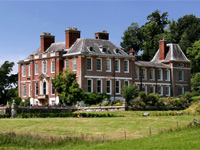
Upton Pynes, Devon (Image: Upton Pynes website)
Easily one of the most impressive houses is one that has always been a sign for me that I’m nearly home when travelling back to Devon on the train. Just outside Exeter is the beautiful grade-II* listed Upton Pynes, which, despite the very English sounding name, bears a striking resemblance to a French chateau. Built c.1700 by Hugh Stafford with very sympathetic later additions, this large but elegant house sits in a commanding position in the Exe Valley, perfectly positioned to catch the sun throughout the day, giving the red-brick façades a warm glow. Described by Pevsner as “…an excellent example of the stately double-pile house that became popular after the Restoration but is relatively rare in Devon.”, the interior features a particularly grand entrance hall created as part of alterations in 1852 by the architect Ambrose Poynter for Sir Stafford Henry Northcote (later the Earl of Iddesleigh). The main interiors of the house, including an enfilade of rooms on the south front and a notable library, largely dates from 1700. The house also has the claim that it was the one Jane Austen had in mind when describing ‘Barton House’ in ‘Sense & Sensibility’. The house still requires some restoration but will definitely reward whoever completes this grand project.
Sometimes a grand house designed by an interesting architect can remarkably remain unlisted, as is the case with the Edwardian Crendle Court in Dorset which was designed by Walter H. Brierley (b.1862 – d.1926) who has been described as ‘the Yorkshire Lutyens’. A prolific architect, he designed over 300 buildings including schools, churches and several country houses including the elegant neo-Georgian Sion Hill Hall in Yorkshire. Brierley was a versatile architect able to work successfully in various styles though with a preference for ‘Wrenaissance’ – a modern re-working of the architectural language of Sir Christopher Wren. Crendle Court was built in 1909 and features elaborate ornamental plasterwork in the main reception rooms by George Bankart, and sits, well, more luxuriates, in 270-acres of grounds. Considering the architect and the quality English Heritage ought to send someone round to evaluate and spot list it before it gets ruined by someone with more money than taste.
Other significant houses available were launched earlier but are now being promoted following price cuts. One such house is the grade-II* listed Rudby Hall in Yorkshire, which was originally given a guide price of £3.5m but now is offered at £2.75m. Designed by Anthony Salvin in 1838 for the 10th Viscount Falkland, who originally called it Leven Grove, but by the late 19th-century it was known as Skutterskelfe Hall before being given its present name by the company which owned it in the 1990s. The house was restored in the 1980s and comprises the main house but with the ancillary buildings converted into let accommodation bringing in a handy £50,000 p/a – so long as you don’t mind sharing your gardens, grounds and woodlands with them.
For those who fancy something more baronial, then Blairquhan Castle in Ayrshire, Scotland may be perfect. The core of the property is a tower house built in 1346 but was later given a new front by William Burn in 1820-24 to provide the imposing if slightly stern façade we see today. The estate was noted for it beauty with Lord Cockburn writing in 1844: “I rose early…and surveyed the beauties of Blairquhan. It deserves its usual praises. A most gentleman-like place rich in all sorts of attractions – of wood, lawn, river, gardens, hill, agriculture and pasture.”. What more could a squire desire?
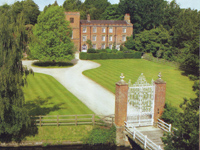
Most of these houses seem to be with Savills so to even things up, and to include a house I’m surprised hasn’t sold already, is Beaurepaire in Hampshire. The house was featured on the blog in more detail (‘Phoenix for sale: Beaurepaire House, Hampshire‘) when it was first launched in June this year. The house is what remains after a devastating fire in 1942 destroyed the main block of the house, leaving the current service wing which was extensively refurbished and remodelled after WWII to give the elegant house which is for sale today. Approached down a long drive, what guest couldn’t fail to be impressed by the wonderful gates designed by Sir John Soane which guard the entrance over the moat? Sitting in a 250-acre estate, the £8m price tag is probably justified for the area – and the owner is apparently in no rush to sell so don’t expect any big price cut soon.





 The Country Seat