The front line: the campaigners for country houses

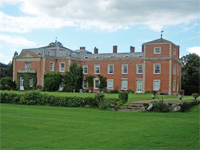
Apethorpe Hall, Northamptonshire (Image: English Heritage)

Despite the image of wealth and power a country house might create, in reality their existence is far more precarious – as can be seen with nearly 1,800 houses lost over the last two centuries.  A house facing the threats of being uninhabited without a concerned, well-funded owner with an inclination to keep it in good repair can quickly deteriorate leaving another gap in the tapestry of the countryside.  Sometimes it requires someone other than concerned locals and architectural historians to highlight and campaign on behalf of those ‘at risk’ so here’s a quick round-up of the main English organisations fighting on behalf of country houses and who are very worthy of support.

English Heritage inhabits a prime position in view of its role in defining and, in conjunction with local authorities, implementing the statutory protection of our built heritage.  Its role can be traced back to the Ancient Monuments Act of 1882 – though the legislation specifically excluded privately owned houses. The responsibilities were exercised through various government departments until it became a quango in 1984.  As well as being responsible for the listing system and the annual production of the various ‘at risk’ registers (focussing mainly on grade-I and -II* properties), EH is also directly responsible for various country houses including Brodsworth Hall (Yorkshire), Rufford Abbey (Nottinghamshire), Hill Hall and Audley End (Essex), Kirby Hall (Northamptonshire), Witley Court (Worcestershire), Stokesay Castle (Shropshire), and Apethorpe Hall (Northamptonshire).   It’s at the grade-I listed Apethorpe where EH has done some of it’s most interesting work; taking a direct role in the restoration of one of the finest Elizabethan/Jacobean houses in the country following a long period of neglect. Since 2008, the house has been for sale for around £5m – though there is a compulsory £4m list of renovations, and if you want complete privacy expect to pay another £8m to fully reimburse EH otherwise you have to open it for 28 days a year; so a nice round £20m to restore, furnish and keep as your own. However, this is a role that I fully support them in taking on – they should be there as owner and restorer of last resort for threatened grade-I houses.  Now perhaps we can interest them in the sadly deriorating Melton Constable Hall in Norfolk…?

Another important group of campaigners are recognised in the 1968 Town and Country Planning Act which formalised the role of what are known as ‘amenity societies‘; that is, well-established voluntary societies who are experts in their areas, who must, by law, be informed of any applications for listed building consent to demolish listed buildings in whole or in part in England and Wales.

One of the best known is the Georgian Group who cover a period broadly from 1700-1837.  The society was established in 1937 and has long campaigned for the sensitive restoration and retention of not only the buildings but the many important, and sometimes sadly overlooked, internal features which are a key part of the character of a building.  Current active campaigns and cases they are involved in include Bank Hall in Lancashire and Trewarthenick House in Cornwall and many others. They also produce a scholarly annual research journal which provides a much more in-depth view of aspects of Georgian architecture.  Access for the wonderful trips to houses not normally open to the public are worth joining for alone.
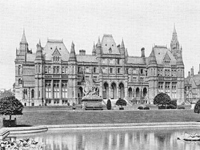
Eaton Hall, Cheshire (by Alfred Waterhouse - dem. 1961) (Image: Lost Heritage)

The Victorian Society (which also covers Edwardian buildings too) was formed in 1958 at a time when almost all things Victorian were disliked and an easy target for demolition.  Founded at the suggestion of Anne, Lady Rosse, along with her influential friends such as Sir John Betjeman and Sir Nicklaus Pevsner, the Society has fought some notable battles; losing some such as Euston Station but winning others, such as the soon-to-reopen St Pancras Midland Grand Hotel building.  Victorian country houses have suffered badly as, although designed by eminent architects such as Richard Norman Shaw and Alfred Waterhouse, they were often built on a much grander and therefore less economically sustainable scale and at the times of greatest threat (the 1930s and 1950s) had few friends to argue on their behalf.  Luckily though this has changed – but with the predominant ‘gothic-revival’ style being quite polarising, threats to houses from this period will always be present. Again, well worth joining.

Perhaps more controversially for this blog, it’s also worth bearing in mind the Twentieth Century Society.  Although the focus of the houses usually covered is before 1900, there has been a growing recognition that some of the country houses built in the 20th-century were well-planned and architecturally pleasing, even if they sometimes replaced a much more attractive Georgian or Victorian house.  It does seem to take about 50 years after a style has passed from being fashionable for it to be appreciated, so I suspect there will be a growing realisation that we need to protect the work of those such as Francis Johnson, Craig Hamilton, Quinlan Terry, and Robert Adam (amongst many others) in the future.

The Society for the Protection of Ancient Buildings (SPAB) is, as its name makes clear, not usually concerned with country houses as they are relatively ‘modern’ in terms of its remit.  However, they do immensely important work in promoting good repair practice to all buildings and their courses have taught generations of owners and craftsmen to respect the country houses and to approach any work required with a more ‘heritage’ mindset.

Although not ‘amenity societies’, two other organisations deserve a mention. The first is the Historic Houses Association which acts on behalf of the private owners of country houses and often lobby government to make them aware of the immense work done by the individual owners to maintain their slice of the national architectural heritage.  It may seem unfashionable in wider society to support the wealthy but they are the ones not only maintaining their homes to the exacting standards of English Heritage, but also restoring and rescuing houses and converting them back into homes again – and for that they deserve our thanks.

The Grange, Hampshire (Image: mpntod / Wikipedia)

The other organisation is one in which I have an interest having worked with them for several years: SAVE Britain’s Heritage.  Founded in 1974, SAVE have taken a very active stance on campaigning, willing to create media interest at short notice, but also to take time to produce some excellent research on houses at risk with thoughtful proposals for their re-use.  These campaigns have saved houses such as Calke Abbey in Derbyshire, The Grange in Hampshire, Barlaston Hall in Staffordshire (where SAVE bravely took on the house for £1!), and, working with Kit Martin, have acted as a catalyst for the saving of other houses through conversion into apartments.  Supporting SAVE’s work and becoming a Friend also gives access to their extensive ‘Buildings at Risk Register’ which features over 800 properties, including several country houses, which are in need of rescue – could it be you?

It is also worth keeping an eye out for local activists and campaigns which can also be remarkably successful at highlighting buildings at risk but can also sometimes take a more direct role; see the wonderful work at Poltimore, Devon, Bank Hall, Lancashire, and Copped Hall, Essex.  These are just three examples where concerned locals have organised themselves and presented a credible alternative and prevented the complete loss of the house.

All of these organisations are worth joining but economics being what they are it can be best to join a national organisation and then another to focus on the period which you prefer.  Joining up means that you are helping to support research but also active campaigns to ensure that as much of our built heritage is passed on to future generations.

———————————————————

I realise this selection is not comprehensive and is quite national in focus and deficient in regional organisations but this will be remedied in another post once I’ve had time to learn a bit more about who’s out there.

– Matthew

———————————————————

Going to the country: more country houses of UK Prime Ministers – Part 2

The first part of this series, highlighted the aristocratic background of our early Prime Ministers – Earls and Dukes abound.  This meant that a country house was just where they had been brought up and simply regarded as home rather than the aspirational purchase.  It also highlighted that the architectural tastes of the PMs reflected their political beliefs with a strong preference for the Classical, representing structure and order.

So, to continue the tour of country houses of Prime Ministers, this time those who served  under George III (1760–1820):

Luton Hoo, Bedfordshire (Image: ickle_angel/Flickr)

The first was John Stuart, 3rd Earl of Bute. Originally a man of rather limited means who only acquired great wealth following his marriage to the rich heiress, Mary Wortley Montagu. The family seat was Mount Stuart on the Isle of Bute; at the time a small Queen Anne house which burnt down in 1877 to be replaced by the Gothic palace we see today.  With his later wealth and prominence the Earl created two fine new country houses.  On his retirement as PM, he bought Luton Hoo, Bedfordshire in 1763 and in 1767 commissioned Robert Adam to create a large neoclassical mansion which, although this was never fully realised, the resulting house (now a hotel) is still sizable.  The wings are a later addition but faithful to Adam’s original conception. Ill health later forced a move to the Dorset coast and having bought a clifftop position he built High Cliff “to command the finest outlook in England.“.  Unfortunately it was a little to fine, the crumbling cliff not only necessitated the demolition of the house in the late 1790s, it also led to the Earl’s death in 1792 due to a fall whilst picking plants.

He was succeeded as PM in 1763 by George Grenville who was born, and lived, at the family seat, Wotton House, Buckinghamshire.  He is one of only nine PMs who did not become a peer on leaving office.

Wentworth Woodhouse, Yorkshire (Image: geograph.co.uk)

If there was a competition for the most impressive house of Prime Ministers then Charles Watson-Wentworth, 2nd Marquess of Rockingham would be feeling rather confident.  His family home, Wentworth Woodhouse, Yorkshire, is one of the largest private country houses in Britain with a main front extending to over 600ft. Built over a 25-year period, the house exemplifies the grand palaces which became possible in Georgian England. Faced with the usual pressures on later owners, plus vindictive coal mining, the family moved out and the house was leased as a teacher training college but since 1999 it has been the home of architect Clifford Newbold and his family who have been undertaking a massive and very impressive restoration programme.

William Pitt the Elder, 1st Earl of Chatham was brought up in great comfort from the proceeds of the sale of the Regent Diamond by his father.  As the younger son, Pitt would not inherit the family seat and so made his own way, choosing politics and becoming PM in 1766.  His country residence was the relatively modest Hayes Place in Kent, which he had built after he bought the estate in 1757.  He later sold it in 1766 to Horace Walpole who encased the house in white brick and enlarged it before selling back to Pitt in 1768 on his retirement.  The house survived until 1933 when it was demolished and houses built on the land.

Euston Hall, Suffolk (Image: David Robarts / flickr)

Another Prime Ministerial seat to suffer later loss was Euston Hall in Suffolk seat of Augustus FitzRoy, 3rd Duke of Grafton who succeeded William Pitt.  The Dukes of Grafton were very wealthy with extensive land holdings in Suffolk, Norfolk, Northamptonshire and London.  Euston Hall had been extensively remodelled by the Palladian architect Matthew Brettingham for the 2nd Duke between 1750-56.  The house suffered a devastating fire in 1902 which destroyed the south and west wings, which were subsequently rebuilt on the same plan but then demolished again by the 10th Duke in 1952.  It should also be noted that the Dukes also owned the splendid Wakefield Lodge in Northamptonshire, designed by William Kent, though it was tenanted and therefore the Dukes never lived there.

William Petty-FitzMaurice, 2nd Earl of Shelburne had the splendid fortune to be brought up in one of the finest of Georgian country houses, Bowood House in Wiltshire, which also became a scandalous loss when it was demolished in 1955/56.  Remodelled for the 1st Earl by Henry Keene between 1755-60, the house also featured interiors by Robert Adam, who also altered Keene’s original portico to create a much grander version.  Afterwards the stables were converted to function as the main house where the 9th Marquess of Lansdowne (as the Earls became) still lives today.

Welbeck Abbey, Nottinghamshire (Image: Mr Nibbler / flickr)

The next PM, William Cavendish-Bentinck, 3rd Duke of Portland inherited Welbeck Abbey, Nottinghamshire, which had also been the home of an earlier PM, his relative Thomas Pelham-Holles, 1st Duke of Newcastle.  As stated in Part 1, this is a fascinating house which has often been overlooked due to the fact that it has been rarely open to the in the last 100 years, public tours having finished in 1914. Extensive work was carried out between 1742-46 by the relatively unknown architect John James who reconstructed the south wing and remodelled the west front for Henrietta, Countess of Oxford.  The west front was subsequently changed again in 1790 to designs by Sir Humphry Repton.  The Dukes of Portland also had a southern seat at Bulstrode Park in Buckinghamshire, though this house was replaced in 1865 by the 12th Duke of Somerset who by then owned the estate.

In contrast to the vast wealth and aristocratic status of the preceeding PM, William Pitt the Younger was able to bring political heritage; his father also having served in the same role. In stark contrast to the size and splendour of Welbeck, his country home was Holwood House in Kent, a modest mansion set in 200-acres for which Pitt paid £7,000 in 1783 before commissioning Sir John Soane to alter and enlarge it in 1786 and 1795.  Soane’s work here led to Pitt recommending him for the work to build what was to be one of Soane’s masterpieces; the Bank of England building which was so sadly demolished in the 1920s.  Holwood was also to be demolished, in 1823, to be replaced by a much grander house designed by Decimus Burton.

The country houses of Henry Addington 1st Viscount Sidmouth have both largely now vanished under the sprawl that is Reading University.  Addington had a low-key record as PM and his houses were equally modest.  Although on becoming PM Addington moved into the beautiful White Lodge in Richmond, his main seat was Woodley House, Berkshire, which had been built in 1777 before being bought by Addington in 1789. At the same time, he also bought the neighbouring estate of Bulmershe Court which was then tenanted, before falling into disrepair in the 19th century leading to two-thirds of it being demolished. Woodley House was used by the Minstry of Defence during WWII but subsequent dereliction led to its demolition in 1960.

William Wyndham Grenville, 1st Lord Grenville, as well as abolishing slavery, also created one of the most elegant of the houses in this series; Dropmore House in Buckinghamshire.  Built in 1795 and designed by Samuel Wyatt (b.1737 – d.1807) with later work by Charles Heathcote Tatham (b.1772 – d.1842), it was Grenville’s refuge, describing it as ‘deep sheltered from the world’s tempestuous strife‘. The grounds were also lavished with attention with Grenville planting 2,500 trees, and creating numerous walks which took in the superb views and even going as far as to remove a hill which blocked the view to Windsor Castle.  Tragically, devastating fires in 1990 and 1997 left a ruined shell but it has been recently rebuilt as a series of luxury apartments.

The only PM to be assassinated, Spencer Perceval, never really had a country seat of his own but had grown up in Enmore Castle, Somerset though he would never inherit as he was the second son of second marriage.  Only a small section of the main house now remains after it was largely demolished in 1833, but originally Enmore, built c1779, was one of the largest houses in the county.  In later life, Perceval lived in a large house called Elm Grove on the south side of Ealing Common in London – though at the time this would have been quite a rural area but not quite enough to classify this as a true country house.

The final PM under George III was Robert Banks Jenkinson, 2nd Earl of Liverpool who again chose to live close to London, though in a country house, at Coombe House in Kingston upon Thames in Surrey.  Originally Tudor, this brick house was replaced with a Georgian mansion which was later altered by Sir John Soane, including the addition of a library.  The house survived until 1933 when it was demolished with houses now covering the site.

So although the Gothic revival movement had started in the 1740s and was the main alternative to the dominant Classical architectural style, even by the 1820s, it did not reflect the tastes of any of the Prime Ministers.  Considering the system still echoed the exclusions of the Reformation with its explicit rejection of all things ‘catholic’ (architectural, theological, political) it was unlikely to change, especially as the Catholic Emancipation Bill wasn’t passed until 1828.  Architecture was taken an expression of belief and so to favour the Gothic could potentially have given the wrong signals.

Next: Prime Ministers under George IV and William IV

List of UK Prime Ministers

Going to the country: the country houses of UK Prime Ministers – Part 1

Houghton Hall, Norfolk (Image: Dennis Smith / Geograph)

Those in important political roles have often sought to escape the pressures of office by escaping to the calm and tranquillity of the countryside.  This has been particularly true of the holder of the most important role; that of Prime Minister.  With early PMs drawn from the aristocracy, their backgrounds provided them with a seat which became a natural refuge but was also an important part of their political identity.  However, as their origins changed, so too did the nature of the country retreat.  However, for all PMs the country retreat has been a fairly constant feature – though not all aspired to live in grandeur.

To make this broad survey more digestible I’ve split this into PMs by ruling monarch, starting from when the role of Prime Minister was first recognised in 1721 under King George I.

The first holder of the office, Robert Walpole, 1st Earl of Orford, was the epitome of the aristocratic leader.  Walpole was born at Houghton Hall in Norfolk – though the house was a more modest one before Sir Robert engaged Colen Campbell in 1722 to rebuild it, creating one of the finest Palladian houses in the country.  The second PM was Spencer Compton, 1st Earl of Wilmington, who also employed Colen Campbell in 1726 to create a more modest home; Compton Place in Sussex.

The seat of Henry Pelham, who became the 3rd PM in 1743, was (according to Howard Colvin) Esher Place in Surrey which he bough in 1729. In 1733, he commissioned William Kent, who was also to create some garden buildings for Claremont for the Duke of Newcastle (see below), to add wings to the original house, Wolsey’s Tower, in a Gothic style.  The wings and garden buildings at Esher have now been demolished but drawings survive in the Victoria & Albert Museum in London.

Pelham was succeeded as PM by his older brother, Thomas Pelham-Holles, the 1st Duke of Newcastle, whose main seat was Claremont in Esher, Surrey which he had bought from Sir John Vanbrugh who had built a ‘very small box’ as his own home.  The Duke then commissioned Vanbrugh to extend the house, adding two large wings.  This house was subsequently demolished as unfashionable by Clive of India who had bought the estate in 1768 following the Duke’s death, before being rebuilt in the Palladian style we see today.   The Duke also had other homes including in Halland, Sussex, an area the Pelham family had dominated since 1595 when they first bought land there.  Halland Place was also sold in 1768 and later demolished for materials.  [Originally I gave Welbeck Abbey as his seat but it was, in fact, inherited by the Holles Earls of Clare branch of the family creating a bitter feud.  A more detailed history of the feud is given by dennis in this comment below (thank you for the correction).]

One of the most fascinating houses in the country, particularly due to the extensive tunnelling work commissioned by the 5th Duke, but also one of the least known due to the reclusiveness of the Bentinck family and then later due to its role as the Army Sixth Form college which ensured military-level privacy. The house was largely the work of Sir Charles Cavendish who was given the house and estate by his mother, the remarkable Bess of Hardwick. [Corrected in response to comment below]

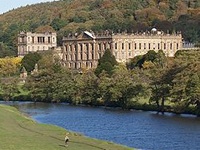
To complete the list of aristocratic PMs during the reign of George I (1714–1727) and George II (1727–1760), the last was William Cavendish, 4th Duke of Devonshire who lived in the peerless Chatsworth in Derbyshire – then, as now, one of the finest of our large country houses.  Interestingly, at the same time as he took on the role of PM in 1756, he also engaged in building at Chatsworth employing James Paine to add a new office wing and court (later replaced by Sir Jeffry Wyatville), a stable block, a bridge in the park, a bridge at Beeley, a water mill and also alterations to interiors of the house – though this work was not to be completed until 1767, long after his time as PM finished in 1757.

One notable feature of all the first PMs was they were all Whigs, a party nicknamed the ‘Country Party’ for their support was strongest in the shires and amongst the great landowners.  Unsurprisingly, these leaders were already managing vast estates which naturally came with sizeable houses which reflected their status – which then gave them the authority to aspire to be PM.  At this time, elections were rather crude affairs with the major landowners having MPs in their pockets due to ‘rotten boroughs‘ which gave the landowner a disproportionate, not to mention undemocratic, influence in the Houses of Commons.  Their country houses were therefore not a symptomatic trapping of power, something that they had aspired to and then acquired, but, in fact, were the foundation of the power which had secured them the position in the first place.

Chatsworth House, Derbyshire

Architecturally, the apparently only acceptable styles were either Palladian or Classical which reflected the political nature of the landowners – symmetry, structure, proportion and the use of the correct orders would have appealed to those who were against monarchical absolutism (which would have challenged their own power) but also reflected a societal structure which ensured their wealth and status.  The Whigs were also closely associated with the Church of England and, as such, would not have entertained the idea of building their houses in the ‘Catholic’ Gothic style, and anyway, with the neo-Gothic movement only really starting in the 1740s it would be several decades before it gained real influence.

So the early years of the role of PM was dominated by the existing ruling class; the great landowners who now shifted from trying to solely influence events through the levers of Royal favouritism (though their support of the Hanoverian succession and therefore King George wasn’t overlooked) to the use of Parliament – though on their terms.  The houses which had often been built to attract and impress a visiting monarch in the hope of securing influence now shifted to helping build alliances with other landowners – and what better way than creating a home they would feel comfortable in? Architecture had become a key part of the political landscape; a physical expression of certain values but also part of a supporting cast which would build the alliances which elevated men to be Prime Minister.

Next: a change of King, and a new PM.

List of UK Prime Ministers

Thanks to Andrew for the original suggestion for this survey

What goes around; the use of rotunda in UK country houses

The UK aristocracy brought back many souvenirs from their grand tours to Italy – pictures, sculpture, drawings etc – but also a delight in the architecture inspired by the ancient ruins.  This fascination manifested itself in country houses across the UK with a profusion of arches,  Serlian windows, porticos and pediments.  However, one device, despite its impressiveness, has been notable by its relative rarity; the rotunda – that grand circular space often featuring a parade of columns leading the eye up to a spectacular dome.  So why would this grand centrepiece be so infrequently used inside our country houses?

Italy - Villa Capra or 'La Rotonda' (Image: Marco Bagarella / Wikipedia)
Italy – Villa Capra or ‘La Rotonda’ (Image: Marco Bagarella / Wikipedia)

The most famous rotunda, and that which was so influential on the Anglo-Palladians, was the Pantheon in Rome.  Built in AD 124, this vast space under a 142ft diameter dome was closely studied by Andrea Palladio and became a key destination for UK architects who later travelled to Rome.  Palladio then developed the use of the rotunda as the central circulation space in his residential villas, most famously with the Villa Capra or “La Rotonda” in Vicenza, begun in 1567.

Palladio was not the first to use a rotunda in a residential setting; the artist Mantegna built his own home in Mantua in the 1470s using a layout and scale very similar to that later used at Villa Capra, using a design probably suggested by the architect-engineer Francesco di Giorgio.  Palladio then modified it and used it to great success to create what is regarded as one of his finest houses.  The rotunda would have neatly solved the challenge of the Villa Capra in that a visitor may at any front, thus negating the traditional linear plan which assumed only one main entrance.

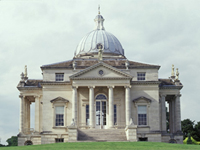
Mereworth Castle, Kent

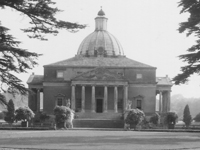
Looking through Colen Campbell‘s ‘Vitruvius Britanicus’ – a highly regarded collection of plans and prints of the best Georgian houses published between 1715-1725 – that over the three volumes a rotunda is only used twice.  The first is in a proposed (but never executed) design for Goodwood House in Sussex for the Earls of March designed by Colen Campbell in 1724 which featured a 40ft diameter space.  The second is the 35ft diameter version which forms the dramatic central hall of Mereworth Castle in Kent.  Mereworth (built 1722-25) was one of only four Georgian houses to be built in the UK which closely followed the design of the Villa Capra; the others being Chiswick House, Middlesex (1726-29), Foots Cray Place, Kent (1754 – demolished 1949), and Nuthall Temple, Nottinghamshire (1757 – demolished 1929).

A later use of the rotunda was at the slightly eccentric Ickworth House, Suffolk. Built in 1795 and based on the designs of Mario Asprucci, an Italian architect;  it was later adapted by Francis and his brother Joseph Sandys who also oversaw construction.  This later use of the rotunda showed how it could be employed as a single dramatic centrepiece in its own right, not hidden in the centre of the house.

Central stairwell and gallery, Wardour Castle, Wiltshire (Image: Strutt & Parker)
Central stairwell and gallery, New Wardour Castle, Wiltshire (Image: Strutt & Parker)

Yet, if it was hidden, it could form a dramatic and surprising irregularity to the procession of square and rectangular rooms which often dominated houses.  One example of this is at Kedleston Hall in Derbyshire where Robert Adam was inspired by his own 1764 study of the ‘Ruins of the Palace of the Emporer Diocletian at Spalatro [Split]’ which paired the circular rotunda with a square vestibulum. Adam also later proposed to convert the courtyard at Syon Park into a huge rotunda. Perhaps one of the most impressive and beautiful expressions of the rotunda is the central staircase at New Wardour Castle in Wiltshire, designed by James Paine, and built between 1769-1776 and later described by Pevsner as ‘the most glorious Georgian interior of Wiltshire’.

So, despite its impressiveness why are most entrances and staircases so determinedly right-angled?  Simple finance can explain it in part; it would be more expensive to create a rotunda as they are more complex, require more space and also usually compromises in the floor plan to include the curvature.

Fashion can also play its part. As architectural taste moved in the Victorian era towards a preference for the gothic, so the opportunities for the use of the rotunda diminished. With its origins in the temple ruins of Classical ancient Rome, the most famous Gothic Revival architect, A.W.N. Pugin (b.1812 – d.1852) considered it part of a more pagan tradition – and therefore completely antithetical to his belief that gothic represented the only true expression of Christianity through architecture. And where Pugin led, others followed.

Or perhaps the answer is more pragmatic.  One of the primary purposes of the country house was to impress visitors.  Often a political power base, the grandest houses were designed to create an impression even before the visitor actually met the owner.  As one of the principal spaces in a house, entrance halls have often played an important role in this domestic ‘theatre’ – and the use of a rotunda requires perhaps too many compromises.

Traditionally the grand rooms where visitors would be met were often on the ground floor and would be processed through, with only the most important visitors reaching the best rooms.  Elizabethan houses changed this with the principal rooms moving to upper floors, such as at Hardwick Hall in Derbyshire, requiring more impressive staircases which, through the use of heraldic and political symbolism in the carving on balusters and handrail could make many a statement before the guest reached the required floor.

Palladian designs continued this with the preference for the piano nobile which moved the principle rooms to a raised ground floor.  The large empty wall spaces of the staircase also formed a useful space for the display of paintings including family portraits or a large selection to show the owner’s taste and style.  The staircase also provided a way to make a dramatic entrance – think ladies in their evening gowns gliding down to join the party.  Yet if a house used a rotunda it compromised both these features.  A curved wall made it difficult to hang the largest and most impressive works of art and staircases were usually spiral and tucked into the walls in the corners, meaning those coming down would only be seen when they emerged at the ground floor – which would never do.

Henbury Hall, Cheshire (Image: Country Life Picture Library)

Yet, the rotunda has not died out and those with the vision and wealth can still create these dramatic spaces.  One of the most impressive has to be Henbury Hall in Cheshire, built between 1984-86 for Sebastien de Ferranti and designed by the architect Julian Bicknell from a painting by the artist Felix Kelly. A faithful recreation of Villa Capra, the dome rises to 15m with the principal rooms radiating from the central hall.  Nigel Anderson at Adam Architects also designed a replacement country house in Surrey which, according to them, is based (I’d say loosely – at least externally) on Villa Capra.  Another fine example is that at Tusmore Park in Oxfordshire, winner of the best new building in the classical tradition award from the Georgian Group in 2004 where the scagliola columns in the central rotunda are said to rival those of the imperial palaces of St Petersburg.

These examples show that, although comparatively rare, the impressive traditions of the rotunda are being continued by architects and clients determined to create the most dramatic interiors in contemporary country houses despite the compromises which have perhaps unfairly limited their use in previous centuries.

An ambition frustrated: country houses never completed

The delight of a country house is the beautiful meeting of house, setting and contents to create a complete picture.  Yet, for some houses, they never make that stage – finances or death of the instigator usually being the main obstacle to completion.  For some, these half-built aspirations are demolished, others left as a shell which can tantalise us today as to why they failed to achieve their purpose.

In previous generations, the simplicity of construction methods would necessarily mean that in some cases a decade could pass from plans being drawn up to actually moving in. As now, families can go from great wealth to poverty in a short time so to build a substantial country house was a commitment and a statement of the aspirations of the owners as to their future good fortune and health – though sometimes it was not to be.

Many a mansion has been started with grand ambitions which will forever remain unfulfilled (how impressive would Goodwood House in Sussex be if they’d completed the other five sides of the intended octogon?).  However this post is focussed on those which were started and ended only as frustrated shells.

Woodchester Mansion, Gloucestershire (Image: Matthew Lister via Wikipedia)

One of the most impressive of these is Woodchester Mansion in Gloucestershire.  Originally built for William Leigh, a wealthy trader, who, inspired by his conversion to Catholicism, sought to create a religious community in the Cotswolds on his estate.  As any good Catholic was inclined to do at the time, he consulted A.W. Pugin, a devout Catholic who believed that Gothic architecture was the only true Christian style.  He produced plans for a grand new house (after naturally condemning the existing house as “…a more hopeless case of repairs I never saw.“) and a church and monastery, and sent his new design for the house with his estimate of £7,118.  Anyone familiar with Pugin’s career will know that he never saw an estimate he couldn’t exceed so Leigh probably had a lucky escape when Pugin resigned the commission in 1846.  Leigh instead turned to another Catholic architect Charles Hansom (b.1817 – d.1888).  Leigh’s religious zeal took priority so the church was completed in 1849 and the monastery in 1853 after which work started on the new house.

However, progress was slow; the workers were occasionally given tasks elsewhere on the estate, funds were inadequate, and Leigh was also a perfectionist who took a close interest which can only have delayed things.  The architect had also changed, with the young and inexperienced Benjamin Bucknall taking over and revising the designs to a combination of Pugin and the French architect Viollet-le-Duc, giving the house a distinctly French influence.  However, Leigh’s declining health overtook the build and he died in 1873 with only the shell complete.  A profligate son, declining family fortunes, the World Wars, and its isolation meant that despite various plans, including completion for use as mental hospital offices, it simply sat in its parkland. Now grade-I listed, the house gives a unique insight into the construction methods of the time.

Worksop Manor, Nottinghamshire (Image: Heritage Images)

Perhaps the grandest house never to be completed was the Worksop Manor in Nottinghamshire for the Dukes of Norfolk.  Part of the ‘Dukeries‘, that area of the county formerly rich in ducal seats, the original 500-room Elizabethan Worksop Manor, designed by Robert Smythson, burnt down in 1761 during renovations, destroying £100,000 (approx. £143m) of works of art from the famous Arundel collection.  Although childless, the 9th Duke decided to rebuild for the benefit of his eventual heir.

The plans were colossal and would have been the largest house in the county and maybe the country – if it had been completed.  Even Horace Walpole, who had developed a discerning eye for country houses during his many tours, thought the Duke’s schemes “…so vast and expensive that it is scarcely possible they can be completed.“. Designed by James Paine (b.1717 – d.1789), the aim was to mark the status and learning of the Duke’s family, building only one side, however it alone was 23-bays, 318ft long and featured a fine Corinthian column supported by six columns, with a 37ft x 25ft entrance hall, decorated by Flemish artist Theodore de Bruyn, and a grand drawing room of 50ft x 30ft.

However, following the death of the heir, Edward Howard, the grief-stricken Norfolks abandoned the project and concentrated on their Sussex seat Arundel Castle.  The 10th and 11th Dukes never completed it so it was therefore unsurprising that the 12th Duke decided to sell the house and estate in 1838 to the neighbouring Duke of Newcastle-under-Lyme for £375,000.  With his own palatial house at the nearby Clumber House, the Duke was not interested in the house, just in adding the land to his own. Rather than pay for the upkeep, the Duke sold the fabric of the building before demolishing the rest in June 1841 leaving just the stables and part of the service wing.  It was these that were later restored to make a rather awkward looking new Worksop Manor.

Lyvden New Bield, Northamptonshire (Image: Ed Bramley via Wikipedia)
Lyveden New Bield, Northamptonshire (Image: Ed Bramley via Wikipedia)

Altogether more mysterious is Lyveden New Beild in Northamptonshire.  Built for the remarkable if oft persecuted Catholic Sir Thomas Tresham (b.? – d.1605), a well-educated and wealthy man who moved in the highest social circles.  Never intended as a main residence (Lyveden Old Bield), this was apparently a summer house, a retreat for the owner during the annual spring clean of his main house.  That said, this is a house with many meanings.  Designed by Robert Stickells (b.? – d.1620) to indulge Tresham’s interest in antiquity and religious symbolism, the house was built in the shape of a cross and other elements aligned or organised according to mystical numbers, often alluding to the Holy Trinity.  Tresham also used the same ideas in his construction of the famous Rushton Triangular Lodge, a small folly also on the estate.

However, the same ardent Catholicism which drove the design of the New Bield and the Lodge also meant that he was regularly persecuted for his faith, frequently being fined huge amounts.  With borrowing his only option, funds were scarce and his estate heavily indebted.  Perhaps surprisingly, this half-finished house, set in fine gardens and parkland, was never bought and completed and so remains an architectural enigma to this day.


Visiting

Woodchester Mansion holds regular open days more details available on their website. The surrounding Park is owned by the National Trust.

Worksop Manor is still very much a private residence and is not open to the public.

Lyveden New Beild is owned by the National Trust and is regularly open.