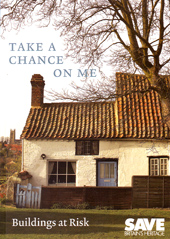
‘Take a Chance on Me’ – Buildings at Risk Register 2011

'Take a Chance on Me' - 2011 SAVE Buildings at Risk Register

Despite the obvious deep and passionate interest society has with historic buildings every year the SAVE Britain’s Heritage Buildings at Risk Register highlights just how many properties are still under threat from neglect and those in power who believe the only good building is a new one with their name on the opening ceremony plaque.  The 2011 BaR register – ‘Take a Chance on Me‘ – has just been published and sadly, as always, it contains some country houses which really deserve a better fate.

Perhaps the one of the most attractive, both architecturally and in terms of being a  case for restoration is Blackborough Hall, near Cullompton in Devon. This elegant, if thoroughly dilapidated grade-II house, is a remnant of the grand building plans of the Earl of Egremont whose many-columned main house, Silverton Park, was demolished in 1902.  The house is actually two, as when built in 1838, it formed one house at the front and a second at the rear for the local rector.  In recent years it became a car scrap yard which covers most of the immediate grounds and would obviously need clearing first – though I suspect the costs could be made back through selling some of the classic cars. The house is currently for sale for a nice round £1m and has been listed with Winkworths who, after an initially poor showing, have now managed to put a few more photos and a floor-plan online.

Elvaston Castle, Derbyshire (Image: Steve Tomkinson / Friends of Elvaston Castle)

Elvaston Castle in Derbyshire has a grade-II* listing putting it in the top 4% of buildings nationally but that hasn’t stopped it making an entry into the Register this year.  Originally built in 1633 for the Earls of Harrington it was largely rebuilt in a ‘Gothick’ style c.1817 to designs by James Wyatt.  Now owned and managed by Derbyshire County Council (who had a fairly poor record in the 20th-century of demolishing country houses in their ‘care’) it is today mostly vacant and with the Council now claiming it can’t afford to maintain it they are seeking a developer to get them out of a hole of their own making.  Luckily an active local campaigning group – the Friends of Elvaston Castle – have been objecting to these plans and trying to force the Council to face up to their responsibilities – though perhaps there is an opportunity for someone else to come up with a viable plan.

Stone Cross Mansion, Cumbria (Image: HiddenShadow / 28dayslater)
Stone Cross Mansion, Cumbria (Image: HiddenShadow / 28dayslater) - click for more images of the house today

Stone Cross Mansion, Cumbria presents the interesting confusion of a Scots Baronial design in England.  Built in the 1870s by a stubborn man, one Myles Kennedy, who wanted to buy Conishead Priory for £30,000, but who met an equally stubborn vendor who wouldn’t accept less than £35,000.  Mr Kennedy may have come to regret his obstinacy when presented with the final bill which totalled nearly £45,000.  The sum reflected the high quality of the workmanship, particularly the impressive High Victorian Gothic grand hall (scroll down) which originally had a fine staircase which was later removed when the house became a special school to make it easier to play indoor football (seriously, where do they find these people?!).  The house then became a corporate headquarters during which it time it was restored to a high-standard before falling into neglect.  Repeated enabling development proposals have been rejected (not that the council is against it) so this house either needs someone willing to restore the house on the back of a sensitive ED proposal – or, ideally, someone to rescue this house and make it a home again.

Plas Gwynfryn, Wales (Image: SAVE Britain's Heritage)

Another house which would make a fantastic home is Plas Gwynfryn in south Wales.  This house has been featured before on this blog (‘Orphan seeks new carers: Plas Gwynfryn, Gwynedd‘) which sparked some passionate debate in the comments about who the owner is – and that same unresolved question is why the house makes an appearance in the BaR this year. Built in 1866 to replace an earlier one, this distinctive house – described in the listing description as ‘romantically assymetrical’ – was a hospital in WWII, before becoming an orphanage and then a hotel before a serious fire in 1982 gutted it.  Although in a derelict condition this house can be restored and would once again be a fine part of the local architectural heritage.

The Register is available from 1 June 2011 priced at £15 (£13 to Friends of SAVE) and can be ordered from the SAVE website. The BaR contains many other types of property so even if your budgets are less lavish than these house might require it is well worth having a look.  Of course, SAVE does superb work across the country to protect our architectural heritage and I would strongly urge everyone to become a Friend to help support their efforts (well, I would say that as I’m on the Committee – but I’d also say it anyway!) which will also give you access to the online version of the BaR register which contains hundreds of other potential future success stories.

——————————————————————————–

A more comprehensive list of country houses currently at risk can be found on my Lost Heritage website: ‘Houses at Risk

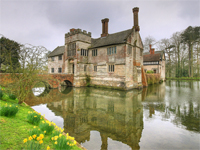
If a moat floats your boat: for sale; Playford Hall and Giffords Hall, Suffolk

Baddesley Clinton, Warwickshire (Image: Nala Rewop / flickr)

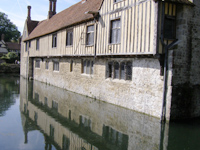
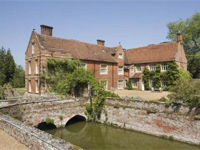
Moated houses are an architectural short cut to a more functional time when where a family lived had to be defensible and not simply a place of relaxation.  Today, of course, we admire them for their ancient charm, the weathered bricks reflected in gently rippling waters.  These houses are an older expression of our love of the natural, which found a more formal form in the later Picturesque movement, their more organic outlines in contrast with the more rigid classicism which followed.

Though once numerous, time has taken its toll and excellent examples are less common – and especially appealing when they come to market, as two have recently. The moated manor house was a result of many factors; the decline of the traditional castle, a more peaceful society, and increased wealth, but still with a need to provide some defence against thieves and attackers.  The latter category was increasingly rare but a moat with gatehouse and even drawbridge had a practical advantage.  However, for families which wished to visually bolster the perceptions of the grandeur of their lineage, a moated house was very evocative of permanence and status, drawing on their architectural ancestry with castles.  As each manor required somewhere for the local owner to stay (sometimes only occasionally if they owned many) each had a house of varying size and status depending on the wealth of the owner.  As each manor often covered a relatively small area this led to the building of thousands of these houses (though not all with moats), particularly in England.

Groombridge Place, Kent (Image: Hans Bernhard / wikipedia)

The organic growth of a moated house often created a pleasing historical collage of styles, such as at Ightham Mote, Kent, though this was sometimes swept away to be replaced by a new house such as at Groombridge Place, also in Kent.  This beautiful house was build in 1662 though in a traditional Jacobean/Elizabethan ‘H’ plan on the footprint of the older, more fortified house – though the diarist John Evelyn thought, following his visit in August 1674, that “…a far better situation had been on the south of the wood, on a graceful ascent.” indicating not everyone found a moat romantic.

Yet not every grand family felt the need to abandon the old house.  The Lygon family (Earls Beauchamp between 1815-1979) have lived at the evocative Madresfield Court, Worcestershire for 28 generations.  At its core, a 15th-century moated manor house, the current building is largely the work of the architect Philip Hardwick in 1865 for the 6th Earl Beauchamp.  The house is a prime example of late Victorian taste; a clever blend of Anglo-Catholic Pugin gothick with extensive Arts-and-Crafts interiors including a wonderful library by C.R. Ashbee of the Cotswold Guild of Handicraft (to read more about this remarkable family and house I can recommend ‘Madresfield: the Real Brideshead‘ by Jane Mulvagh).

Ightham Mote, Kent (Image: Matthew Beckett)

The physical security of a moated house was also a factor in its decline as it limited the space available for expansion as either the family, wealth or ambition of the owner grew. Many a grand country house was constructed elsewhere to replace a smaller manor with the old house either being abandoned, demolished (sometimes for building materials), or used as a secondary or dower house.  Yet, as a harsher economic reality came to pass from the 1880s, and as these smaller houses were lauded in magazines such as Country Life, so their attractiveness grew with many rescued from neglect and sometimes reinstated as a principle house on the estate.

H. Avray Tipping, one of the most influential of the Country Life writers, was a prime supporter of the smaller houses as reflected in his choice of house for the weekly ‘Country Houses and Gardens’ section – nearly a fifth of them in 1910, for example.  This was also a time when John Ruskin was arguing for more honesty in architecture and against the over-enthusiastic renovations of the Victorians which he regarded as ‘ignorant’. This regret at the neglect of manor houses in general can be seen even in the earliest Country Life articles.  Writing in 1897 (the year it was founded), John Leyland writing about Swinford Old Manor, Oxfordshire, said;

“There are manor houses through the length and breadth of the land as charming, it may be, as this, but awaiting, like sleeping beauties, the kiss that is to arouse them to fresh and unsuspected charm, the needed touch of the loving hand invested with creative skill.”

Plumpton Place, Sussex (Image: Knight Frank)

Perhaps one of the best examples of this loving restoration can be seen at Plumpton Place, Sussex for Country Life proprietor Edward Hudson by the architect Sir Edwin Lutyens.  When Hudson bought the it in 1928 the house was semi-derelict though with an intrinsic beauty from its setting on an island in the middle of the uppermost of three lakes.  Lutyens successfully restored and adapted the house to create one of the best current examples of a moated manor house – which was also offered for sale in July 2010 for £8m (and featured in another post: ‘For those who like their houses with pedigree: Plumpton Place, Sussex‘)

So having whetted our collective appetites, those with £3.5m to spare currently have a choice of two historic moated manor houses in Suffolk; Playford Hall, near Ipswich (£3.25m), and Giffords Hall, in Wickhambrook (£3.5m).

Playford Hall, Suffolk (Image: Savills)

Playford Hall has the beauty of the warm red-brick with two wings placed off-centre, hinting at the further wing demolished in the 1750s after a devastating storm in 1721 blew holes in the roof and following a long period of dereliction from 1709 following the death of the owner, Sir Thomas Felton, who had remodelled the house in its current style.  The house then passed by marriage into the estate of the Earls of Bristol, in which it remained until sold after WWII.  The house has been restored and updated – though whoever buys it will probably want to re-do the eye-wateringly pink dining room.

Giffords Hall, Suffolk (Image: Savills)

No such concerns about the wonderful interiors of Giffords Hall – the house abounds with historic woodwork, from the masses of exposed beams to the extensive panelling.  The exterior, in contrast to Playford, is almost entirely timber-framed, with an Arts-and-Crafts style north wing added in 1908 by the owner Mr A. H. Fass who also carefully restored the house following a period of neglect.   Now cleverly brought up-to-date, in co-operation with English Heritage, the house now has a full suite of reception rooms, a new kitchen and a full quota of bathrooms.

So, proving the folly of those who allowed these romantic houses to decay and the wisdom of those who restored them – with thanks to the evangelism of Country Life – another important branch of the nation’s architectural history has been redeemed and now, once again, attracts high valuations which reflect the immediate attraction these houses can exert on us all.

—————————————————————————-

For further reading, the excellent ‘The English Manor House – from the archives of Country Life’ by Jeremy Musson – though unfortunately this appears to be out of print and surprisingly expensive. One for the second-hand bookshop search, I think.

For those looking to visit, a handy list: ‘Manors in England‘ [Britain Express]

Country House Rescue returns for Series 3: Wyresdale Park, Lancashire

Wyresdale Park, Lancashire (Image: Channel 4)

The history of the country house is sadly often a cycle of rise and fall with the main variable being the speed of each respectively.  The old phrase was ‘one generation made the wealth, the second enjoyed it, and the third lost it’. Over recent decades the trend has changed slightly in that, with longer life expectancies prolonging the older generations, the houses have had fewer chances for the rejuvenation which inheritance often brought.  As an alternative, Ruth Watson uses Country House Rescue as a catalyst for the type of entrepreneurial change which is the only way for these houses to survive – if only the owners would listen!

The first episode in Series 3, to be broadcast at on Channel 4 at 21:00 on 6 March 2011, takes us to Wyresdale Park in Lancashire to meet a father and son who don’t agree on the best way to maximise the obvious potential of the beautiful estate.

Wyresdale Hall was built between 1856-65 for Bolton cotton-magnate-turned-banker, Peter Ormrod, who bought 6,000-acres from the Duke of Hamilton to create his estate.  The house, which cost £50,000 (about £4m at today’s value) at the time, was designed by noted local architect Edward Graham Paley (b.1823 – d.1895) who had an extensive practice, partnering first with his mentor Edmund Sharpe, then, following Sharpe’s retirement, Hubert Austin, before being joined by his son, Henry Paley. The work of Paley & Austin in particular was well-regarded with Pevsner  saying they “did more outstanding work than any other in the county” and was “outstanding in the national as well as the regional context”.

Paley worked on relatively few country houses, being much better known for his ecclesiastical output, with included the design of Lancaster Cathedral.  Paley was brought up in deeply religious home and, working with Edmund Sharpe, who was heavily influenced by Pugin, it was unsurprising that Paley adopted the strict ecclesiastical style with the ‘correct’ use of Gothic elements.  Perhaps looking a little too much like a convent rather than a home, the house is, nonetheless, still a good example of the type of regional interpretations of Pugin’s architectural theories which gained ground in the 19th-century.

The grade-II listed house and estate passed through the Ormrod family before the land was bought by the Whewell family in the 1920s who then bought the house in 1967.  Now the family are facing the usual struggles of a listed house, an extensive list of improvements, and the need to make the changes which sometimes sit uncomfortably with the more traditional older generation.

———————————

Country House Rescue – Series 3

My usual powers have slightly failed me and I haven’t a verified list of all the houses in Series 3 but here are the ones I have identified so far:

See also:

Going to the country: more country houses of UK Prime Ministers – Part 2

The first part of this series, highlighted the aristocratic background of our early Prime Ministers – Earls and Dukes abound.  This meant that a country house was just where they had been brought up and simply regarded as home rather than the aspirational purchase.  It also highlighted that the architectural tastes of the PMs reflected their political beliefs with a strong preference for the Classical, representing structure and order.

So, to continue the tour of country houses of Prime Ministers, this time those who served  under George III (1760–1820):

Luton Hoo, Bedfordshire (Image: ickle_angel/Flickr)

The first was John Stuart, 3rd Earl of Bute. Originally a man of rather limited means who only acquired great wealth following his marriage to the rich heiress, Mary Wortley Montagu. The family seat was Mount Stuart on the Isle of Bute; at the time a small Queen Anne house which burnt down in 1877 to be replaced by the Gothic palace we see today.  With his later wealth and prominence the Earl created two fine new country houses.  On his retirement as PM, he bought Luton Hoo, Bedfordshire in 1763 and in 1767 commissioned Robert Adam to create a large neoclassical mansion which, although this was never fully realised, the resulting house (now a hotel) is still sizable.  The wings are a later addition but faithful to Adam’s original conception. Ill health later forced a move to the Dorset coast and having bought a clifftop position he built High Cliff “to command the finest outlook in England.“.  Unfortunately it was a little to fine, the crumbling cliff not only necessitated the demolition of the house in the late 1790s, it also led to the Earl’s death in 1792 due to a fall whilst picking plants.

He was succeeded as PM in 1763 by George Grenville who was born, and lived, at the family seat, Wotton House, Buckinghamshire.  He is one of only nine PMs who did not become a peer on leaving office.

Wentworth Woodhouse, Yorkshire (Image: geograph.co.uk)

If there was a competition for the most impressive house of Prime Ministers then Charles Watson-Wentworth, 2nd Marquess of Rockingham would be feeling rather confident.  His family home, Wentworth Woodhouse, Yorkshire, is one of the largest private country houses in Britain with a main front extending to over 600ft. Built over a 25-year period, the house exemplifies the grand palaces which became possible in Georgian England. Faced with the usual pressures on later owners, plus vindictive coal mining, the family moved out and the house was leased as a teacher training college but since 1999 it has been the home of architect Clifford Newbold and his family who have been undertaking a massive and very impressive restoration programme.

William Pitt the Elder, 1st Earl of Chatham was brought up in great comfort from the proceeds of the sale of the Regent Diamond by his father.  As the younger son, Pitt would not inherit the family seat and so made his own way, choosing politics and becoming PM in 1766.  His country residence was the relatively modest Hayes Place in Kent, which he had built after he bought the estate in 1757.  He later sold it in 1766 to Horace Walpole who encased the house in white brick and enlarged it before selling back to Pitt in 1768 on his retirement.  The house survived until 1933 when it was demolished and houses built on the land.

Euston Hall, Suffolk (Image: David Robarts / flickr)

Another Prime Ministerial seat to suffer later loss was Euston Hall in Suffolk seat of Augustus FitzRoy, 3rd Duke of Grafton who succeeded William Pitt.  The Dukes of Grafton were very wealthy with extensive land holdings in Suffolk, Norfolk, Northamptonshire and London.  Euston Hall had been extensively remodelled by the Palladian architect Matthew Brettingham for the 2nd Duke between 1750-56.  The house suffered a devastating fire in 1902 which destroyed the south and west wings, which were subsequently rebuilt on the same plan but then demolished again by the 10th Duke in 1952.  It should also be noted that the Dukes also owned the splendid Wakefield Lodge in Northamptonshire, designed by William Kent, though it was tenanted and therefore the Dukes never lived there.

William Petty-FitzMaurice, 2nd Earl of Shelburne had the splendid fortune to be brought up in one of the finest of Georgian country houses, Bowood House in Wiltshire, which also became a scandalous loss when it was demolished in 1955/56.  Remodelled for the 1st Earl by Henry Keene between 1755-60, the house also featured interiors by Robert Adam, who also altered Keene’s original portico to create a much grander version.  Afterwards the stables were converted to function as the main house where the 9th Marquess of Lansdowne (as the Earls became) still lives today.

Welbeck Abbey, Nottinghamshire (Image: Mr Nibbler / flickr)

The next PM, William Cavendish-Bentinck, 3rd Duke of Portland inherited Welbeck Abbey, Nottinghamshire, which had also been the home of an earlier PM, his relative Thomas Pelham-Holles, 1st Duke of Newcastle.  As stated in Part 1, this is a fascinating house which has often been overlooked due to the fact that it has been rarely open to the in the last 100 years, public tours having finished in 1914. Extensive work was carried out between 1742-46 by the relatively unknown architect John James who reconstructed the south wing and remodelled the west front for Henrietta, Countess of Oxford.  The west front was subsequently changed again in 1790 to designs by Sir Humphry Repton.  The Dukes of Portland also had a southern seat at Bulstrode Park in Buckinghamshire, though this house was replaced in 1865 by the 12th Duke of Somerset who by then owned the estate.

In contrast to the vast wealth and aristocratic status of the preceeding PM, William Pitt the Younger was able to bring political heritage; his father also having served in the same role. In stark contrast to the size and splendour of Welbeck, his country home was Holwood House in Kent, a modest mansion set in 200-acres for which Pitt paid £7,000 in 1783 before commissioning Sir John Soane to alter and enlarge it in 1786 and 1795.  Soane’s work here led to Pitt recommending him for the work to build what was to be one of Soane’s masterpieces; the Bank of England building which was so sadly demolished in the 1920s.  Holwood was also to be demolished, in 1823, to be replaced by a much grander house designed by Decimus Burton.

The country houses of Henry Addington 1st Viscount Sidmouth have both largely now vanished under the sprawl that is Reading University.  Addington had a low-key record as PM and his houses were equally modest.  Although on becoming PM Addington moved into the beautiful White Lodge in Richmond, his main seat was Woodley House, Berkshire, which had been built in 1777 before being bought by Addington in 1789. At the same time, he also bought the neighbouring estate of Bulmershe Court which was then tenanted, before falling into disrepair in the 19th century leading to two-thirds of it being demolished. Woodley House was used by the Minstry of Defence during WWII but subsequent dereliction led to its demolition in 1960.

William Wyndham Grenville, 1st Lord Grenville, as well as abolishing slavery, also created one of the most elegant of the houses in this series; Dropmore House in Buckinghamshire.  Built in 1795 and designed by Samuel Wyatt (b.1737 – d.1807) with later work by Charles Heathcote Tatham (b.1772 – d.1842), it was Grenville’s refuge, describing it as ‘deep sheltered from the world’s tempestuous strife‘. The grounds were also lavished with attention with Grenville planting 2,500 trees, and creating numerous walks which took in the superb views and even going as far as to remove a hill which blocked the view to Windsor Castle.  Tragically, devastating fires in 1990 and 1997 left a ruined shell but it has been recently rebuilt as a series of luxury apartments.

The only PM to be assassinated, Spencer Perceval, never really had a country seat of his own but had grown up in Enmore Castle, Somerset though he would never inherit as he was the second son of second marriage.  Only a small section of the main house now remains after it was largely demolished in 1833, but originally Enmore, built c1779, was one of the largest houses in the county.  In later life, Perceval lived in a large house called Elm Grove on the south side of Ealing Common in London – though at the time this would have been quite a rural area but not quite enough to classify this as a true country house.

The final PM under George III was Robert Banks Jenkinson, 2nd Earl of Liverpool who again chose to live close to London, though in a country house, at Coombe House in Kingston upon Thames in Surrey.  Originally Tudor, this brick house was replaced with a Georgian mansion which was later altered by Sir John Soane, including the addition of a library.  The house survived until 1933 when it was demolished with houses now covering the site.

So although the Gothic revival movement had started in the 1740s and was the main alternative to the dominant Classical architectural style, even by the 1820s, it did not reflect the tastes of any of the Prime Ministers.  Considering the system still echoed the exclusions of the Reformation with its explicit rejection of all things ‘catholic’ (architectural, theological, political) it was unlikely to change, especially as the Catholic Emancipation Bill wasn’t passed until 1828.  Architecture was taken an expression of belief and so to favour the Gothic could potentially have given the wrong signals.

Next: Prime Ministers under George IV and William IV

List of UK Prime Ministers

The rise and fall of French taste on UK country houses

Wrest Park, Bedfordshire (Image: English Heritage)

For all the traditional antipathy towards the French, the influence of their architecture has been felt throughout Britain’s country houses.  Although initially the use of the French architectural vocabulary was a sign of wealth and education only available to the best families, the style was regarded as sullied by the later, more energetic, constructions of the Victorians – an association which still sadly lingers today.

The first wave of Anglo-French design started in the Elizabethan period; a time when it was acceptable to display one’s knowledge conspicuously. The French style, with its dramatic rooflines, dovetailed with the traditional English manor house and its own profusion of gables and chimneys.  Houses such as Burghley in Northamptonshire made dramatic use of the style with the central, three-storey pavilion, dated 1585, based on the French triumphal arch but oddly includes a traditional mullioned window on the third floor. Burghley was the product of the owner, Lord Burghley, an architectural enthusiast who as far back as 1568 was known to have been writing to France to obtain specific architectural books.

This early use of the French style was relatively restrained – probably more by the conservatism of the ruling gentry who were most likely to be building these houses.  Yet, our impressions now are more strongly influenced by the bolder, more assertive French style which was so popular during the Victorian era – though this same popularity was to also lead to it being derided.

The first of the Victorian nouveau-riche were keen to be accepted by society and so built houses which largely followed the same designs used by the local families.  The end of the Napoleonic wars in 1815 led to a rush across the Channel leading to a revival of interest in French design, particularly in relation to interiors, such as the Elizabeth Saloon at Belvoir Castle, Rutland, built c.1825.  By the mid-nineteenth century this was being more confidently expressed in dramatic houses which sought to boldly make their mark.

The second French Renaissance was influenced by lavish works such as the new block at the Louvre in Paris, built between 1852-70.   However, there were earlier examples such as the complete Louis XV chateau at Wrest Park in Bedfordshire, designed by the owner Earl de Grey, built in 1834-39, and Anthony Salvin’s French roofs added to Oxonhoath in Kent in 1846-47.  Yet, after the Louvre, the fashion gathered pace with designs such as R.C. Carpenter’s redesign of Bedgebury in Kent in 1854-55, and Salvin’s work at Marbury Hall in Cheshire in 1856-8.  Less successfully, the architect Benjamin Ferrey built Wynnstay in Denbighshire for Sir Watkin Williams-Wynn which, for all its dramatic high roofs and pavilions, was thought rather gloomy.  Another dramatic, albeit slightly awkward, design was that of Plas Rhianfa, Wales, built in 1849, which seems to mix both Scots baronial and French, whilst Sir Charles Barry completed a more successful use of the two styles at Dunrobin Castle for the Dukes of Sutherland in 1845.  Also of note was Nesfield’s design for Kinmel Hall, described as a Welsh ‘Versailles’.

These houses were largely for the existing gentry who found the impressive skylines met their needs for a dramatic statement as was fashionable at the time.  With the fashion spreading into London and being used for luxury hotels, clubs and offices it was inevitable that the newly wealthy would wish to emulate in the country the world they already enjoyed.  The last burst of ‘aristocratic French’ could be seen in the designs for Hedsor House in Buckinghamshire, 1865-68 for Lord Boston, Alfred Waterhouse’s Eaton Hall in Cheshire, 1870-72 for the Duke of Westminster, and T.H. Wyatt’s Nuneham Paddox in Warwickshire for the Earl of Denbigh, built in 1875.  From around this time, its fashionability declined.

One of the earliest of this new wave was Normanhurst in Sussex, built in 1867 for Thomas Brassey, son of the famous railway contractor.  Reputedly, Lady Ashburnham from nearby Ashburnham Place (note the very different architectural style of house) would snootily refer to him as ‘that train driver over the hill’.  In Worcestershire, the equally dramatic red-brick Impney Hall – later Chateau Impney – was built in 1869-75 for local salt tycoon John Corbett, who employed Auguste Tonquois, who had extensive experience around Paris.  In County Durham, the foundation stone of the Bowes Museum, originally designed to be part-home also, was laid in 1869 for John and Josephine Bowes.  Designed by Jules Pellechet with J.E. Watson of Newcastle-upon-Tyne, the house reflected their love of France but also made a statement as to their wealth – and possibly sought to hide their less-than-solid social position as illegitimate son of an Earl and an actress.  In Yorkshire, the additions to Warter Priory were considered unsuccessful, either due to the strange proportions or because the style had simply fallen out of favour.  More successfully, St Leonard’s Hill, Berkshire, was transformed from a Georgian house in the mid-1870s to create a dramatic chateau visible from Windsor Castle.

Waddesdon Manor, Buckinghamshire (Image: National Trust)

Interestingly though, perhaps the most famous of the English chateau was also one of the latest.  Waddesdon Manor in Buckinghamshire was built in 1889 for Baron Ferdinand de Rothschild to a design by French architect Gabriel-Hippolyte Destailleur, mixing elements from various famous French chateaux such as Blois, Chambord and Anet.  The last of these grand French imports was Halton House, designed by William R. Rogers and built in 1882-88, also in Buckinghamshire and also for a Rothschild, Alfred Charles; Baron Ferdinand’s cousin.  Equally grand, this house also featured a wonderful winter garden, though this was sadly demolished to make way for an accommodation block for the RAF who bought the house and turned it into an officer’s mess.

Perhaps one of the final straws as to the desirability of the French style was the spectacular collapse of the Victorian financier Baron Grant who, in 1875, spent over £270,000 (approx. £20m) building a huge house in Kensington before his crimes were exposed in 1879 with the subsequent public disgrace, and the demolition the house in 1883.  Such a high-profile scandal and its flash monument would have been felt in society and tarnished the style for no-one would wish to be associated with such disgrace.  However, fashion would have played a more significant role, with taste moving on to new styles, leaving these extravagant mementos to an earlier, brasher architectural exuberance which now give us an unexpected glimpse of France in the British countryside.


Credit: a wonderful insight into the period is Mark Girouard’s ‘The Victorian Country House’ which was most useful in the research for this post.

For more information on Chateau Impney; ‘Chateau Impney – the story of a Victorian country house’ by John Hodges