Developer shows sense; Ruperra Castle for sale

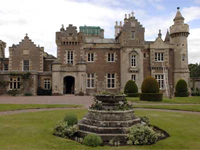
Ruperra Castle, Newport, Wales (Image: Savills)

Run-down or derelict country houses are often an enticing prospect for a developer, especially where the house still retains some land, on which they can propose ‘enabling development’.  In theory this is the correct use of this exemption but frequently the developer will suggest too many houses or ignore the fact that the house has too little land to avoid any development compromising the setting of the house.  When this happens, it is often the house which suffers as the developers wait for appeals or a change in policy whilst allowing the house to deteriorate further.  So in the case of Ruperra Castle in Wales it’s encouraging that the owner has decided to bow out giving someone else the chance to restore this architecturally interesting house.

Ruperra is an early example of the ‘mock’ castles which became fashionable in the Elizabethan and Stuart eras and were an example of life imitating art as the idea of these houses drew from the ‘pageant castles’ as featured in court entertainment of the time.  These stage castles formed the centrepiece to the royal ‘masques’ and were laden with allegorical symbolism as they might be populated by damsels (signifying virtue) but successfully defended against attacking knights (signifying baser desires).  Works such as Edmund Spenser’s The Faerie Queen (published in 1590 and 1596) also fed a fashion for chivalry and heraldic forms. Importantly, the long period of domestic peace during Elizabeth’s reign meant that the design of houses moved from being primarily military and defensive to more simply domestic with the look of a house increasingly dictated by aesthetics.

Ruperra wasn’t quite the first of it’s type; that distinction could be said to be held by houses such as Michaelgrove in Sussex built for the Shelley family in 1536 (dem. 1830s), and Mount Edgcumbe in Devon, built between 1547 – 1554, which also were not fortresses and featured a square or rectangular central block with drum or square towers on each corner.  This was followed by the fabulous Wollaton Hall in Nottinghamshire, begun in 1580, which was an altogether more grandiose statement of power but broadly followed the same layout – as did Hardwick Hall, although in an adapted form. However, the Renaissance ornamentation of Robert Smythson‘s design at Wollaton contrasted dramatically with more austere designs of the true ‘mock’ castles which harked back to the earlier simplicity of decorated castles such as Herstmonceaux Castle in Sussex, begun in 1440, with its many windows and regularised defensive elements (such as the arrow loops) making them almost decorative.

Lulworth Castle, Dorset (Image: Matthew Beckett)

The design for Ruperra Castle was clearly based on that for Lulworth Castle, just 100 miles away in Dorset, and built between 1603-05.  Always called a ‘castle’ but built with the instruction from Lord Howard of Bindon that it ‘prove pretty’, it was never military.  Indeed, Thomas Gerard writing in 1630 described it as ‘well seated for prospect and pleasure; but of little other use’. Bought by the Weld family from Lord Howard it remained their family seat until a devastating fire in 1929 completely gutted the interior – as it remains today, although the building itself has been restored.  Another house thought to have been built around 1612 is Compton Bassett House in Wiltshire (dem. c1929) which clearly shared a similar layout although the corner turrents were square.

The builder of Ruperra Castle was Thomas Morgan (b.1564 – d.1632), who made his fortune as the Steward for the Earls of Pembroke at Wilton House, Wiltshire.  Morgan would have been regularly exposed to court life and would have been very aware of the latest architectural fashions.  Hence when he came to build his own house, which was finished in 1626, he deliberately drew on the latest architectural fashions and created one of the first of the ‘modern’ country houses.  The layout was a significant departure as the rooms were orientated to the outside to make the most of views – hence Ruperra’s elevated site chosen for its beauty rather than defensibility.  Interestingly the ‘castle’ design seemed to fall quite quickly from favour and so there are few other examples of this type – though one late example was Beaurepaire Park in Hampshire built in 1777 (sadly burnt down in 1942).

Ruperra Castle remained as part of the Morgan’s vast Tredegar estate and was traditionally used to house the eldest son before he inherited Tredegar House, the family’s principal seat.  The castle originally had dormers but these were removed during the rebuilding after a fire in 1785 and replaced with the crenellations there today.  It was last inhabited during World War II when a searchlight battery requisitioned it and they were there when the terrible fire caused by faulty wiring broke out in 1941.  Despite best efforts, the house was completely gutted and was eventually sold, along with the rest of the 52,000-acre Tredegar estate in 1952.

Since then, constant promises of restoration have come to nothing and it has steadily deteriorated, most dramatically when, in 1982, the south east tower largely collapsed.  Sold to the current vendor, Mr Ashraf Barakat, in 1998 he had hoped to convert the house into 11 flats and build 18 more houses in the 14-acre grounds that remained with the house.  After a final rejection at a public enquiry in 2009, Mr Barakat has now, wisely, put the still grade-II* listed Ruperra Castle on the market for £1.5m, rather than holding on and letting the house deteriorate further.  This should not be considered a development opportunity, so hopefully now someone with deep pockets will come forward to restore, as a single family house, this architecturally important building.  Its rescue would once again connect the modern history of country house design in Wales, bringing life back to a house which, when it was built, was the most sophisticated in the country.

Property details: ‘Ruperra Castle, Lower Machen, Gwent, Wales‘ [Savills]

More on this story:

More information:

Credit: I’m indebted to the prior work of Mark Girouard (‘Elizabethan Architecture‘ 2009) and the late Andor Gomme for their knowledge of Elizabethan architecture.

Restoration continues inside and out; Wilton House and others

Wilton House, Wiltshire (Image: John Goodall/Geograph)

Any time of economic difficulties can often lead to any expenditure being put on hold, including vital restoration projects.  So it’s encouraging to see projects still being completed – but as some of these were approved and started back in the heady days of government largesse, perhaps these are the last we’ll see for a while except where private money can fill the gap?

One of the most impressive has been the award-winning restoration of the family dining room at Wilton House, Wiltshire – and maybe all the more impressive as it was funded privately by the owner, the 18th Earl of Pembroke.  Although ranked as joint 574th in the Sunday Times Rich List 2010, with an estimated worth of £115m, most of this wealth is tied up in the value of the house, the contents (including superb paintings by Van Dyck and Rembrandt), and the estate.

Anyone undertaking an architectural project at Wilton is following in some fairly illustrious footsteps.  The main house, one of the finest still in private hands, is unusual in that the scale of the house was a response to the incredible gardens designed by Issac de Caus in 1632.  The design is sometimes attributed to Inigo Jones but a drawing found by Howard Colvin at Worcester College by de Caus showed he was responsible for the original plan for a much larger, 21-bay palace, with a grand central portico, running to a total length of 330-ft.  However, the untimely death of the newly-married Earl in 1636 and the subsequent return of the huge £25,000 marriage dowry (approx £40m today) to the bride’s father, the Duke of Buckingham, meant that the scheme was now too ambitious and so just one half of the original design was built; which is what we see today. The half-a-house was considered plain so Jones became involved, adding the one-storey corner towers to the design.

Private dining room - Wilton House (Image: Historic Houses Association)

Wilton’s interior, in particular the celebrated set of seven state rooms in the southern facade which includes the famous Double Cube room, were largely the creation of Jones, assisted by his able deputy John Webb.  Yet there are other fine rooms which had become misused over the years and one has now been restored in sumptuous style as a private dining room.  Formerly cluttered with the normal ephemera of family life – CDs, books, old furniture etc – it was  fairly sorry sight.  The current Earl and Countess of Pembroke have spent an undisclosed, but undoubtedly substantial, sum on creating a glorious dining room but which will sadly not be included on the tourist trail.  Tapestries now cover the deep green walls, interspersed with family portraits by Reynolds, completing what James Stourton, chairman of Sotheby’s UK described as “…one of the outstanding country house renovations of the decade.” and winning the 2010 HHA/Sotheby’s Restoration Award.

One of the largest of the recent projects has been the £5.6m restoration of grade-II listed Bedwellty House in Tredegar, south Wales.  Built in 1818 for the owner of the first iron works in Tredegar, it was increasingly at risk of falling into dereliction.  Realising the importance of the building, the local council spent four years securing grants to fund the ambitious programme from organisations such as the Heritage Lottery Fund, the Welsh Assembly, Blaenau Gwent council, and Cadw [Welsh equivalent to English Heritage] .  The works have included work on the ornate plaster ceilings, the sash windows and shutters, and the main structure.  Work will now continue on the parkland and gardens to bring them back to their former glory.

The grounds of our country houses were also not just a buffer to keep the world from intruding but also a stage on which to create idealised landscapes and views.  To this end they were often populated with follies or architectural creations to catch the eye of those looking out from the house but also those walking the grounds.  Sadly, the isolation of these buildings has often meant that in recent years they have been cut-off from the main house, forgotten, or neglected and vandalised.  Nowadays these wonderful architectural vignettes have been increasingly valued and urgent works undertaken to restore them.  One fine example is the grade-I listed Wentworth Castle Rotunda in Yorkshire.  Started in 1739 and finished in 1742, the design is based on the Temple of Vesta at Tivoli near Rome.  One of 26 listed buildings in the 500-acre parkland, the temple has now been restored following a grant of £300,000, which has enabled the removal of overgrowing shrubs, and the cleaning and repair of the stonework, roof, and floors.

Thankfully the official organisations don’t have a monopoly on generosity. Perhaps those selling a house in need of some restoration might take a lead from admirable seller of Newberry Hall, Ireland, Richard Robinson.  Realising that the elegant Palladian house with its wonderful flanking pavilions is in dire need of restoration, the elderly owner has put the house on the market but with the offer of a substantial contribution towards the costs of restoration to bring the house back to its former glory.  With such generosity, one hopes a suitably sympathetic buyer can be found who will be willing to take on the project and complete an appropriate restoration.

Restoration has always been expensive so in their straitened times we can only hope that funds for basic care and maintenance are found so that in a few years time we are not faced with a slew of houses and monuments suffering from any short-sighted desire to save a few pence today at the cost of many pounds tomorrow.  Long may the stories be of enhanced glories such as that at Wilton House rather than urgent appeals to save buildings at risk.

Full story: ‘Winner of Historic Houses Restoration Award 2010 Announced‘ [Art Daily]

Full story: ‘Tredegar’s Bedwellty House restoration work unveiled‘ [BBC News]

Full story: ‘Restoration of Wentworth Castle Rotunda completed‘ [BBC News]

Full story: ‘Rotunda is reopened to round of applause for works‘ [Yorkshire Post]

Full story: ‘Deal for buyer who will rescue Kildare demesne‘ [Irish Times]

The danger of interpretation: Abbotsford House, Scotland

Abbortsford House, Scotland (Image: The Scotsman)
Abbotsford House, Scotland (Image: The Scotsman)

For Abbotsford House in Scotland, home of the famous author Sir Walter Scott, the recent news that it was to receive a £4.85m Heritage Lottery Fund grant is the sort of news which should be welcomed as that level of funding can usually remedy any necessary maintenance or repairs.  However, the grant is not actually to be spent on the house (despite headlines such as ‘Lottery cash means Walter Scott’s beloved Abbotsford will get £10m facelift‘ [The Scotsman]) but mainly on a new, separate visitors centre.

Sir Walter Scott (b.1771 – d.1832) played a key part creating a literary context for the developing Picturesque movement which sought to reject the rigid formality of the Georgians and create a more organic architecture, which he developed in the construction of his own house.

The theory of the Picturesque raised the importance of how one ‘felt’ about a scene or view – a definite break with the austere, ‘correct’ classicism which so dominated.  The exploration of more fluid forms had started in the 1750s and had been adopted by such noted figures as Sir Horace Walpole for his own house at Strawberry Hill in Surrey.  However it was a local Surrey parson, the Rev. William Gilpin, whose guidebooks were to lead the way for those who came afterwards such as Herefordshire squires Sir Uvedale Price and Richard Payne Knight who had the funds to realise these ideas.

Inspired in part by the idealised landscapes of the artists Nicholas Poussin or Claude Lorrain, architects sought to provide an almost ‘arcadian’ vision of buildings integrating naturally with an environment, forcing them to think of the building and environment as a whole rather than simply viewing their particular work in isolation. This also affected the plan of the house, with rooms now being aligned along the best viewing lines rather than simply lined up. One architect who took on this new style was John Nash who met Uvedale Price in about 1790 during Nash’s time in Wales.  Price was at the time building a small summer house and Nash, after meeting him, proposed a typical villa – a design antithetical to Price’s own philosophy.  Price instead guided Nash to design a new house where rooms followed views, and the overall design echoed its rocky coastal location; as he wrote ”The form of it is extremely varied from my having obliged him [Nash] to turn the rooms to different aspects‘.  Castle House, sadly demolished in 1897, was a watershed in the rejection of the dominant Georgian style and Nash quickly developed new designs based on these radical principles which became his distinctive ‘cottage orne‘ style.

Sir Walter Scott didn’t set out to link literature and architecture – in fact his ‘Waverley’ novels were simply a quick way to make some money after financial difficulties.  The books, which he initially wrote anonymously, were the first truly successful historical fiction, and brought Scott considerable wealth and, once his authorship was known, praise.  It was this wealth that enabled him to set about creating his ideal house.  Raised in the Scottish borders he had a close affinity for the natural landscape and so the Picturesque style would have appealed.  However, Scott ensured the existing designs for Abbotsford House had a distinctly Scottish twist, creating what is known today as the ‘Scots Baronial’ style so closely associated with our romantic notions of Scotland today.

Scott bought a small farmhouse in 1811 and engaged William Atkinson (b.c1774 – d.1839) who, between 1814-24, created the house we see today.  Atkinson was not considered one of the best ‘Gothick’ architects, with Howard Colvin thinking that his designs lacked the elegant charm of the 18th-century work and the scholarly accuracy of the 19th-century.  However at Abbotsford, the architectural vocabulary he employed – steeply pitched slate roofs, turrets, bartizans, and crowstepped gables – became the standard language of Scots country houses for anyone not following the Classical style.

So Abbotsford House is an architectural genesis – the first of it’s kind.  It seems a shame to lavish millions on a separate interpretation centre in a modern design which will only compete with the existing architecture of the house and estate.  It’s also a competition the new building is unlikely to win.  Perhaps it would be better for the money to be spent on sensitively incorporating the displays and materials from Scott’s life and work into the home he so lovingly and thoughtfully created.

More details: ‘Lottery cash means Walter Scott’s beloved Abbotsford will get £10m facelift‘ [The Scotsman]

Official website: ‘Abbotsford House

Background: the Picturesque movement [Wikipedia]

Orphan seeks new carers: Plas Gwynfryn, Gwynedd

Plas Gwynfryn, Wales (Image: SAVE Britain's Heritage)

It’s often been said that there are no problem buildings, just problem owners.  However, an even more difficult situation is where the house is ‘orphaned’ because no legitimate owner can be found.  This can make it doubly frustrating for those looking to buy and restore a property who are forced to sit by and watch a building deteriorate as the search goes on to find the owner.  This also highlights something of a legislative loophole as having no known owner also prevents the council serving an ‘Urgent Works Notice’ to force repairs thus ensuring that the house will continue to deteriorate. Which brings us to Plas Gwynfryn; an orphan with good prospects if adoption takes place quickly.

The grade-II listed Plas Gwynfryn is another of the many Welsh country houses built to serve the minor gentry, with their increased wealth from the Victorian industrial boom.  The estate had been inherited from a childless uncle by Owen Jones Ellis-Nanney in 1819, and he hugely increased the size of his lands by purchasing the neighbouring Plas Hen estate. On his death it passed to his son, Hugh John Ellis-Nanney.  Having been educated at Eton and Oxford and, on his 21st birthday, now owner of a huge estate, Hugh was the epitome of the eligible bachelor and wanted a house to reflect his status.

The old house was demolished in 1866 and the new house was completed by 1876 at the then astronomical cost of £70,000 (approximately £3m in today’s money).   The design, by architect George Williams, was regarded as very fashionable to the extent that the house was featured in ‘The Builder’ magazine in June 1877.  Hugh was very active in local politics and in 1895 almost beat the local Liberal candidate, the future Prime Minister David Lloyd George, losing by only 194 votes.  Almost by way of consolation Hugh was given a baronetcy and happily lived out his days at Plas Gwynfryn, dying in 1925, with his wife following in 1928.  As their only son had died aged just eight, the house was inherited by their daughter who moved out to Plas Hen.  The house was then let to the Church of Wales before being sold off in 1959 when the estate was broken up.

It then became a hospital and then a hotel before a mysterious fire entirely gutted it in 1982.  Since then it has stood as an empty shell, slowly deteriorating, and is now in serious danger of collapse with the tower a particular risk.  Almost no work has been done on the house except for a brief period when a conservation-minded squatter moved in and started work.  This prompted the only known appearance by the apparently Canadian owner who appeared in a local court during eviction proceedings.   Since then nothing has been heard of the owner and the local council, though aware of the situation, seem powerless to act unless the owner can be found.  A local developer, Aaron Hill, who has completed other historic restorations, is keen to find the owner and buy Plas Gwynfryn with a view to fully restoring it as a family home – which would surely be the best outcome.

Although rare, this example shows that despite the combined efforts of the local Council and a potential buyer an owner can remain a mystery, thwarting well-intentioned efforts to rescue a house before it deteriorates beyond the point of repair.  If there is a legislative loophole it must be closed to prevent any other houses languishing in such a way.

Perhaps councils could be given the legal power to compulsorily purchase when a house is at risk of complete loss, with the money held in escrow in case the owner should appear. Councils are often reluctant to use their powers of compulsory purchase as they become legally responsible for repairs but surely in cases like this with an owner desperate to take the house on, the risk to the public purse is very low. The power would have to only be used in extremis when all other avenues had been exhausted but at least it would give a tool of last resort to ensure that more of our heritage is not lost just because a problem owner can’t be located and forced to honour their responsibilities.

If you are the owner and you happen to read this, please do get in contact with either me or the Council or SAVE Britain’s Heritage who would be more than happy to help get the process of rescuing this house under way.

Anyone with deep pockets? Country houses at risk today

It seems remarkable that between the popularity of country houses as tourist attractions or business or simply as homes that any would be at risk.  Yet as the 2010 SAVE Britain’s Heritage Building’s at Risk Register shows there are still a broad selection of fine houses which, for various reasons, are in need of someone with a desire to restore part of our heritage, lots of dedication, and pretty deep pockets.

Nocton Hall, Lincolnshire (photo copyright: Tom Vaughan)

One of the saddest is the case of Nocton Hall in Lincolnshire – a county which has lost so many of it’s fine old country houses already.  Fire is still one of the main reasons a house can quickly go from being a secure home to an ‘at risk’ shell.  Grade-II listed Nocton Hall is a warm honey-coloured stone house built for the 1st Earl of Ripon in 1841 to replace the original Jacobean house which burnt down in 1834.  After a stint as an RAF hospital in WWII it became a residential home before being bought by a property developer.  Unfortunately no development took place and the house was allowed to slowly deteriorate before a serious fire severely damaged what had been a perfectly good house.  Still sitting in its own gardens and parkland and near the village Nocton Hall cries out to be restored either as a h,otel or ideally as a grand family home.

Barmoor Castle, Northumberland (Photo: SAVE Britain's Heritage)

To look at the photo, Barmoor Castle in Northumberland looks in pretty good shape – but a picture can hide as much as it shows.  The first issue with Barmoor is that it actually is unused and sits in the middle of a caravan park which has been established in the grounds. Inside, there is some water damage as the roof has been leaking – although recent work, part funded by English Heritage, has alleviated this for the moment. Barmoor was built in 1801 around an older tower by the architect John Patterson of Edinburgh in a castellated Gothic Revival style for Francis Sitwell, in whose family it remained until 1979 when it was sold along with 200-acres.  The current owners have operated the caravan park since then but didn’t live in the house or use it leading to it’s current neglected state.  This is a classic example of where a house could be rescued from an inappropriate use, restored and enjoyed as a fine country house as was intended.

St Botolph's Mansion, Wales (Image: SAVE Britain's Heritage)

St Botolphs Mansion in Pembrokeshire was built in the early 1800’s for General Richard Le Hunt is a house in need of a use rather than repair.  The Doric porch and neat window architraves create an interesting facade which would normally ensure that such a house would be jealously fought over if it came to market.  However it is now owned by the nearby oil refinery (the proximity probably ruling out residential use) but they are exploring options as to how to make use of this elegant Georgian house – perhaps as a conference facility might be more appropriate.  Either way, this is a house which shouldn’t be forgotten.

Other country houses of note in the report include the Grade-II* listed Plas Machen nr Newport, the surviving portion of the 15th-century house of the Morgans who moved up in the world to Tredegar House, which is for sale. Also for sale, since 2007, is Benwell Towers in Newcastle which was a country house when built but is now suburban, achieving fame in later life as the set for the kid’s TV series ‘Byker Grove’.

Even if your pockets can’t stretch to a country house there are many other buildings seeking a saviour so do order your copy of ‘Live or Let Die‘ and certainly consider joining SAVE Britain’s Heritage to help to preserve our architectural legacy for future generations.