What goes around; the use of rotunda in UK country houses

The UK aristocracy brought back many souvenirs from their grand tours to Italy – pictures, sculpture, drawings etc – but also a delight in the architecture inspired by the ancient ruins.  This fascination manifested itself in country houses across the UK with a profusion of arches,  Serlian windows, porticos and pediments.  However, one device, despite its impressiveness, has been notable by its relative rarity; the rotunda – that grand circular space often featuring a parade of columns leading the eye up to a spectacular dome.  So why would this grand centrepiece be so infrequently used inside our country houses?

Italy - Villa Capra or 'La Rotonda' (Image: Marco Bagarella / Wikipedia)
Italy – Villa Capra or ‘La Rotonda’ (Image: Marco Bagarella / Wikipedia)

The most famous rotunda, and that which was so influential on the Anglo-Palladians, was the Pantheon in Rome.  Built in AD 124, this vast space under a 142ft diameter dome was closely studied by Andrea Palladio and became a key destination for UK architects who later travelled to Rome.  Palladio then developed the use of the rotunda as the central circulation space in his residential villas, most famously with the Villa Capra or “La Rotonda” in Vicenza, begun in 1567.

Palladio was not the first to use a rotunda in a residential setting; the artist Mantegna built his own home in Mantua in the 1470s using a layout and scale very similar to that later used at Villa Capra, using a design probably suggested by the architect-engineer Francesco di Giorgio.  Palladio then modified it and used it to great success to create what is regarded as one of his finest houses.  The rotunda would have neatly solved the challenge of the Villa Capra in that a visitor may at any front, thus negating the traditional linear plan which assumed only one main entrance.
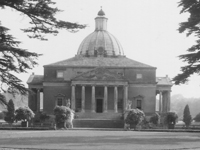
Mereworth Castle, Kent

Looking through Colen Campbell‘s ‘Vitruvius Britanicus’ – a highly regarded collection of plans and prints of the best Georgian houses published between 1715-1725 – that over the three volumes a rotunda is only used twice.  The first is in a proposed (but never executed) design for Goodwood House in Sussex for the Earls of March designed by Colen Campbell in 1724 which featured a 40ft diameter space.  The second is the 35ft diameter version which forms the dramatic central hall of Mereworth Castle in Kent.  Mereworth (built 1722-25) was one of only four Georgian houses to be built in the UK which closely followed the design of the Villa Capra; the others being Chiswick House, Middlesex (1726-29), Foots Cray Place, Kent (1754 – demolished 1949), and Nuthall Temple, Nottinghamshire (1757 – demolished 1929).

A later use of the rotunda was at the slightly eccentric Ickworth House, Suffolk. Built in 1795 and based on the designs of Mario Asprucci, an Italian architect;  it was later adapted by Francis and his brother Joseph Sandys who also oversaw construction.  This later use of the rotunda showed how it could be employed as a single dramatic centrepiece in its own right, not hidden in the centre of the house.

Central stairwell and gallery, Wardour Castle, Wiltshire (Image: Strutt & Parker)
Central stairwell and gallery, New Wardour Castle, Wiltshire (Image: Strutt & Parker)

Yet, if it was hidden, it could form a dramatic and surprising irregularity to the procession of square and rectangular rooms which often dominated houses.  One example of this is at Kedleston Hall in Derbyshire where Robert Adam was inspired by his own 1764 study of the ‘Ruins of the Palace of the Emporer Diocletian at Spalatro [Split]’ which paired the circular rotunda with a square vestibulum. Adam also later proposed to convert the courtyard at Syon Park into a huge rotunda. Perhaps one of the most impressive and beautiful expressions of the rotunda is the central staircase at New Wardour Castle in Wiltshire, designed by James Paine, and built between 1769-1776 and later described by Pevsner as ‘the most glorious Georgian interior of Wiltshire’.

So, despite its impressiveness why are most entrances and staircases so determinedly right-angled?  Simple finance can explain it in part; it would be more expensive to create a rotunda as they are more complex, require more space and also usually compromises in the floor plan to include the curvature.

Fashion can also play its part. As architectural taste moved in the Victorian era towards a preference for the gothic, so the opportunities for the use of the rotunda diminished. With its origins in the temple ruins of Classical ancient Rome, the most famous Gothic Revival architect, A.W.N. Pugin (b.1812 – d.1852) considered it part of a more pagan tradition – and therefore completely antithetical to his belief that gothic represented the only true expression of Christianity through architecture. And where Pugin led, others followed.

Or perhaps the answer is more pragmatic.  One of the primary purposes of the country house was to impress visitors.  Often a political power base, the grandest houses were designed to create an impression even before the visitor actually met the owner.  As one of the principal spaces in a house, entrance halls have often played an important role in this domestic ‘theatre’ – and the use of a rotunda requires perhaps too many compromises.

Traditionally the grand rooms where visitors would be met were often on the ground floor and would be processed through, with only the most important visitors reaching the best rooms.  Elizabethan houses changed this with the principal rooms moving to upper floors, such as at Hardwick Hall in Derbyshire, requiring more impressive staircases which, through the use of heraldic and political symbolism in the carving on balusters and handrail could make many a statement before the guest reached the required floor.

Palladian designs continued this with the preference for the piano nobile which moved the principle rooms to a raised ground floor.  The large empty wall spaces of the staircase also formed a useful space for the display of paintings including family portraits or a large selection to show the owner’s taste and style.  The staircase also provided a way to make a dramatic entrance – think ladies in their evening gowns gliding down to join the party.  Yet if a house used a rotunda it compromised both these features.  A curved wall made it difficult to hang the largest and most impressive works of art and staircases were usually spiral and tucked into the walls in the corners, meaning those coming down would only be seen when they emerged at the ground floor – which would never do.
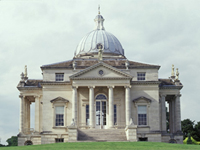
Henbury Hall, Cheshire (Image: Country Life Picture Library)

Yet, the rotunda has not died out and those with the vision and wealth can still create these dramatic spaces.  One of the most impressive has to be Henbury Hall in Cheshire, built between 1984-86 for Sebastien de Ferranti and designed by the architect Julian Bicknell from a painting by the artist Felix Kelly. A faithful recreation of Villa Capra, the dome rises to 15m with the principal rooms radiating from the central hall.  Nigel Anderson at Adam Architects also designed a replacement country house in Surrey which, according to them, is based (I’d say loosely – at least externally) on Villa Capra.  Another fine example is that at Tusmore Park in Oxfordshire, winner of the best new building in the classical tradition award from the Georgian Group in 2004 where the scagliola columns in the central rotunda are said to rival those of the imperial palaces of St Petersburg.

These examples show that, although comparatively rare, the impressive traditions of the rotunda are being continued by architects and clients determined to create the most dramatic interiors in contemporary country houses despite the compromises which have perhaps unfairly limited their use in previous centuries.

So you can’t afford a whole house: country house apartments

Charlton Park, Wiltshire (Image: Chesterton Humberts)

Country houses were always a community with not only the family but also a significant number of staff.  Yet as these houses became more uneconomical and houses emptied, large sections often lay dormant, until the family moved out and, in darker times, the house might be demolished.  However, conversion of the house into multiple individual homes offered a route to not only save the house but ensure that it was lived in rather than just used as a conference centre or hotel.  These apartments are now highly prized and offer the fascinating possibility of living in a grand stately home without many of the burdens – but only if it was converted sensitively and the setting preserved, which sadly isn’t always the case.

The idea of converting country houses into smaller, more manageable units is a fairly modern practice, largely since World War II, though some smaller conversions had taken place previously.  A pioneer was the now defunct Country Houses Association which was set up in 1955 to provide shared accommodation, with communal meals, for well-to-do retirees in good health in a style to which many residents had formerly been accustomed. The first house to be bought and converted, in 1956, was the red-brick Elizabethan Danny in Sussex. Next, in 1959, was the grade-I listed Aynhoe Park in Northamptonshire, a Soanian masterpiece with an elegant central block framed by two wings (though this has now been converted back into being a single home).  These set the pattern which was successfully repeated for seven other houses, some of which remain as retirement communities despite the collapse of the CHA scheme.

Around the same time, Christopher Buxton formed ‘Period and Country Houses Ltd’ which focused on creating independent units within the house and estate buildings.  Buxton had several notable successes such as the restoration of Kirtlington Park in Oxfordshire, keeping the splendid central portion as his own home, and also Charlton Park in Wiltshire, seat of the Earls of Suffolk, who currently still live in a portion of the house and own the 4,500-acre estate surrounding it.

In the 1950s and 60s, sale adverts for country houses often included the phrase “eminently suitable for conversion”.  Other developers could now see the potential and developed their own schemes – but with little heritage protection they often did more harm than good.  For them the key to getting the maximum profit was to cram in as many units as possible within the house and estate buildings before trying to built in the parkland.  This sadly meant that the grandest rooms in the houses – ballrooms, libraries etc, – would be crudely sub-divided, wreaking their proportions and destroying decorative details.  Sometimes developers simply developed the houses in the estate and then neglected to restore the main house, often citing the mounting costs of the work.

Northwick Park, Gloucestershire (Image: Cotswold District Council)

A sad example of where the house has been compromised through too many units is at Northwick Park in Gloucestershire, a grade-I listed house of 1686, with later work by Lord Burlington in 1728-30 for Sir John Rushout.  An architecturally interesting house with a Classical east front topped with a decorated pediment, which contrasts with Burlington’s work on the east front, which was later, oddly, given shaped gables sometime between 1788-1804.   Empty from 1976 with significant thefts of chimneys and doorcases and general deterioration, it was then bought including just 19-acres in 1986 by a local developer for £2m.  With repairs estimated at the time to come to at least £1.5m, the local authority permitted some enabling development totalling 68 new units – with just six in the main house itself.  However, the new properties had to be sited within the footprint of existing estate buildings leading to an overcrowded development with the house becoming almost an architectural ornament, lost in the rest of the residential development.

Many of the most successful and sensitive conversions have been undertaken by Kit Martin, a gifted architect who has saved some wonderful houses and been instrumental, with assiduous promotion by Marcus Binney of SAVE Britain’s Heritage, in demonstrating that it is possible to convert a house without compromising it.  His particular skill was in dividing the houses vertically, rather than horizontally, which gave each residence (as they always are in KM’s developments – never apartments) a range of rooms and usually included one of the fine rooms.  Starting with Dingley Hall, a beautiful but terribly derelict house at risk of complete loss, he has worked on a number of significant houses including The Hazells in Bedfordshire, Burley-on-the-Hill in Leicestershire, and Ecton Hall in Northamptonshire.  His finest work, however, has been at Gunton Park in Norfolk, grade-II* listed house of 1742 designed by Matthew Brettingham with later work c1785 by Samuel and William Wyatt.

Formerly seat of Lord Suffield it had suffered a serious fire in 1872 leaving a large section of the main house as a burnt out shell.   Fortunately for Mr Martin, extensive Georgian estate buildings had been constructed in anticipation of future work to enlarge the house which never happened, leaving him with a perfect opportunity to create a new community.  He then proceeded to vertically divide the main house into four large 5,000 sq ft houses, with other smaller houses created in the wings and outbuildings.  Having restored the house, he then sought to recreate the 1,500-acre parkland by William Gilpin and Humphrey Repton and has succeeded in re-acquiring over 1,000-acres and has been replanting over 6,000 trees – each one in the place originally marked out on Repton’s plan.

It’s not known in total how many country houses have been converted to multiple residences but it is probably at least between 40-50.  Many of these would otherwise likely have been demolished so conversion is preferable but only where it respects the existing architectural heritage and setting.  However, where successful, these fascinating properties allow the opportunity for those of lesser means to experience living in the grandeur of a stately home with the cost and responsibility of owning a whole one.


Examples of apartments currently for sale in country houses:


Monumental follies: current large country houses in the UK

Hampton Court Palace, Surrey (Image: Andreas Tille/Wikipedia)

In previous centuries the country house was primarily a home, but also included other functions such as storehouse, dormitory, dairy, bakery, laundry.  This inevitably led to their size increasing to the point where they could be regarded as small villages – but despite the scale of houses such as Knole or palaces such as Hampton Court we still admire their elegance and charm.   So what’s changed now that the modern ‘palaces’ so lack the beauty of those which went before?  Is it because so many have been demolished that we have no sense of how to design the largest of country houses?

The size of a country house has always been used as a simple measure of the owner’s wealth – and subsequent owners could also argue it would equally symbolise the size of their burden.  In the UK, traditionally the name ‘palace’ was reserved for the homes of the monarchy or bishops with few landowners being bold enough to take the name for their own houses – regardless of size.  One of the few to do so were the Dukes of Hamilton, whose home – Hamilton Palace in Scotland – could truly be said to justify the name.  A vast Classical edifice with a north front stretching over 260-ft long, the interiors and collections were easily a match for any other house in Europe.  Yet, financial circumstances, wartime damage and apparent mining subsidence condemned the house and it was demolished in 1921.

Fonthill Abbey, Wiltshire (Image: Wikipedia)

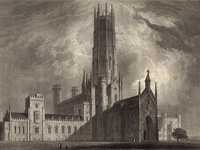
Other houses were conceived on an even grander scale.  Perhaps the most famous is Fonthill Abbey in Wiltshire, designed by James Wyatt for the immensely wealthy William Beckford. Inspired by a love of the Gothic, Beckford set out to create what was effectively a residential cathedral.  The vast 300-ft tower and huge 35-ft tall doors all contributed to an awe-inspiring impression for the few visitors able to see it before it collapsed under its own ambition in 1825.  Wanstead House in Essex, built in 1715, was also conceived on a similar scale to the later Hamilton Palace but again was lost – this time when creditors tore it down so the materials could be sold to pay debts in 1825.  The roll call of other huge houses includes Eaton Hall in Cheshire, Worksop Manor and Clumber House in Nottinghamshire, Nonsuch Palace in Surrey, and Haggerston Castle in Northumberland.  Yet what distinguishes all these houses in that they have been demolished – their very size eventually condemning them as later economic circumstances rendered them unsupportable.  However, each was architecturally an interesting house, one that, if it still survived, would be admired today (well, perhaps less so the bulky Haggerston Castle).

No modern palace has yet matched the beauty of the UK’s largest private country house still standing – Wentworth Woodhouse in Yorkshire.  From the end of one dome-capped wing to the other, the house, built largely in the 1730s, runs for over 600-ft but is an object lesson in Classical elegance.  The huge and imposing portico towers over the façade provide balance and a natural harmony with the scale of the flanking wings. Other large house still in existence which were built on a similar scale include Blenheim Palace and Castle Howard.

Updown Court, Surrey (Image: Savills)

So what have lost that means that the houses built to a similar scale today are so poor architecturally?  Perhaps one of the best (worst?) examples of this problem is Updown Court in Surrey. Completed at the end of 2006, this vast mansion is described on the official sales website as symbolising “the grand and imposing presence of the Great Houses of England.” (stop sniggering at the back!).  Although the ‘in excess of £70m’ price tag will naturally limit the pool of potential buyers, is it just the size or the price causing the problem? Perhaps it is the curse of the American ‘McMansion’ which leaves it to languish?  The derogatory term ‘McMansion’ was coined in the US in the 1980s to describe the huge houses being constructed which valued sheer size over architectural merit.  The architect of Updown, the American John B Scholz, can truly be said to pay fervent homage to such excess.  Extending to over 50,000 sq ft – bigger than Hampton Court or Buckingham Palace – the house is a exemplar of the type of house which simply is built with little thought to design beyond the ill-considered use of architectural elements to just decorate the house.

However, is no design better than too much? At Hamilton Palace in Surrey the owner, the notorious Nicholas van Hoogstraten, has taken great pains to ensure the design reflects his character.  Over-bearing and rather menacing, it was designed by Anthony Browne Architects (who are no longer involved), with work starting in 1985 and still ongoing though so far it includes a huge copper dome and a massive floor reserved for Hoogstraten’s art collection. The east wing is designed as a mausoleum where he can be hubristically entombed after death with his art collection in the manner of the Pharoahs. Yet for all the attention which has been lavished on the design and a reputed £30m spent so far, it has none of the grace and elegance of the earlier palaces.  Perhaps this is the ultimate expression of ‘self’ – a shameless design, built without a care as to what others think.  Which is probably a good things as it has been described by The Observer as “a cross between Ceausescu’s palace and a new civic crematorium” and by John Martin Robinson in The Independent Magazine (October 1988) as “Post-Modern Classical with a touch of meglomania”.

One final example, which although not strictly a country house, exemplifies this rush for scale over beauty is the proposed replacement for Athlone House in Hampstead, north London.  Owned by a Middle Eastern billionaire, this 50,000 sq ft pile is being designed by Robert Adam, a pre-eminent neo-Classical architect.  Despite this he has managed to produce a design described by one local critic as a ‘cross between a Stalinist palace and a Victorian lunatic asylum’ – and yet Mr Adam is responsible for some elegant examples of country houses such as the proposed Grafton Hall, Cheshire.

Obviously the scale of a modern palace is way beyond the realm of normal domesticity – and that’s fine.  The house has long been an expression of power and prestige but it was also one of taste, a refined justification as to the choice of a particular architect or style.  The modern ‘palace’ (and I use the word simply to suggest scale not beauty) is sometimes just the product of an architect interpreting vague notions from clients who seem unwilling to invest the time to become educated.  The end results are over-sized houses which lack the intellectual justification which underpinned the Fonthills and Eaton Halls of their day.  Nowadays, the need to spend the budget on a sad checklist of gimmicks seems to be pushing houses away from architecture and simply into a form of ‘decorated construction’ – a largely functional building given a variety of architectural fig leaves to hide its naked purpose as simply a Corbusier-esque ‘machine for living’ – but on a monumental and unpalatable scale.

Original story: ‘Hot property: Palaces‘ [ft.com]

Official website: ‘Updown Court, Surrey

Property details: ‘Updown Court, Surrey‘ [savills.com]

More criticism of Athlone House by Simon Jenkins ‘Greed, egos and yet another blot on the horizon‘ [thisislondon.com]

Developer shows sense; Ruperra Castle for sale

Ruperra Castle, Newport, Wales (Image: Savills)

Run-down or derelict country houses are often an enticing prospect for a developer, especially where the house still retains some land, on which they can propose ‘enabling development’.  In theory this is the correct use of this exemption but frequently the developer will suggest too many houses or ignore the fact that the house has too little land to avoid any development compromising the setting of the house.  When this happens, it is often the house which suffers as the developers wait for appeals or a change in policy whilst allowing the house to deteriorate further.  So in the case of Ruperra Castle in Wales it’s encouraging that the owner has decided to bow out giving someone else the chance to restore this architecturally interesting house.

Ruperra is an early example of the ‘mock’ castles which became fashionable in the Elizabethan and Stuart eras and were an example of life imitating art as the idea of these houses drew from the ‘pageant castles’ as featured in court entertainment of the time.  These stage castles formed the centrepiece to the royal ‘masques’ and were laden with allegorical symbolism as they might be populated by damsels (signifying virtue) but successfully defended against attacking knights (signifying baser desires).  Works such as Edmund Spenser’s The Faerie Queen (published in 1590 and 1596) also fed a fashion for chivalry and heraldic forms. Importantly, the long period of domestic peace during Elizabeth’s reign meant that the design of houses moved from being primarily military and defensive to more simply domestic with the look of a house increasingly dictated by aesthetics.

Ruperra wasn’t quite the first of it’s type; that distinction could be said to be held by houses such as Michaelgrove in Sussex built for the Shelley family in 1536 (dem. 1830s), and Mount Edgcumbe in Devon, built between 1547 – 1554, which also were not fortresses and featured a square or rectangular central block with drum or square towers on each corner.  This was followed by the fabulous Wollaton Hall in Nottinghamshire, begun in 1580, which was an altogether more grandiose statement of power but broadly followed the same layout – as did Hardwick Hall, although in an adapted form. However, the Renaissance ornamentation of Robert Smythson‘s design at Wollaton contrasted dramatically with more austere designs of the true ‘mock’ castles which harked back to the earlier simplicity of decorated castles such as Herstmonceaux Castle in Sussex, begun in 1440, with its many windows and regularised defensive elements (such as the arrow loops) making them almost decorative.

Lulworth Castle, Dorset (Image: Matthew Beckett)

The design for Ruperra Castle was clearly based on that for Lulworth Castle, just 100 miles away in Dorset, and built between 1603-05.  Always called a ‘castle’ but built with the instruction from Lord Howard of Bindon that it ‘prove pretty’, it was never military.  Indeed, Thomas Gerard writing in 1630 described it as ‘well seated for prospect and pleasure; but of little other use’. Bought by the Weld family from Lord Howard it remained their family seat until a devastating fire in 1929 completely gutted the interior – as it remains today, although the building itself has been restored.  Another house thought to have been built around 1612 is Compton Bassett House in Wiltshire (dem. c1929) which clearly shared a similar layout although the corner turrents were square.

The builder of Ruperra Castle was Thomas Morgan (b.1564 – d.1632), who made his fortune as the Steward for the Earls of Pembroke at Wilton House, Wiltshire.  Morgan would have been regularly exposed to court life and would have been very aware of the latest architectural fashions.  Hence when he came to build his own house, which was finished in 1626, he deliberately drew on the latest architectural fashions and created one of the first of the ‘modern’ country houses.  The layout was a significant departure as the rooms were orientated to the outside to make the most of views – hence Ruperra’s elevated site chosen for its beauty rather than defensibility.  Interestingly the ‘castle’ design seemed to fall quite quickly from favour and so there are few other examples of this type – though one late example was Beaurepaire Park in Hampshire built in 1777 (sadly burnt down in 1942).

Ruperra Castle remained as part of the Morgan’s vast Tredegar estate and was traditionally used to house the eldest son before he inherited Tredegar House, the family’s principal seat.  The castle originally had dormers but these were removed during the rebuilding after a fire in 1785 and replaced with the crenellations there today.  It was last inhabited during World War II when a searchlight battery requisitioned it and they were there when the terrible fire caused by faulty wiring broke out in 1941.  Despite best efforts, the house was completely gutted and was eventually sold, along with the rest of the 52,000-acre Tredegar estate in 1952.

Since then, constant promises of restoration have come to nothing and it has steadily deteriorated, most dramatically when, in 1982, the south east tower largely collapsed.  Sold to the current vendor, Mr Ashraf Barakat, in 1998 he had hoped to convert the house into 11 flats and build 18 more houses in the 14-acre grounds that remained with the house.  After a final rejection at a public enquiry in 2009, Mr Barakat has now, wisely, put the still grade-II* listed Ruperra Castle on the market for £1.5m, rather than holding on and letting the house deteriorate further.  This should not be considered a development opportunity, so hopefully now someone with deep pockets will come forward to restore, as a single family house, this architecturally important building.  Its rescue would once again connect the modern history of country house design in Wales, bringing life back to a house which, when it was built, was the most sophisticated in the country.

Property details: ‘Ruperra Castle, Lower Machen, Gwent, Wales‘ [Savills]

More on this story:

More information:

Credit: I’m indebted to the prior work of Mark Girouard (‘Elizabethan Architecture‘ 2009) and the late Andor Gomme for their knowledge of Elizabethan architecture.

Restoration continues inside and out; Wilton House and others

Wilton House, Wiltshire (Image: John Goodall/Geograph)

Any time of economic difficulties can often lead to any expenditure being put on hold, including vital restoration projects.  So it’s encouraging to see projects still being completed – but as some of these were approved and started back in the heady days of government largesse, perhaps these are the last we’ll see for a while except where private money can fill the gap?

One of the most impressive has been the award-winning restoration of the family dining room at Wilton House, Wiltshire – and maybe all the more impressive as it was funded privately by the owner, the 18th Earl of Pembroke.  Although ranked as joint 574th in the Sunday Times Rich List 2010, with an estimated worth of £115m, most of this wealth is tied up in the value of the house, the contents (including superb paintings by Van Dyck and Rembrandt), and the estate.

Anyone undertaking an architectural project at Wilton is following in some fairly illustrious footsteps.  The main house, one of the finest still in private hands, is unusual in that the scale of the house was a response to the incredible gardens designed by Issac de Caus in 1632.  The design is sometimes attributed to Inigo Jones but a drawing found by Howard Colvin at Worcester College by de Caus showed he was responsible for the original plan for a much larger, 21-bay palace, with a grand central portico, running to a total length of 330-ft.  However, the untimely death of the newly-married Earl in 1636 and the subsequent return of the huge £25,000 marriage dowry (approx £40m today) to the bride’s father, the Duke of Buckingham, meant that the scheme was now too ambitious and so just one half of the original design was built; which is what we see today. The half-a-house was considered plain so Jones became involved, adding the one-storey corner towers to the design.

Private dining room - Wilton House (Image: Historic Houses Association)

Wilton’s interior, in particular the celebrated set of seven state rooms in the southern facade which includes the famous Double Cube room, were largely the creation of Jones, assisted by his able deputy John Webb.  Yet there are other fine rooms which had become misused over the years and one has now been restored in sumptuous style as a private dining room.  Formerly cluttered with the normal ephemera of family life – CDs, books, old furniture etc – it was  fairly sorry sight.  The current Earl and Countess of Pembroke have spent an undisclosed, but undoubtedly substantial, sum on creating a glorious dining room but which will sadly not be included on the tourist trail.  Tapestries now cover the deep green walls, interspersed with family portraits by Reynolds, completing what James Stourton, chairman of Sotheby’s UK described as “…one of the outstanding country house renovations of the decade.” and winning the 2010 HHA/Sotheby’s Restoration Award.

One of the largest of the recent projects has been the £5.6m restoration of grade-II listed Bedwellty House in Tredegar, south Wales.  Built in 1818 for the owner of the first iron works in Tredegar, it was increasingly at risk of falling into dereliction.  Realising the importance of the building, the local council spent four years securing grants to fund the ambitious programme from organisations such as the Heritage Lottery Fund, the Welsh Assembly, Blaenau Gwent council, and Cadw [Welsh equivalent to English Heritage] .  The works have included work on the ornate plaster ceilings, the sash windows and shutters, and the main structure.  Work will now continue on the parkland and gardens to bring them back to their former glory.

The grounds of our country houses were also not just a buffer to keep the world from intruding but also a stage on which to create idealised landscapes and views.  To this end they were often populated with follies or architectural creations to catch the eye of those looking out from the house but also those walking the grounds.  Sadly, the isolation of these buildings has often meant that in recent years they have been cut-off from the main house, forgotten, or neglected and vandalised.  Nowadays these wonderful architectural vignettes have been increasingly valued and urgent works undertaken to restore them.  One fine example is the grade-I listed Wentworth Castle Rotunda in Yorkshire.  Started in 1739 and finished in 1742, the design is based on the Temple of Vesta at Tivoli near Rome.  One of 26 listed buildings in the 500-acre parkland, the temple has now been restored following a grant of £300,000, which has enabled the removal of overgrowing shrubs, and the cleaning and repair of the stonework, roof, and floors.

Thankfully the official organisations don’t have a monopoly on generosity. Perhaps those selling a house in need of some restoration might take a lead from admirable seller of Newberry Hall, Ireland, Richard Robinson.  Realising that the elegant Palladian house with its wonderful flanking pavilions is in dire need of restoration, the elderly owner has put the house on the market but with the offer of a substantial contribution towards the costs of restoration to bring the house back to its former glory.  With such generosity, one hopes a suitably sympathetic buyer can be found who will be willing to take on the project and complete an appropriate restoration.

Restoration has always been expensive so in their straitened times we can only hope that funds for basic care and maintenance are found so that in a few years time we are not faced with a slew of houses and monuments suffering from any short-sighted desire to save a few pence today at the cost of many pounds tomorrow.  Long may the stories be of enhanced glories such as that at Wilton House rather than urgent appeals to save buildings at risk.

Full story: ‘Winner of Historic Houses Restoration Award 2010 Announced‘ [Art Daily]

Full story: ‘Tredegar’s Bedwellty House restoration work unveiled‘ [BBC News]

Full story: ‘Restoration of Wentworth Castle Rotunda completed‘ [BBC News]

Full story: ‘Rotunda is reopened to round of applause for works‘ [Yorkshire Post]

Full story: ‘Deal for buyer who will rescue Kildare demesne‘ [Irish Times]