Tidmington House, Warwickshire (Image: Philip Halling/Geograph)
With sad co-incidence, having recently posted about how owners respond to fires in country houses, news comes through that Tidmington House in Warwickshire was badly damaged whilst undergoing renovations.
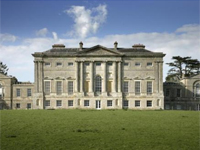
Tidmington was built in the early 17th-century but was re-fronted in the 18th-century giving it a pleasing and elegant facade, which is visible from the road. Distinctive gables top a neat front which successfully mixes Elizabethan elements with the classical. The recessed central section runs from a smaller middle gable featuring a Diocletian (or thermal) window, above a first floor tripartite Venetian window, sometimes known as Palladian or Serlian after the two architects most associated with popularising it, with finally the two wings being joined by a Tuscan colonnade. Two 1-bay pavilions extend to the left and right, providing a clever balance to the height of the main house.
The grade-II* listed house was once the home of Thomas Beecham, 2nd son of the famous conductor, before being put up for sale in 2009 for £3.95m by the owners who had moved there in 1988. The house was then given a glowing write-up in The Times by Marcus Binney who relished the bold use of colour; the sky-blue library, the jade green dining room – but I wonder if the bold colours in the house contributed to the situation as it was during renovations by the new owners that the fire started.
The blaze is reported to have badly damaged the first floor where the fire started and also part of the ground floor but hopefully a majority of the 8,500 sq ft house will have been spared from the flames – though the inevitable smoke and water damage will have spread beyond the immediate blaze. Again, it shows that insurance companies are right to demand to be told when works are taking place as it is so often during renovations when these fires seem to break out – please don’t let this be another workman being careless with a blow-torch.
West Acre High House, Norfolk (Image: Strutt & Parker)
In any age, once someone is successful they often seek the traditional status symbols – with a country house being high on the list. For footballers it seems that the modern, bling-laden mansions are the favoured style but for an increasing number of modern artists it’s the historic houses which are finding favour. The news that Anthony Gormley has bought West Acre High House in Norfolk adds him to a distinguished roll-call of artists who are forming what has been glibly named, the ‘artocracy’.
Artists moving to the country to help their work has a long history including Peter Paul Rubens buying the Castle of Steen Manor House in the Netherlands in 1635 which led to some of his finest landscape paintings. West Acre High House was regarded as one of the prize estates when it came up for sale in 2008 for £9.5m with 1,000-acres. Yet, it languished on the market despite the nearby 1,600-acre Kelling estate being sold which was listed at the same time.
West Acre High House was built in 1756 by Edward Spelman (d. 1767), a writer and translator and known eccentric, who had inherited the estate from the Barkhams. The design raised eyebrows, particularly for that part of the world, with its novel piano nobile arrangement which was also being used around that time in the construction of Holkham Hall and Houghton Hall. A visitor in that year, Caroline Girle, reported:
“I paid a droll visit to see an odd house, of a still odder Mr Spelman, a most strange bachelor of vaste fortune but indeed I’ll not fall in love with him. We were introduced to him in the library where he seemed deep in study (for they say he’s really clever) sitting in a Jockey Cap in stiff white Dog’s Gloves. On seeing Mr Spelman one no longer wonders at the oddity of the edifice he has just finished.”
The house is also unusual in that the south front is 7 bays with the central 5 deeply recessed, but the north front is 13 bays due to the flanking wings being built level with the main block. The wings were built by Anthony Hamond (b.1742 – d. 1822), a nephew of Richard Hamond who had bought the estate from Spelman in 1761. The next major change was put in effect by Anthony’s second son, another Anthony, who, in c.1829, employed the well-known country house architect, W.J. Donthorn, who refaced the whole house in pale oatmeal Holkham brick, crenellated it and created the spectacular internal double-flight staircase. The staircase leads to a picture gallery modelled on the one in Buckingham Palace and is formed of five perfect cubes of 18ft.
The house was bought by Henry Birkbeck in 1897 who might have inherited it having married Anthony Hamond’s daughter in 1849 but, for reasons unknown, purchased it instead. It remained in the Birkbeck family until the sale to Gormley, who has bought the house plus 100-acres for just £3m having had the price reduced by wanting less land and after factoring in the £1.5m cost of restoration.
Toddington Manor, Gloucestershire (Image: Images of England/Heritage Gateway)
The restoration costs may well turn out to be much higher – as Damien Hirst, another of the ‘artocrats’, has found out. He has admitted recently that he has been affected by the recent economic turmoil and in addition to closing down his studios, he has paused the vast, £10m restoration programme he is undertaking at his equally vast country house, Toddington Manor in Gloucestershire, which he bought in 2005 for £3m. Built in 1819-35 for Charles Hanbury-Tracy, later 1st Baron Sudeley, using his own very accomplished designs. He drew his inspiration from the Perpendicular architecture of Oxford and Pugin‘s work, to create an important Gothic-revival building at a cost of £150,000 (equivalent to £15m in today terms). The design clearly influenced Sir Charles Barry in his design for Highclere Castle in Berkshire (built between 1838-78) and the Houses of Parliament (started in 1840) – but perhaps Barry was playing to the audience with the latter as Hanbury-Tracy was also on the committee which chose the design for the new Parliament. After being empty for 20 years until Hirst bought it, the house was a cause for serious concern with outbreaks of dry-rot and a pressing need to replace the acres of roof. After being saved from becoming a hotel, Hirst bought the grade-I listed house as both a home but also to eventually become a gallery for his work.
Another artist seeking the country life is Anish Kapoor who was apparently interested in taking the lease on Ashdown House in Berkshire – though it eventually went to Pete Townshend of The Who. One of our prettiest country houses, and now owned by the National Trust, leasing it would have given him the status without the huge restoration costs.
One of the most encouraging aspects of both Gormley and Hirst’s purchases has been the willingness and ability to finance the necessary huge restoration projects. For Hirst, this has involved covering the whole of Toddington Manor in some ‘Christo’-esque scaffolding with the expectation that the restoration will be a lifetime’s work. Any restoration has an element of being a labour of love but, in exchange, their houses will give them status, but most importantly, a home – these are houses to be lived in, albeit on a much grander scale than most.
Property listing: ‘West Acre High House‘ [Strutt & Parker] – marked as ‘Sold’ so may not be on the website for long.
Detailed architectural listing: ‘West Acre High House‘ [British Listed Buildings]
Love is a strange emotion which by chance can leave a person very attached to something. For Clare and Mark Oglesby the object of their affections is the elegant Goldsborough Hall in Yorkshire, which, after five years hard work and a substantial budget has been rescued from dereliction and possible development.
Goldsborough Hall was built between 1601-1625 for Sir Richard Hutton, a London judge who used his wealth to establish himself in Yorkshire and was High Sheriff in 1623. The internal plan of the house is interesting as it features a lateral corridor on all three floors and originally included fashionable features Sir Richard probably learnt of from his London friends such as a long gallery which useful for exercise in the inclement weather. Slightly unusually it was on the first floor (though not uniquely as Beaudesert, Condover Hall, and Treowen House also have this) when they were normally on the upper floors as, high up, their excess of glass gave visitors the most impressive view of the house – see, most famously, ‘Hardwick Hall, more glass than wall’.
The house was then rebuilt in the mid 18th-century for Richard Byerley before being bought by the Earls of Harewood, the Lascelles family, who employed the famous architect John Carr of York to remodel the interior in 1764-5, whilst he was also working on their main house, Harewood. Goldsborough features numerous mementos of the family with their crest embedded in rainwater heads and in stained glass. The house remained in the Lascelles family until 1965 when it was sold to pay death duties. It then became a school, a private home, a hotel and then nursing home before being put up for sale in 2003 when the Oglesby’s first saw it but had their offer rejected. At that time the house was still in good condition but this had changed dramatically when the estate agent contacted them again in 2005 to say it was between them and a developer. They successfully bid but now, just two years later, water was running down the 17th-century oak staircase and the panelling in the library, and the house lacked heating or working plumbing. Undaunted, over the last five years they have spent around £2m on the restoration which has now rescued this wonderful house from ruin and is back to being a family home which pays it way by hosting weddings.
Rise Hall, Yorkshire (Image: Pastscape)
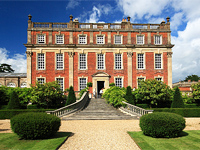
Another house which needed work and has now been restored explicitly as a wedding venue and family home is Rise Hall, also in Yorkshire. Set in a beautiful small park laid in the 1770s, the grade-II* listed seat of the Bethell family was rebuilt between 1815-25, though the architect is disputed with some claiming it’s by Robert Abraham (whose eldest daughter was conveniently married to the owner, Baron Westbury) but more likely, as given by Howard Colvin, it was by Watson & Pritchard who also designed a Doric lodge for the house in 1818. The slightly austere, 9-bay ashlar Georgian facade is dramatically enlivened by a full-height, tetra-style Ionic portico. Inside the house features a top-lit staircase hall and some neoclassical decoration with an Adam-style dining room. The house remained in the Bethell family until 1946 when they moved into the former rectory, now Rise Park, and let the house to the Canonesses Regular of St. Augustine, who ran a Catholic boarding school there until 1998.
The house was then bought as a second home by Sarah Beeny, star of many property restoration TV shows. She and her husband used the house for many years but realised that the 97-room house was simply too large to function as just a weekend retreat and it also needed to pay for its own restoration. Beeny seems to take a rather hard-headed approach – unsurprisingly given her background – but is committed to achieving the right result. The location ruled out use as a hotel so they decided that they would convert it into a wedding venue in just eight months as part of a TV show called ‘Beeny’s Folly‘ which will be broadcast in Autumn 2010 on Channel 4. This will be a chance for the wider public to get a real insight into just how much work is required to restore and maintain a stately home. Who knows, it might even inspire someone with deep pockets and hopefully a sympathetic attitude, to find and fall in love with a one of our other country houses at risk and bring it back to life as a home.
Our best motorways draw us through beautiful landscapes, by turns revealing hills, valleys, broad vistas and narrow glimpses, sometimes punctuated with a country house. Yet, country house owners have long fought many battles to keep the roads from carving up their precious parks and ruining the Arcadian views.
A recent article in the Guardian (‘Britain’s best views: motorway mansions‘) highlighted three great houses of Derbyshire each visible from the M1 motorway: Bolsover Castle, Sutton Scarsdale, and Hardwick Hall. In our haste to get to destinations it’s easy to forget that where we drive was once part of great estates and previous owners would have wielded sufficient political power to ensure roads were routed away from their domains. The echoes of this power can still be seen today if you look at aerial views of some of the great houses – major roads circle the gardens and immediate parkland such as at Chatsworth, Eaton Hall, and Clumber Park (though for the latter the house was demolished in 1938).
Yet, in other cases, officials either due to sheer bureaucratic efficiency, malice, or philistinism have carved roads through some historic parklands, cutting off the house from its setting, sometimes playing their part in step towards the eventual demise of the house. Sometimes the motorway is the gravestone; tarmac lies across the original sites of two lost houses so spare a thought for Tong Castle as you drive northbound just past junction 3 on the M54, or for Nuthall Temple, just north of junction 26 on the M1.
For planners, bypasses naturally need space and the obvious choice would be through the convenient estate which often borders a town. From their perspective, taking on just single owner seems the easiest option, especially as it can be difficult to muster public support to defend a private landowners personal paradise.
One country house owner who has had several run-ins with roads is the National Trust, with varying degrees of success. When they accepted Saltram House in Devon in 1957 they knew that a road was proposed which would cut across the parkland to the east of the house. However, as a matter of principle they had to fight when finally earmarked for action in 1968, particularly as the road was much wider than originally proposed – though ultimately they were unsuccessful. For the private owners of Levens Hall in Cumbria, it was their research which prevented a link road to the M6 cutting across an avenue by proving it was originally planted in 1694 by garden designer Guillaume de Beaumont. Yet other battles were lost; Capability Brown’s work at Chillington, Staffordshire was butchered by the M54, with the road now running just 35 yards from the grade-I listed Greek Temple. At Tring Park in Hertfordshire the A41 slashes through the original tree-lined avenue.
The longest running, and most successful battle has been by the National Trust at Petworth House in Sussex. The Trust has long accepted evolutionary changes but opposes drastic alterations regardless of the possible benefits to the local area – convenience does not trump heritage. The village of Petworth suffers from heavy traffic so in the 1970s a four-lane bypass was approved which would run through the middle of the 700-acre, Capability Brown parkland, forever destroying the celebrated views painted by J.M.W. Turner in the early 1800s. After objections were raised, an alternative, but equally damaging plan was suggested which used a ‘cut and cover’ tunnel – causing just as much destruction, particularly to the gardens, but then hiding their vandalism. However, after a spirited public campaign, which included a dramatic poster showing the house with tyre tracks rolling over it (designed by David Gentleman for SAVE Britain’s Heritage), the plan was blocked and has almost certainly been killed off permanently.
So although the motorway has helped us to visit our wonderful country houses they also have, and continue to, pose a threat to them. Thanksfully, stronger planning legislation which recognises the value of historic parkland has made it harder for the planners to simply draw a line between A and B without regard for the beautiful and important landscapes they would destroy.
The recent financial crisis has forced many properties onto the market and easily one of the grandest was the main apartment of Wardour Castle in Wiltshire which has now been bought by the fashion designer Jasper Conran.
The Apartment (as it’s imaginatively known) includes the wonderful central staircase, described by Pevsner as ‘the most glorious Georgian interior of Wiltshire’, plus the other major state rooms which were restored with the assistance of John Pawson, the high priest of Minimalism. This particular property has featured twice in this blog, once for suggested conversion back to being a single family home, but also later with the news that the property was one of the grandest repossessions in the country.
Ven House, Somerset (Image: Mike Searle/wikipedia)
What is interesting about Conran’s purchase is that he appears to be collecting fine Georgian houses in the same way one might collect furniture or paintings. In 2007 he bought the incredibly elegant Ven House in Somerset for just less than the £8.5m asking price. At the time the house had languished on the market for two years before Conran took it on. Although more famous as a fashion designer, Conran has a good track record with property restoration having bought Walpole House in Chiswick, London for £7.25m which was sold following refurbishment for £12.5m in 2008 or Flemings Hall in Suffolk which he sold for £2m in 2006. Ven required comparatively little work and has remained his country home, opening it up for use by local organisations for charity fund-raisers.
It seems fashion designers have a taste for Georgian as Jasper’s father Terence Conran lives in Barton Court, an elegant red-brick villa-style house in west Berkshire which he bought in the 1970s and has carefully restored. On a much larger scale, the American fashion designer Leon Max famously bought the magnificent Easton Neston in Northamptonshire for £15m in 2005. The grade-I listed house, designed by Nicholas Hawksmoor and built between 1695-1710, was the home of the Hesketh-Fermor family for nearly 500-years before the current Lord Hesketh decided to sell up. Leon Max purchased the house with the intention of converting a fire-damaged wing into a base for his fashion company.
Perhaps the natural grace and light of the best of the Georgian homes appeals just as much to the aesthetic eye of the designer as it does to most of us, confirming their broad appeal. Happily for Wardour Castle it seems that has caught the eye of someone who has a good track record of looking after the wonderful homes he has bought. Perhaps he might be open to suggestions for others that need some attention: Melton Constable Hall perhaps?


 The Country Seat