Rent a doll’s house: Gunby Hall, Lincolnshire

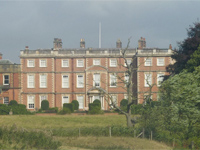
Gunby Hall, Lincolnshire (Image: Gardens-Guide)

Sitting on a small rise, just off the A158 on the road to Skegness in Lincolnshire sits one of the prettiest of the National Trust’s many country houses; Gunby Hall. However, unlike the others, where we can only ever dream of moving in, Gunby is currently available to rent for the bargain rate of £10,000 per year – but do remember to add an estimated £100,000 for the annual running costs.

Gunby Hall was built in 1700 (commemorated with the date on the rainwater heads) for Sir William Massingberd by an unknown architect but one who was obviously familiar with the work of Sir Christopher Wren.  Built of warm plum-red bricks the sophisticated 3-storey exterior shows the elegant use of stone dressings which elevates this grade-I listed house to being one of the finest of the smaller country houses.  Although showing stylistic links with Wren it was almost certainly by a skilled provincial imitator or local builder.  Wren designed very few country houses – Tring Park in Hertfordshire, Winslow Hall and, according to John Harris, contributed designs for Wimpole Hall in Cambridgeshire, and Houghton Hall in Norfolk – all for patrons who were somehow connected to Wren.  So unless someone discovers a link between Sir William and Sir Christopher it is likely that the local ‘architect’ had only been shown Wren’s designs.
Newby Hall, Yorkshire (Image: johnet/flickr)

When Gunby Hall was built it would have been regarded as very fashionable as Baroque style houses had only become popular in the 1680s.  Newby Hall in Yorkshire is one of the best examples and was rated as the finest house in Yorkshire when it was completed c.1690 (remember the houses we regard as the finest today in Yorkshire such as Castle Howard, Wentworth Castle, and Wentworth Woodhouse amongst others hadn’t yet been built).  In many ways, Gunby Hall and Newby Hall are architectural ‘cousins’ – closely stylistically related but distinct, particularly in size; reflecting the relative wealth of the owners .  Similarities can also be seen with other Yorkshire houses such as the earlier Ribston Hall, built in 1674, and the wonderful but now sadly demolished Wheatley Hall built in 1680, and the later Bolton Hall.

Gunby Hall was later altered c.1730 and extended in 1873 and 1900 to very successfully add a Dining Room, Servants’ Hall and Service Wing.  The later additions blend very neatly with the existing building creating the harmonious look which is so attractive today.  Gunby has long been admired with the famous poet Lord Alfred Tennyson reputedly using it as his inspiration when he wrote during one visit:

. . . an English home – gray twilight

On dewy pastures, dewy trees

Softer than sleep – all things in order stored,

A haunt of ancient peace.

The house was also admired by James Lees-Milne who described it as ‘an Augustan squire’s domain, robust, unostentatious, dignified and a little prim.’.  Lees-Milne was a regular visitor and was instrumental in not only bringing the house to the National Trust, as he did many other houses, but also saving it from outright demolition during WWII.  This terrible prospect came about in 1943 when the Air Ministry wished to extend the airfield they had built at Great Steeping only later discovering that Gunby Hall inconveniently blocked the proposed path of the longer runway.  Luckily the combined forces of James Lees-Milne and the impressively named owner, Field Marshal Sir Archibald Montgomery-Massingberd, persuaded them to re-route the runway thus saving the house.  In thanks, the family immediately made over the house to the National Trust becoming one of the few houses to be taken on during the war.

So if you fancy living in one of the prettiest stately homes in the country and don’t mind a few tourists having a look round occasionally, get in contact with the Savills Lincoln office.

More details: ‘Stately home can be yours for just £10k a year… plus another £100k for the staff‘ [This is Lincolnshire]

Property details: ‘Gunby Hall‘ [Savills]

Houses as hospitals: the country houses in medical service

Hatfield House, Hertfordshire (Image: Amy Lloyd/flickr)

Our country houses have always been adaptable as changing fashions or functions required they accommodate new ways of living or roles.  One role which quite a few houses have taken on is that of hospital – either privately or as a fully-fledged part of the NHS – though this use has not always been sympathetic.  However, as the modern health service centralises to larger sites it seems some country houses are re-emerging to become homes again.

Hospitals were traditionally monastic, centred on the abbeys and convents but these were obviously scarce.  The ill were treated in large dormitories although some established houses in the country away from the main abbey to care for the mentally ill.  However the dismantling of the religious orders during the Reformation from 1536, meant that increasingly the burden for care of the pauper sick fell to secular civic bodies, with towns creating their own hospitals.  This model persisted until the 17th-century when private benefactors became increasingly prominent, donating funds and buildings for the care of the ill.

One of the earliest country houses to be converted was the partially completed Greenwich Palace. Originally a Tudor royal house, it had become derelict during the English Civil War, so in 1664 Charles II commissioned John Webb to design a replacement but which was only partially completed.  It was this building which Queen Mary II, who had been affected by the sight of the wounded sailors returning from the Battle of La Hogue in 1692, ordered to be converted to a navel hospital in 1694, to the designs of Sir Christopher Wren and Nicholas Hawksmoor and later Sir John Vanbrugh.

Possibly inspired by the royal example, other country houses were donated or converted for use as hospitals.  However, it quickly became apparent that they weren’t particularly suitable with one Irish physician, Edward Foster, complaining in 1768 that ‘In general, Houses have been rented for Hospitals, which are as fit for the Purposes, as Newgate for a Palace‘.  By the 1850s hospital design was beginning to emerge as a distinct branch of architecture -Florence Nightingale wrote to an officer of the Swansea Infirmary in 1864 saying that a hospital was a difficult to construct as a watch; no building ‘requires more special knowledge‘.  From this time, the country houses themselves became less important than the space they offered with the house itself being used as accommodation or offices. However, for the treatment of respiratory illness the clear country air was considered part of the cure with houses being acquired as tuberculosis sanatoria such as at Moggerhanger Park in Bedfordshire originally designed by Sir John Soane for the Thornton family.

The First World War necessarily required country houses to come back into medical use due to the terrible consequences of the strategy of attrition through trench warfare in WWI which created large numbers of wounded.  Without a national health service there were fewer hospitals able to cope with the seriously disabled or even those simply convalescing.  Many country houses were pressed into service, their clean country air and fine grounds considered most helpful to rest and recuperation. During WWII, fewer houses were used as military hospitals as changes in military tactics led to many fewer casualties than expected.  However, a significant number were used either by the military or as civilian replacements for urban hospitals which it was feared would be bombed.

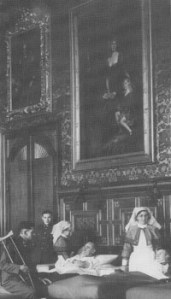
Hatfield House, Herts - King James Drawing Room as a hospital ward in WWII

For country house owners, given the possible options of who might take over their house, the bed-ridden were infinitely preferable to the bored squaddies who wreaked such havoc at other houses (apparently housing art treasures was first preference, evacuated schools second, hospitals third).  This reality plus a genuine sense of wanting to help led to many owners voluntarily turning over their houses as hospitals including the Earl of Harewood offering Harewood House, Lord Howard of Glossop Carlton Towers, Lady Baillie lent Leeds Castle and the 4th Marquess of Salisbury offering Hatfield House as he had done during WWI.  On the civilian side, Brocket Hall in Hertfordshire became a maternity hospital as was Battlesden Abbey in Bedfordshire, Stockeld Park and Farnley Hall, both in Yorkshire. Cholmondeley Castle in Cheshire became a Royal Navy Auxiliary Hospital, treating ‘cases of good morale, who are suffering from nervous breakdown usually as the result of operational stresses’.

After the war many houses were returned to their owners in such terrible disrepair that unfortunately hundreds were demolished.  Others continued in their wartime roles with some such a Poltimore House in Devon becoming hospitals after the war when two local GPs recognised the need for more bedspaces and so took over the old seat of the Bampfyldes until it was nationalised after the creation of the NHS in 1948.  There were also many War Memorial hospitals, founded by public subscription after WWI, which often made use of a country house. The nationalisation of these hospitals gave the NHS many of the country houses it has today – although it is relatively few overall as less than 5% of all their buildings are grade II* or grade I listed.  Of the historic ‘therapeutic’ landscapes it manages, seven are included on the English Heritage Register of Parks and Gardens of Special Historic Interest in England.

However, sometimes these country houses and their settings can escape and revert to being homes, either through conversion or, if the houses has been lost, replacement.   Bretby Hall in Derbyshire, built between 1813-15 by Sir Jeffry Wyatville for the Earl of Chesterfield, was an orthopaedic hospital until the 1990s when the main house was converted into flats, as was the High Victorian Wyfold Court in Berkshire.  Harewood Park in Hertfordshire was demolished in 1959 after use as hospital in WWII but the estate has been bought by the Duchy of Cornwall with proposals for an elegant and very impressive new Classical house by Craig Hamilton Architects.  A similar plan has been put forward for the 57-acre site of the former Middleton Hospital in Yorkshire with the permission requiring the demolition of various redundant buildings from its former use to restore the site.

Sadly though, sometimes the NHS fails to adequately look after the houses it has in its care.  As the trend has moved towards large, new hospitals so the historic elements have been overlooked or abandoned as new hospitals are built elsewhere. As funding for new hospitals is not dependent on the sale of the old site and the house, sadly they can be neglected or subject to inappropriate development as has been the case with the grade-II listed Stallington Hall in Staffordshire, which became a home for the mentally ill in 1928, but after it closed has been vandalised and neglected with a housing development built inappropriately close to the house across the lawn, forever ruining it as a country house –  a poor payback for years of public service.

Related story: ‘Developers draw up plan for country house‘ [Ilkley Gazette]

Background information: ‘Reusing historic hospitals‘ [Institute of Historic Building Conservation]

Restoration continues inside and out; Wilton House and others

Wilton House, Wiltshire (Image: John Goodall/Geograph)

Any time of economic difficulties can often lead to any expenditure being put on hold, including vital restoration projects.  So it’s encouraging to see projects still being completed – but as some of these were approved and started back in the heady days of government largesse, perhaps these are the last we’ll see for a while except where private money can fill the gap?

One of the most impressive has been the award-winning restoration of the family dining room at Wilton House, Wiltshire – and maybe all the more impressive as it was funded privately by the owner, the 18th Earl of Pembroke.  Although ranked as joint 574th in the Sunday Times Rich List 2010, with an estimated worth of £115m, most of this wealth is tied up in the value of the house, the contents (including superb paintings by Van Dyck and Rembrandt), and the estate.

Anyone undertaking an architectural project at Wilton is following in some fairly illustrious footsteps.  The main house, one of the finest still in private hands, is unusual in that the scale of the house was a response to the incredible gardens designed by Issac de Caus in 1632.  The design is sometimes attributed to Inigo Jones but a drawing found by Howard Colvin at Worcester College by de Caus showed he was responsible for the original plan for a much larger, 21-bay palace, with a grand central portico, running to a total length of 330-ft.  However, the untimely death of the newly-married Earl in 1636 and the subsequent return of the huge £25,000 marriage dowry (approx £40m today) to the bride’s father, the Duke of Buckingham, meant that the scheme was now too ambitious and so just one half of the original design was built; which is what we see today. The half-a-house was considered plain so Jones became involved, adding the one-storey corner towers to the design.

Private dining room - Wilton House (Image: Historic Houses Association)

Wilton’s interior, in particular the celebrated set of seven state rooms in the southern facade which includes the famous Double Cube room, were largely the creation of Jones, assisted by his able deputy John Webb.  Yet there are other fine rooms which had become misused over the years and one has now been restored in sumptuous style as a private dining room.  Formerly cluttered with the normal ephemera of family life – CDs, books, old furniture etc – it was  fairly sorry sight.  The current Earl and Countess of Pembroke have spent an undisclosed, but undoubtedly substantial, sum on creating a glorious dining room but which will sadly not be included on the tourist trail.  Tapestries now cover the deep green walls, interspersed with family portraits by Reynolds, completing what James Stourton, chairman of Sotheby’s UK described as “…one of the outstanding country house renovations of the decade.” and winning the 2010 HHA/Sotheby’s Restoration Award.

One of the largest of the recent projects has been the £5.6m restoration of grade-II listed Bedwellty House in Tredegar, south Wales.  Built in 1818 for the owner of the first iron works in Tredegar, it was increasingly at risk of falling into dereliction.  Realising the importance of the building, the local council spent four years securing grants to fund the ambitious programme from organisations such as the Heritage Lottery Fund, the Welsh Assembly, Blaenau Gwent council, and Cadw [Welsh equivalent to English Heritage] .  The works have included work on the ornate plaster ceilings, the sash windows and shutters, and the main structure.  Work will now continue on the parkland and gardens to bring them back to their former glory.

The grounds of our country houses were also not just a buffer to keep the world from intruding but also a stage on which to create idealised landscapes and views.  To this end they were often populated with follies or architectural creations to catch the eye of those looking out from the house but also those walking the grounds.  Sadly, the isolation of these buildings has often meant that in recent years they have been cut-off from the main house, forgotten, or neglected and vandalised.  Nowadays these wonderful architectural vignettes have been increasingly valued and urgent works undertaken to restore them.  One fine example is the grade-I listed Wentworth Castle Rotunda in Yorkshire.  Started in 1739 and finished in 1742, the design is based on the Temple of Vesta at Tivoli near Rome.  One of 26 listed buildings in the 500-acre parkland, the temple has now been restored following a grant of £300,000, which has enabled the removal of overgrowing shrubs, and the cleaning and repair of the stonework, roof, and floors.

Thankfully the official organisations don’t have a monopoly on generosity. Perhaps those selling a house in need of some restoration might take a lead from admirable seller of Newberry Hall, Ireland, Richard Robinson.  Realising that the elegant Palladian house with its wonderful flanking pavilions is in dire need of restoration, the elderly owner has put the house on the market but with the offer of a substantial contribution towards the costs of restoration to bring the house back to its former glory.  With such generosity, one hopes a suitably sympathetic buyer can be found who will be willing to take on the project and complete an appropriate restoration.

Restoration has always been expensive so in their straitened times we can only hope that funds for basic care and maintenance are found so that in a few years time we are not faced with a slew of houses and monuments suffering from any short-sighted desire to save a few pence today at the cost of many pounds tomorrow.  Long may the stories be of enhanced glories such as that at Wilton House rather than urgent appeals to save buildings at risk.

Full story: ‘Winner of Historic Houses Restoration Award 2010 Announced‘ [Art Daily]

Full story: ‘Tredegar’s Bedwellty House restoration work unveiled‘ [BBC News]

Full story: ‘Restoration of Wentworth Castle Rotunda completed‘ [BBC News]

Full story: ‘Rotunda is reopened to round of applause for works‘ [Yorkshire Post]

Full story: ‘Deal for buyer who will rescue Kildare demesne‘ [Irish Times]

A salute to determination: Goldsborough Hall, Yorkshire

Goldsborough Hall, Yorkshire (Image: Goldsborough Hall)

Love is a strange emotion which by chance can leave a person very attached to something.  For Clare and Mark Oglesby the object of their affections is the elegant Goldsborough Hall in Yorkshire, which, after five years hard work and a substantial budget has been rescued from dereliction and possible development.

Goldsborough Hall was built between 1601-1625 for Sir Richard Hutton, a London judge who used his wealth to establish himself in Yorkshire and was High Sheriff in 1623.  The internal plan of the house is interesting as it features a lateral corridor on all three floors and originally included fashionable features Sir Richard probably learnt of from his London friends such as a long gallery which useful for exercise in the inclement weather. Slightly unusually it was on the first floor (though not uniquely as Beaudesert, Condover Hall, and Treowen House also have this) when they were normally on the upper floors as, high up, their excess of glass gave visitors the most impressive view of the house – see, most famously, ‘Hardwick Hall, more glass than wall’.

The house was then rebuilt in the mid 18th-century for Richard Byerley before being bought by the Earls of Harewood, the Lascelles family, who employed the famous architect John Carr of York to remodel the interior in 1764-5, whilst he was also working on their main house, Harewood.  Goldsborough features numerous mementos of the family with their crest embedded in rainwater heads and in stained glass.  The house remained in the Lascelles family until 1965 when it was sold to pay death duties.  It then became a school, a private home, a hotel and then nursing home before being put up for sale in 2003 when the Oglesby’s first saw it but had their offer rejected.  At that time the house was still in good condition but this had changed dramatically when the estate agent contacted them again in 2005 to say it was between them and a developer. They successfully bid but now, just two years later, water was running down the 17th-century oak staircase and the panelling in the library, and the house lacked heating or working plumbing.  Undaunted, over the last five years they have spent around £2m on the restoration which has now rescued this wonderful house from ruin and is back to being a family home which pays it way by hosting weddings.

Rise Hall, Yorkshire (Image: Pastscape)

Another house which needed work and has now been restored explicitly as a wedding venue and family home is Rise Hall, also in Yorkshire.  Set in a beautiful small park laid in the 1770s, the grade-II* listed seat of the Bethell family was rebuilt between 1815-25, though the architect is disputed with some claiming it’s by Robert Abraham (whose eldest daughter was conveniently married to the owner, Baron Westbury) but more likely, as given by Howard Colvin, it was by Watson & Pritchard who also designed a Doric lodge for the house in 1818.  The slightly austere, 9-bay ashlar Georgian facade is dramatically enlivened by a full-height, tetra-style Ionic portico.  Inside the house features a top-lit staircase hall and some neoclassical decoration with an Adam-style dining room.  The house remained in the Bethell family until 1946 when they moved into the former rectory, now Rise Park, and let the house to the Canonesses Regular of St. Augustine, who ran a Catholic boarding school there until 1998.

The house was then bought as a second home by Sarah Beeny, star of many property restoration TV shows.  She and her husband used the house for many years but realised that the 97-room house was simply too large to function as just a weekend retreat and it also needed to pay for its own restoration. Beeny seems to take a rather hard-headed approach – unsurprisingly given her background – but is committed to achieving the right result. The location ruled out use as a hotel so they decided that they would convert it into a wedding venue in just eight months as part of a TV show called ‘Beeny’s Folly‘ which will be broadcast in Autumn 2010 on Channel 4.  This will be a chance for the wider public to get a real insight into just how much work is required to restore and maintain a stately home.  Who knows, it might even inspire someone with deep pockets and hopefully a sympathetic attitude, to find and fall in love with a one of our other country houses at risk and bring it back to life as a home.

Full story on Goldsborough Hall: ‘We’ve moved from our 4-bed detached to an 80-room stately home‘ [Daily Express]

Official website: ‘Goldsborough Hall

Detailed architectural description: ‘Rise Hall, Yorkshire

More buildings at risk: ‘Live and Let Die – 2010 Buildings at Risk Register‘ [SAVE Britain’s Heritage]

After the fire, the difficult choices: Raasay House, Scotland

Raasay House, Scotland (Image: BBC News)

When Raasay House on the Isle of Skye Raasay was largely destroyed by a huge fire in January 2009 just days before it was due to reopen following a £4m refurbishment, the locals and owners vowed to quickly rebuild the house as it was.  Fire has always been one of the major threats to our country houses and when it strikes the responses to the destruction can vary greatly – particularly in the modern era.

For many country house owners in the 16th-19th-centuries immediate rebuilding was the favoured response if funds allowed – either to re-create the original house or sometimes to build an entirely new one.  Raasay House was built in 1746 for the clan Macleod after the previous house, built in the 1500s, was deliberately burnt down in 1745 in the wave of retribution which followed the Battle of Culloden.  The house, extended in the 1870s, was run as an outdoor pursuits centre and was an important part of the economy on the Isle of Skye Raasay.  This meant the response was largely on the basis of local economics which required the house to be rebuild to support the business, apparently not for its intrinsic architectural value.  However, the Scottish grade-A listing (equivalent to the English grade-I) means that the ‘new’ Raasay will be a faithful recreation of the original house as it was before the fire.

Although country house owners have long rebuilt, the principle that the house will be strictly rebuilt exactly as it was is, in some ways, a modern response as heritage legislation requires full salvage of any architectural fragments with the presumption of restoration.  Insurance companies also pay out for recreation of the old building, not the construction of a new one.  So responses now are sometimes based on the architectural or heritage value, and sometimes due to the constraints placed on the owners.  The wishes of the owners also play an important part with some looking to recreate whilst others follow the principles of the Society for the Protection of Ancient Buildings who state:

Although no building can withstand decay, neglect and depredation entirely, neither can aesthetic judgement nor archaeological proof justify the reproduction of worn or missing parts. Only as a practical expedient on a small scale can a case for restoration be argued.

– SPAB manifesto

The 1992 fire at Windsor Castle destroyed large sections of the State Apartments including the Crimson and Green Drawing Rooms, the Queen’s Private Chapel and St George’s Hall.  It was quickly decided by the Restoration Committee (headed by Prince Philip) that many of the rooms would be restored to as close as possible their original state with only a few modern rooms and the Queen’s Private Chapel to be restored in a modern style.

However, no lesser organisation than the National Trust also has firmly followed the faithful re-creation approach, particularly following the devastating 1989 fire at Uppark, Sussex.  Although the dramatic pictures of the fire would suggest total loss, brave efforts by staff saved the majority of the contents of the house and the fire was found to have only destroyed the attic and first floors whilst severely damaging the ground floor.  It was then announced by Martin Sekers, the National Trust’s Regional Director for the Southern Region, that “We feel that enough survives to justify total restoration.”.  So how much has to survive to warrant re-creation?  A spirited public debate at the time brought forward opposing views such as that expressed by the respected architecture critic Deyan Sudjic who argued in an article in the Sunday Correspondent (17 Sept 1989) that:

“…it won’t actually be Uppark no matter how skilful the work of the 20th Century craftsman who seek to recreate it. What tourists come to see will, in fact, be a replica, one which could be said to diminish those fragments which actually are authentic…”

However, other eminent architectural historians such as Dan Cruikshank came out strongly in favour of recreation principally from the point that it provided the opportunity to re-learn old techniques and provide a model in their use.  Andor Gomme argued that a recreated Uppark would be the only appropriate way to show the rescued contents in an appropriate setting.  Gomme also highlighted that in previous cases where a house owned by the National Trust had burnt down (the incomparable Coleshill, Berkshire in 1953 and Dunsland House, Devon in 1967) the decision at the time to demolish what remained was later deeply regretted.

So for public organisations the clear preference is strongly in favour of re-creation despite the claims of the modernist and the SPAB that such an approach is to miss an opportunity or is simply fake.  Yet, for private country house owners, their long-held preference has been to simply restore as much as possible – even if just the walls were left standing.

When Knepp Castle, Sussex was gutted by fire in 1904, work started in 1905 to recreate John Nash’s original design.  Similarly after fires at Bramham Park in 1828, Duncombe Park in 1879, Stourhead in 1902, Monzie Castle in 1903 and Sledmere in 1911, the owners all worked to faithfully recreate the houses to the state as they had been.  For houses such as Lees Court in Kent which was almost completely destroyed in 1911 (scroll to last image) the house was just rebuilt using what remained of the outer walls.

So is restoration the best approach?  Although there is danger that the new work might be a poor pastiche of the earlier work, to just discard what has been salvaged and what remains and to only allow modern work would seem to be overly dogmatic.  However, it will only work if any restoration is of the highest quality to avoid any chance that what is produced is merely a lifeless reproduction.  Owners over the last 400-years when faced with a greater or lesser degree of loss have often sought to restore and to continue that tradition today is to draw on a much longer history than to rely only on the intellectual restrictions of the later purists.

Full story: ‘Fire damaged Raasay House to rise from ashes‘ [BBC News]